India semiconductor import data: What stands out in H1 2026
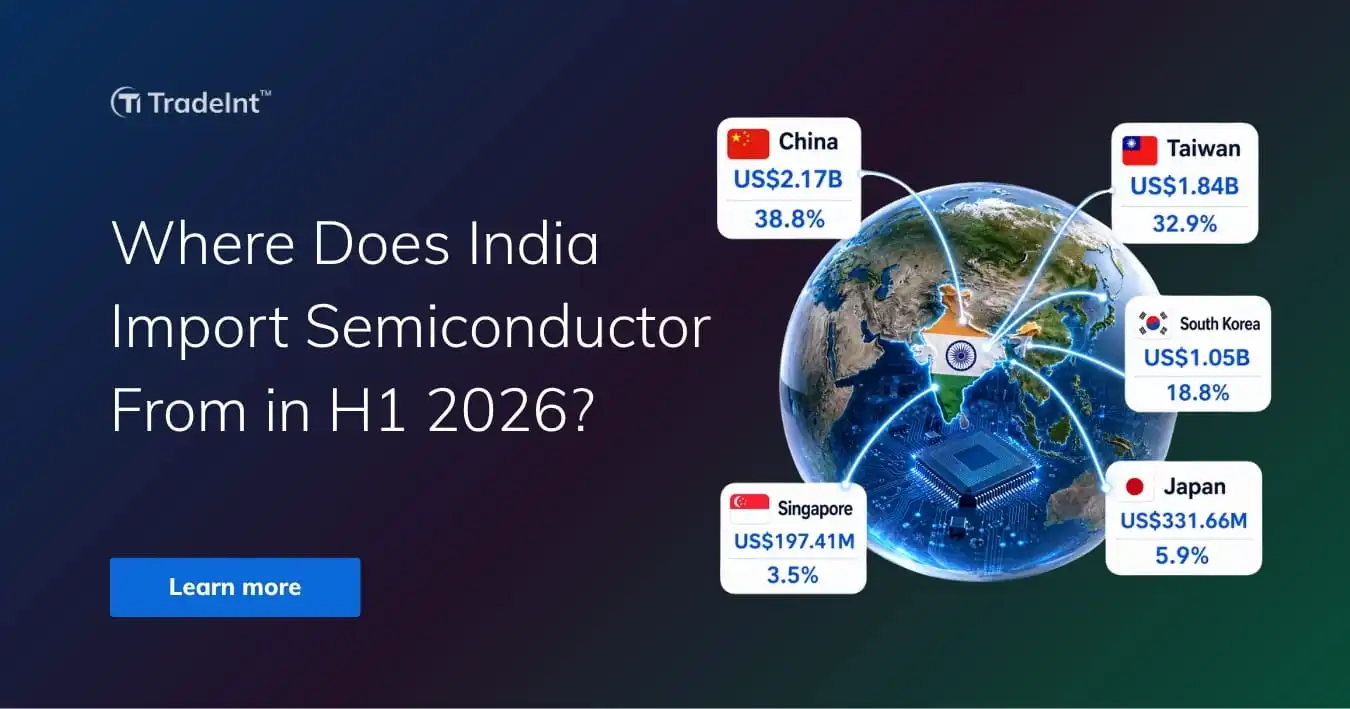
- China leads the answer to india imports semiconductor from which country is US$2.17 billion in the January to May 2026 period, ahead of Taiwan at US$1.84 billion under HS 8486, 8541, and 8542.
- Processors and controllers (HS 854231) are the largest single product line at US$3.24 billion, with Taiwan the main exporting origin, showing India's dependence sits in advanced logic rather than basic components.
- Three East Asian origins, China, Taiwan, and South Korea, account for the bulk of recorded value, while Indonesia enters the top ten mainly through photovoltaic cells rather than integrated circuits.
- For FY25, India's semiconductor import bill reached US$30.30 billion, up from US$19.30 billion in FY23, on Ministry of Electronics and Information Technology estimates.
India import semiconductor from which country? (Jan-May 2026 data)
Based on TradeInt's India semiconductor import data, between January to May 2026, India sources most semiconductors from China at US$2.17 billion, Taiwan at US$1.84 billion, and South Korea at US$1.05 billion. The list is completed by Japan, Singapore, Malaysia, Indonesia, the US, Vietnam, and Laos.
Top 5 semiconductor import partners in India in 2026:
- China - US$2.17 billion: The largest semiconductor source for India, supplying memory chips, microassemblies, photovoltaic cells, transistors, and manufacturing machinery across multiple HS lines.
- Taiwan - US$1.84 billion: The primary origin for processors and controllers (HS 854231), the single highest-value product line, with Apple Operations Ltd as the leading supplier.
- South Korea - US$1.05 billion: A major memory and logic supplier led by Samsung Electronics, covering DRAM, SRAM, and integrated circuit assemblies for India's device manufacturers.
- Japan - US$331.66 million: A specialist source for memory modules and processors, with Apple Operations Ltd handling the largest recorded shipment share of this origin.
- Singapore - US$197.41 million: A regional hub supplying memory and processor lines, led by Samsung Electronics, likely routing assembled components through its logistics base.

TradeInt is a global trade data platform providing access to over 10 billion verified import and export records. Its coverage spans over 200 countries and more than 80 customs data sources.
This article provides an overview of India’s semiconductor imports. Use TradeInt to explore more detailed trade records and continue tracking this market as new data becomes available. Search India semiconductor import records →
Preview India Historical Trade Records by HS Codes
Sumitronics Hong Kong, Foshan Glimpse Technology, and DENSO CORPORATION are among the verified importers in TradeInt'ss India semiconductor shipment records, with fields covering exporter, origin, trade value, weight, and ports.
Preview now: Semiconductor past records search by product name or HS code
#1. China - The largest source
China holds the top position in India's semiconductor sourcing, yet New Delhi is actively working to narrow that dependence. In 2024-25, India's trade deficit with China approached US$100 billion, with Global Trade Research Initiative analysis showing nearly 90% of imports from China fall in the low-to-medium technology range, a category New Delhi considers within domestic technological reach.
Supply risk turned concrete during 2025. Between April and October 2025, China imposed phased export curbs on rare earth elements and related technologies affecting India, covering dysprosium, terbium, and yttrium, and applying a 0.1% threshold rule requiring approvals for products containing even trace amounts.
India answered with a component-level industrial policy. In March 2026, the government approved 29 electronics component projects worth about ₹7,100 crore (~US$850 million) under the Electronics Component Manufacturing Scheme, which carries a total outlay of ₹40,000 crore (~US$4.80 billion).
- Localisation targets are specific: Domestic output under the scheme is expected to cover around 50% of India's printed circuit board demand and about 61% of lithium-ion battery demand, with rare earth magnets reaching roughly 25%.
- Rare earth corridors extend the response upstream: In the 2026-27 Union Budget, India announced dedicated rare earth corridors across Odisha, Kerala, Andhra Pradesh, and Tamil Nadu to secure critical minerals feeding electronics and semiconductor production.
#2. Taiwan
Taiwan ranks second among India's semiconductor origins and supplies the highest-value product category in the basket: processors and controllers. In March 2026, India's Union Budget introduced five-year tax exemptions and near-zero import charges targeting the semiconductor supply chain, giving Taiwanese suppliers clearer incentives to reassess India investment feasibility, though large foundry players stayed cautious.
On the other hand, the HCL-Foxconn venture focuses on chip packaging and testing, a segment viewed as critical for supply chain resilience, with CTCI appointed to build on its existing Foxconn work in Taiwan and the US.
Policy direction shifted during 2026 as well. Under ISM 2.0, India moved emphasis from fabs alone toward design, equipment, and intellectual property, broadening where Taiwanese firms can participate.
- Component makers are filing to enter: In 2026, tier-1 component manufacturers from Japan, South Korea, and Taiwan submitted expressions of interest to establish India manufacturing under the component scheme, drawn by incentives and proximity to India's assembly base.
- Fabrication timelines remain the constraint: India's first commercial fabrication plant, built by Tata Electronics, is expected to begin production by mid-2028, keeping advanced logic imports necessary through the interim.
#3. South Korea
South Korea is India's third-largest semiconductor origin, reflecting its position in global memory production. Even as a leading producer, South Korea itself imported US$60.70 billion worth of integrated circuits in 2024, based on World Integrated Trade Solution data, because it dominates memory yet still buys advanced logic, analog, and automotive chips.
That pattern frames India's own position. In 2024, India imported US$23.50 billion worth of integrated circuits, a figure that sits alongside Japan's US$24.30 billion and reflects specialisation rather than industrial failure.
India is now moving into the packaging layer where Korean memory output lands. As of 2026, Micron produces memory packaging at Sanand, with Tata Electronics covering logic and display and CG Power handling automotive-grade assembly.
- Assembly capacity is operational: As of May 18, 2026, India had 13 approved semiconductor projects operational or under development, including an assembly and test facility inaugurated in Bhiwadi, Rajasthan on May 15, 2026.
- Output ambitions are large: Combined facility plans from Tata Group, CG Power, and Kaynes are projected to produce a cumulative 69 million chips daily once commercial operations reach full stride, on MeitY figures.
What type of semiconductor does India import in 2026?
Drawn from TradeInt's India records for the January to May 2026 period, the leading semiconductor types are processors and controllers (HS 854231) at US$3.24 billion, memories (HS 854232) at US$1.21 billion, and other microassemblies (HS 854239) at US$861.16 million.
Photovoltaic cells, transistors, semiconductor manufacturing machinery, diodes, and amplifiers complete the recorded top ten product lines.
Top 5 semiconductor types imported by India in 2026:
- Processors and controllers (HS 854231) - US$3.24 billion: integrated circuits combining logic and memory, mainly from Taiwan.
- Memories (HS 854232) - US$1.21 billion: DRAM, SRAM, and flash memory modules for devices and computing.
- Other microassemblies (HS 854239) - US$861.16 million: integrated circuits not classified elsewhere, covering mixed-function parts.
- Unassembled photovoltaic cells (HS 854142) - US$497.46 million: solar cells not yet built into modules, largely from Indonesia.
- Assembled photovoltaic cells (HS 854143) - US$252.21 million: solar cells built into modules or panels.
✔ India Import data ✔ India Export DataTradeInt is a global trade data platform covering 200+ countries and 80+ customs sources. Learn about TradeInt →
🛢️ India Crude Oil Sourcing Breakdown
Iraq leads India's crude oil imports at US$3.21 billion in Q1 2026, ahead of Russia and Saudi Arabia under HS 270900. This article maps the full origin breakdown of India's oil sourcing, showing how the Middle East, Russia, and emerging suppliers compete for share in the world's third-largest crude import market.
Read more: India imports crude oil from which countries in 2026?
India's semiconductor imports reflect where global specialisation actually sits. No single country controls the full chip stack, with lithography based in the Netherlands, design software in the US, leading-edge logic in Taiwan, memory in South Korea, and specialty chemicals in Japan, Brickwork Ratings noted in July 2026.
In fact, India compound semiconductor capacity is part of the planned answer. Under the government roadmap, MeitY intends to establish four to six fabrication plants, 10 assembly and test facilities, and six to 10 compound semiconductor plants over the next five years.
Key points about India's semiconductor import types:
- Logic and memory dominate the value: India's demand concentrates in advanced categories that domestic OSAT capacity cannot yet supply, keeping high-value imports necessary through the fab build-out.
- Solar cells form a distinct import stream: Photovoltaic lines under HS 8541 bring Indonesia, Vietnam, and Laos into the top ten, separate from integrated-circuit trade with East Asia.
- Equipment imports signal factory build-out: Semiconductor manufacturing machinery under HS 8486 appears in the basket, consistent with new assembly and packaging lines coming online during 2026.
Who are the biggest semiconductor buyers in India?
In the list of verified importers on TradeInt, India's leading semiconductor buyers are Foxconn Hon Hai Technology India Mega Development, Samsung India Electronics Private Limited, Tata Electronics Systems Solutions Private Limited, Tata Electronics Products and Solutions, and Vivo Mobile India.
Top 5 semiconductor buyers in India in 2026:
- Foxconn Hon Hai Technology India Mega Development: a contract manufacturer producing smartphones, consumer devices, and integrated circuit hardware.
- Samsung India Electronics Private Limited: a manufacturer assembling mobile devices, appliances, and semiconductor-based assemblies.
- Tata Electronics Systems Solutions Private Limited: a technology enterprise developing semiconductor packaging and micro-assembly solutions.
- Tata Electronics Products and Solutions Limited: a manufacturer producing precision semiconductor components and sub-assemblies.
- Vivo Mobile India Private Limited: a telecommunications manufacturer assembling smartphones and importing integrated circuit modules.
✔ Lite ✔ Pro ✔ Premium ✔ EnterpriseTradeInt is a global trade data platform covering 200+ countries and 80+ customs sources. Learn about TradeInt →
🌱 Latest Trend: India Import Trade Data Analysis by TradeInt
India's complete import trade analysis by TradeInt includes overall import market analysis, top imports, a list of verified buyers, and partners in India in 2026.
Read more: India import data Q1 2026: Top import partners & categories
How many semiconductors does India import? India semiconductor import analysis from 2025-2026
From India semiconductor import records on TradeInt, quarterly value peaked at US$52.02 billion in Q2 2025 - a 435.99% surge from the Q1 2025 baseline of US$9.71 billion - before declining sharply to US$10.55 billion in Q3 2025 (-79.72%) and settling around US$9.29 billion in Q4 2025.
By Q1 2026, value slipped further to US$6.68 billion, down 28.05% quarter on quarter and 31.15% below the pre-peak Q1 2025 level, marking the lowest recorded quarter in the series.
India's semiconductor import bill has climbed steeply across the last several years. For FY25, imports reached US$30.30 billion, up from US$19.30 billion in FY23 and US$11.90 billion in FY19, according to MeitY estimates.
Highlights of India's semiconductor import trend:
- Self-sufficiency is targeted: MeitY aims to meet 50% of domestic semiconductor demand through local manufacturing by FY35, leaving imports central through the next decade.
- India's subsidy scale trails major rivals: China's semiconductor incentives are estimated at US$95 billion, and the US CHIPS and Science Act provides US$52 billion, against India's US$21 billion commitment.
- Imports persist even for leading producers: In 2024, China imported US$386.50 billion of integrated circuits despite decades of domestic capacity building, showing scale alone does not remove import reliance.
How to find India semiconductor import data and buyers?
To find India semiconductor import data and buyers, follow these six steps used by global trade professionals:
- Identify the HS code — Focus on relevant codes such as HS 8541 and 8542.
- Assess import demand — Analyze India's import volumes and recent market trends.
- Search shipment records — Use shipment-level databases such as TradeInt to identify active semiconductor importers.
- Shortlist buyers — Prioritize companies with recurring shipments and established purchasing activity.
- Analyze suppliers — Review their existing suppliers, sourcing countries, shipment frequency, and order patterns to identify opportunities.
- Verify companies — Confirm business activities and contact details through company websites, industry directories, and associations.
Step 1. Identify the correct HS code
Start by determining the HS code for the semiconductor product you plan to export. Most semiconductor imports fall under HS Chapter 85, particularly HS 8541 (semiconductor devices, LEDs, photovoltaic cells) and HS 8542 (electronic integrated circuits). Using the correct HS code ensures your search focuses on the relevant product category.
Step 2. Analyze India's import volume
Review India's recent import trends to understand market demand. Import statistics reveal whether demand is growing, seasonal, or concentrated in specific semiconductor categories, helping you validate the market before approaching buyers.
Step 3. Search shipment-level import records
Unlike official trade statistics, shipment-level trade databases show individual import transactions. You can search by HS code, importer name, supplier, country of origin, destination port, shipment date, and quantity to identify companies that are actively importing semiconductors.
Step 4. Shortlist active buyers
Focus on importers with multiple shipments over recent months rather than one-off purchases. Recurring import activity usually indicates established procurement demand and makes these companies stronger sales prospects.
Step 5. Analyze existing suppliers
Review who currently supplies each importer, including supplier countries, shipment frequency, average order size, and sourcing patterns. This helps determine whether the buyer works with multiple suppliers or relies on a single long-term partner, allowing you to identify opportunities to compete.
Step 6. Validate company information
Before making contact, verify each shortlisted importer through official company websites, industry directories, or organizations such as the India Electronics and Semiconductor Association (IESA). This confirms the company's business activities and provides contact information for purchasing or sourcing teams.
✔ Lite ✔ Pro ✔ Premium ✔ EnterpriseTradeInt is a global trade data platform covering 200+ countries and 80+ customs sources. Learn about TradeInt →
Request India Data Samples from TradeInt
Trade intelligence platforms such as TradeInt enable exporters to identify active buyers, analyze sourcing patterns, and build targeted prospect lists instead of relying only on aggregated government statistics.
Request here: India trade data samples by product and HS code
Conclusion
India imports semiconductor from which country in 2026 come down to three East Asian sources: China at US$2.17 billion, Taiwan at US$1.84 billion, and South Korea at US$1.05 billion. Processors and controllers lead the product mix at US$3.24 billion, ahead of memories at US$1.21 billion and other microassemblies at US$861.16 million, with Foxconn, Samsung India, and Tata Electronics heading the buyer list.
With domestic fabrication not expected before mid-2028, transaction-level records give procurement teams a clearer view of supply routes than annual totals.
Contact TradeInt to access India semiconductor import data by HS code, supplier, and shipment record.
Frequently asked questions
What is India's semiconductor chip?
India does not yet produce a widely recognised domestic semiconductor chip at commercial scale. The country currently focuses on assembly, testing, and packaging under the India Semiconductor Mission, with Tata Electronics' first wafer fabrication plant at Dholera expected to produce its first silicon by mid-2028.
Is India producing semiconductors?
India has 13 approved semiconductor projects operational or under development as of May 2026, with Micron producing memory packaging at Sanand, Tata Electronics covering logic and display assembly, and CG Power handling automotive-grade chips. Full wafer fabrication is expected from mid-2028 onward.
Who is the biggest semiconductor manufacturer in India?
Tata Electronics is the most prominent name in India's emerging semiconductor manufacturing push, operating assembly and packaging facilities and building the country's first commercial wafer fab at Dholera, Gujarat.