China coal import data: What stands out in 2026?
- Indonesia is the top origin for China coal imports at US$2.42 billion in the January to June 2026 period, yet its lead is thin because Mongolia trails at US$2.17 billion under HS 2701.
- Mongolia is the fastest-rising supplier, with recorded value up 58.31% year on year, the only top-five origin posting growth while every other source declined.
- Bituminous coal dominates the product mix at US$2.99 billion, ahead of other coal grades, showing China's imports skew toward power-station feedstock rather than metallurgical material by value.
- In June 2026, China's coal imports rose 29.5% year on year after a fatal Shanxi mine explosion cut domestic output, based on Centre for Research on Energy and Clean Air figures.
Where does China import its coal from? China coal imports by country 2026
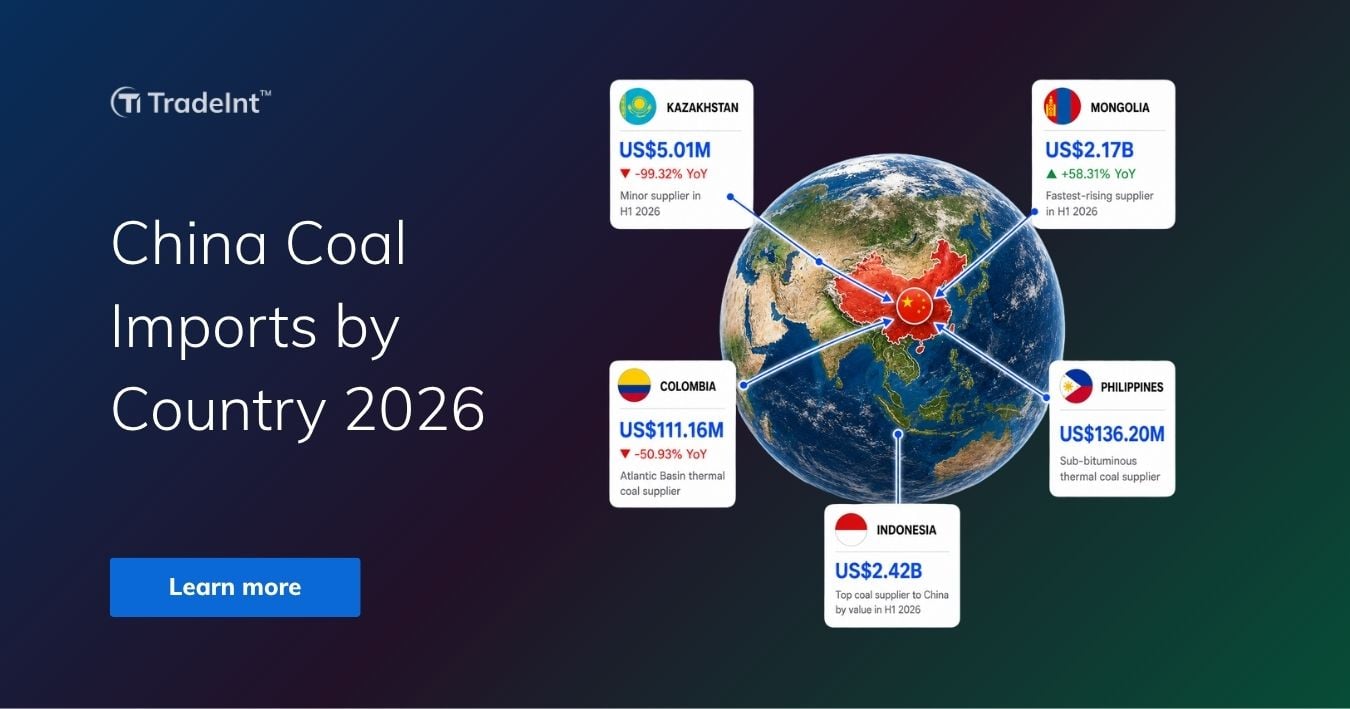
Based on TradeInt's China import data for H1 2026, China sources most of its coal from Indonesia at US$2.42 billion, Mongolia at US$2.17 billion, and the Philippines at US$136.20 million under HS 2701. The top 4 & 5 China coal import by country are Colombia and Kazakhstan, respectively.
Top 5 China coal import sources in 2026:
- Indonesia - US$2.42 billion: Largest coal supplier to China by value, with thermal grades from Tiwa Abadi leading shipments under HS 2701.
- Mongolia - US$2.17 billion: Fastest-rising origin, up 58.31% year on year, driven by overland coking coal crossing the Gashuunsukhait-Gantsmod border route.
- Philippines - US$136.20 million: Sub-bituminous thermal coal supplier, with Semirara Mining Power Corporation the dominant exporter to Chinese buyers.
- Colombia - US$111.16 million: Atlantic Basin thermal coal origin facing a steep 50.93% year-on-year decline as long-haul freight costs reduce competitiveness against regional suppliers.
- Kazakhstan - US$5.01 million: Minor origin in the recorded period, down 99.32% year-on-year, with AO Shubarkol Komir, the sole identified supplier.

TradeInt is a global trade data platform providing access to over 10 billion verified import and export records. Its coverage spans over 200 countries and more than 80 customs data sources.
This article provides an overview of China’s coal imports. Use TradeInt to explore more detailed trade records and continue tracking this market as new data becomes available. Search China coal import records →
🔎 Preview China Coal Import Records on TradeInt
Historical China import shipments of coal (HS 2701) are searchable by HS code, importer, and country of origin as transaction-date records.
Access now: China coal import records searched by HS 2701
In late May 2026, a fatal explosion at a Shanxi mine triggered safety inspections that closed 155 mines across the province, cutting domestic coal output by 9.7% year on year in June and pulling more cargo in from abroad, according to Centre for Research on Energy and Clean Air (CREA) figures.
At the same time, Indonesia moved to route all coal exports through a new state body, adding uncertainty for buyers. In June 2026, thermal coal prices climbed as Indonesia tightened export controls and the Shanxi accident halted operations, pushing the Newcastle benchmark toward two-year highs above US$150 a tonne, Nikkei Asia found.
Key points about China's coal import market by origin in 2026:
- Land-based supply gained ground: In June 2026, China's coal imports from Mongolia and Australia jumped 62% and 46% year on year while Russian volumes fell 15%, on customs data compiled by Reuters, showing overland and high-grade cargo displacing some seaborne flow.
- Coking coal led the rebound: China imported 11.15 million tonnes of coking coal in May 2026, up 50.9% year on year, according to Sxcoal, as steel mills replaced Shanxi tonnes lost to safety curbs.
#1. Indonesia: The biggest coal supplier for China
Indonesia held its lead in China's import market through 2026, but a run of policy changes and soft pricing left its position exposed.
In February 2026, Indonesian miners limited spot-market shipments in protest at a government plan to cap production, on Kpler data compiled by Reuters, unsettling buyers who rely on prompt cargo.
- A state body now controls exports: From June 2026, Indonesian thermal coal exporters must report to a new state-run company, Danantara, which analysts said tightened seaborne supply and thinned the inventory cushion.
- Production slipped early in the year: For the first four months of 2026, Indonesian thermal coal output fell 7% year on year, limiting the surplus available for export just as China's demand recovered.
- China stayed the anchor market: In 2025, China took a 42% share of Indonesia's thermal coal exports, the largest single destination, so any China demand swing moves Indonesian volumes directly.
Due to these shifts, Indonesia's share of China's monthly imports narrowed. In March 2026, its share fell to 39% from 46% a month earlier as Mongolian cargo surged, according to APBI-ICMA figures.
✔ Indonesia Import Data ✔ Indonesia Export DataTradeInt is a global trade data platform covering 200+ countries and 80+ customs sources. Learn about TradeInt →
🇮🇩 TradeInt's Indonesia Coal Export Data
Coking and steam coal (HS 270119) is the top Indonesian coal export at US$4.16 billion, with China its second-largest buyer at US$814.07 million. This TradeInt article breaks down the latest coal export market in Indonesia, top coal buyers and suppliers, destinations, and coal types. Indonesia coal export data: Top export markets & suppliers
#2. Mongolia
Mongolia is the standout gainer in China's 2026 coal trade, briefly overtaking Indonesia as the top monthly supplier. In April 2026, Mongolia shipped 11.33 million tonnes of coal across the border, edging past Indonesia's 11.12 million tonnes, a 61% year-on-year jump, on China customs data reported by Reuters.
- Coking coal drove the gains: Over the first five months of 2026, Mongolian supply to China rose 66.6% year on year to 33.4 million tonnes, on IndexBox figures, as proximity and lower freight favoured overland cargo.
- Infrastructure widened the pipe: In 2025, the Gashuunsukhait-Gantsmod crossing handled about 49 million tonnes, more than half of Mongolia's total exports, on Petromindo data, giving China a land route insulated from seaborne freight.
- The structural shift is large: Between 2021 and 2025, China's coal imports from Mongolia surged 441% to 88.96 million tonnes, narrowing the gap with Indonesia from 27 times to under 2 times by early 2026.
#3. Philippines
The Philippines supplies China with sub-bituminous thermal coal, but its recorded value fell as domestic policy and contract uncertainty weighed on its main exporter.
Semirara Mining and Power, which accounts for more than 90% of Philippine coal output, faces a contract set to expire in July 2027, Philstar found.
- Export supply might be ring-fenced: In May 2026, the Department of Energy proposed requiring future Semirara bidders to reserve a minimum share of output for the domestic market, which could cap volumes available for China.
- Spending cut sharply: In the first quarter of 2026, Semirara cut capital spending about 79% to around 500 million pesos (~US$8.90 million) amid the auction delay, signalling caution on new production.
- Regional demand still supports the grade: For 2025, ASEAN coal consumption was forecast to reach 516 million tonnes, up 4% year on year, with power generation driving about 75% of demand, on IEA figures cited by Philstar.
#4. Colombia
Colombia is China's most distant top-five origin, and its recorded value dropped as Atlantic Basin coal struggled to compete on freight against overland and regional supply.
In June 2026, China leaned on nearer sources: imports from Indonesia, Mongolia, and Australia jumped 44%, 62%, and 46% year on year, on customs data reported by Reuters, leaving long-haul Colombian cargo at a cost disadvantage.
- Freight economics work against distance: In March 2026, Panamax rates for Indonesian coal into south China reached US$11.90 a tonne, up 38% in weeks, on Argus Media data, sharpening the penalty on far longer Colombian voyages.
- Domestic competitiveness capped low-grade demand: Higher domestic output and lower local prices reduced the pull of imported low-calorific cargo in China's coastal market through mid-2026, on Signal Ocean analysis, limiting room for seaborne thermal grades.
Does China still buy coal from Australia?
Yes, China still buys Australian coal, and volumes rose sharply through mid-2026 as buyers chased high-grade material after the Shanxi accident.
In May 2026, China's imports of Australian coking coal jumped 114% month on month to 1.48 million tonnes and rose 77% year on year, SteelOrbis found, supported by stronger end-user demand and competitive pricing.
- June acceleration confirmed the trend: In June 2026, Australian coal shipments to China rose 46% year on year, one of the fastest gains among China's suppliers that month.
- Prices firmed alongside volume: Australia's premium hard coking coal rose US$5 a tonne in April and US$6 a tonne in May 2026 on tight spot availability and higher freight, keeping replacement costs high for buyers.
- Momentum later eased at the margin: In early July 2026, Australian high-grade coking coal eased 1.3% to US$238.90 a tonne as weak demand from China and India outweighed supply concerns, on IndexBox data, showing the rebound was demand-led rather than structural.
What are the primary types of coal imported by China in 2026?
Drawn from TradeInt's China records for the January to June 2026 period, the leading coal types are bituminous coal at US$2.99 billion, other coal including sub-bituminous grades at US$1.84 billion, and anthracite at US$17.24 million under HS 2701.
Top China imported coal types in 2026:
- Bituminous coal (HS 270112) - US$2.99 billion: a higher-calorific grade widely used for power generation.
- Other coal, including sub-bituminous (HS 270119) - US$1.84 billion: thermal grades, whether or not pulverised, for baseload power.
- Anthracite (HS 270111) - US$17.24 million: a high-grade coal used in specialised metallurgy.
In H1 2026, China's coking coal imports rose to a record, with total coal imports up 1.7% year on year to 225.4 million tonnes, on General Administration of Customs data via SteelOrbis, while June imports alone rose 29.5% year on year.
What's worth noticing about China's coal imports in 2026:
- Coking coal grew fastest: In May 2026, China's coking coal imports rose 50.9% year on year to 11.15 million tonnes, on Sxcoal figures, as mills replaced Shanxi supply.
- Thermal demand tracked power burn: In June 2026, China's coal-fired generation rose 1.7% year on year for a sixth straight month, on CREA estimates, supporting steam-coal grades.
- Steel output steadied late in H1: In June 2026, China's crude steel output grew 0.4% year on year after an H1 decline of 3%, on CREA data, firming coking-coal appetite into mid-year.
Who are the biggest global suppliers of coal to China?
According to verified TradeInt trade company profiles, the largest recorded suppliers under HS 2701 are Mongolian Gold Mac LLC, Energyresource LLC, and Tiwa Abadi. The top 5 coal suppliers to China also include Sausgobi Sands LLC Gho and Energi Batubara Perkasa.
Top 5 suppliers of coal to China in 2026:
- Mongolian Gold Mac LLC (Mongolia): a Mongolian mining group exporting premium coking and metallurgical grades to China.
- Energyresource LLC (Mongolia): a resource developer shipping washed coking coal from regional mine basins.
- Tiwa Abadi (Indonesia): an Indonesian producer of sub-bituminous thermal coal grades.
- Sausgobi Sands LLC Gho (Mongolia): a cross-border exporter of coking and thermal coal into northern China.
- Energi Batubara Perkasa (Indonesia): a commercial supplier of thermal coal to power utilities.
✔ Lite ✔ Pro ✔ Premium ✔ EnterpriseTradeInt is a global trade data platform covering 200+ countries and 80+ customs sources. Learn about TradeInt →
🏆 TradeInt's Data List of Global Coal Export Leaders
Kazakhstan ranks as the world's largest coal exporter by value at about US$35.37 billion in H1 2025, over half of global coal export value.
Read more: Top 5 Coal Exporting Countries with the highest Trade Value 2025
How much coal does China import in 2025-2026?
Drawn from TradeInt's China import records, coal import value reached US$4.85 billion across H1 2026, the sum of US$2.13 billion in Q1 and US$2.72 billion in Q2 under HS 2701. Q2 rose 28.10% over Q1, recovering from a soft start to the year.
By 2026, Rystad Energy expects Asian coal consumption to rise by close to 70 million tonnes as a liquefied natural gas shortfall forces gas-dependent utilities to run existing coal fleets harder.
The Q2 2026 recovery tracked a genuine supply shock rather than a price movement. In H1 2026, China's coal output fell 1.7% year on year while imports rose 1.7%, as the Shanxi mine explosion cut domestic supply, Reuters reported. Coal output has now gone eleven consecutive months without year-on-year growth.
In June 2026, China's coal import demand intensified further. China's June coal imports rose 28.6% month on month to 42.78 million tonnes, on GACC data via SteelOrbis, as safety inspections kept Shanxi mines offline into the summer.
Seasonal heat and tight gas supply added to the pressure. In June 2026, gas-fired generation dropped 18.1% year on year amid Strait of Hormuz shipping disruptions, on CREA estimates, leaving coal to fill the gap in the power market.
Highlights of China's coal import performance in 2026:
- Imports rose as output fell: In June 2026, China's coal imports rose 29.5% year on year while domestic output dropped 9.7%, on CREA figures, a direct swap of home supply for foreign cargo.
- Coking coal set the pace: In May 2026, China's coking coal imports rose 50.9% year on year, on Sxcoal data, outpacing thermal grades as mills rebuilt feedstock.
- Coal power kept pulling volume: In June 2026, China's coal-fired generation rose for a sixth consecutive month, up 1.7% year on year, even as wind output dropped 19.7% during an unusually weak wind event, on CREA estimates.
- Cement output remained low: In H1 2026, China's cement output fell 8% year on year to its lowest first-half level since 2020, on CREA estimates, capping thermal-coal demand from the construction sector.
✔ Lite ✔ Pro ✔ Premium ✔ EnterpriseTradeInt is a global trade data platform covering 200+ countries and 80+ customs sources. Learn about TradeInt →
🌐 Find Trade Data Across 220 Countries On TradeInt
TradeInt covers import and export trade statistics for over 200 regions, including exclusive markets such as the USA, Turkey, Indonesia, Mexico, and Brazil.
Explore more: TradeInt country-level trade data
What do you use China coal import data for?
TradeInt's China coal import data helps enterprises to stay active with the coal trade market movement, track competitors' activity, find potential suppliers, and monitor supply-chain disruptions.
Because China is the world's largest coal buyer, its shipment figures signal whether inland transport is strained, whether power grids face shortages, and how healthy the manufacturing sector looks.
Here is how China coal import data is valuable:
- Evaluating industrial demand: Coking coal import volumes track steel and heavy-manufacturing output, while thermal coal volumes gauge power-sector needs.
- Monitoring supply risks: Import spikes often reveal domestic disruptions, such as the safety inspections that followed the May 2026 Shanxi mine explosion and cut local production.
- Tracking global trade flows: Origin-level records reveal seaborne and overland shifts, showing how policy moves in Indonesia, Mongolia, and Australia redirect cargo.
- Energy policy and security analysis: Import figures help measure how Beijing balances carbon-reduction goals against short-term energy security.
- Approaching potential coal buyers in China: Company- and shipment-level records help identify active coal exporters, importers, trading companies, and industrial buyers by product type, origin, volume, and purchasing frequency.
Access TradeInt's full China trade statistics overview by product and HS code, with importer names and origin countries in the data sample.
Conclusion
China coal imports by country in 2026 show Indonesia leading at US$2.42 billion and Mongolia close behind at US$2.17 billion, with the Philippines third at US$136.20 million.
Bituminous coal dominates the product mix at US$2.99 billion, ahead of other grades at US$1.84 billion. Mongolia's 58.31% year-on-year jump - the only original posting growth - reflects a broader shift toward overland coking-coal supply as seaborne Indonesian volumes declined.
Book a demo with TradeInt to access the latest detailed China trade data.
Frequently asked questions
Why did China reduce coal purchases from some seaborne suppliers?
In 2026, higher domestic output and lower local prices cut the competitiveness of imported low-calorific cargo in China's coastal market, based on Signal Ocean analysis. Overland Mongolian coal also gained on proximity and lower freight, narrowing the gap with Indonesia to under two times by early 2026.
Is China the biggest coal importer in the world?
Yes. China is the world's largest coal importer, and in H1 2026 its total coal imports rose 1.7% year on year to 225.4 million tonnes, based on General Administration of Customs data.