What is Bangladesh's main import? Bangladesh import products 2026
Based on TradeInt's Bangladesh import data across HS 2710, 8402, 1001, 8501, 3901, and 7201 in H1 2026, petroleum spirits and gasoline (HS 271012) lead at US$5.52 billion (70.25%) with Singapore as the top origin, followed by wheat (HS 100119) at US$1.02 billion (13.01%) drawn from Argentina.
Meanwhile, fuel oils and gas oils (HS 271019) rank third at US$802.38 million (10.22%), also via Singapore, ahead of ethylene copolymers (HS 390140) at US$153.99 million (1.96%) from Saudi Arabia and polyethylene (HS 390120) at US$126.33 million (1.61%) from Saudi Arabia.
Top 5 Bangladesh imports in H1 2026 (HS 2710, 8402, 1001, 8501, 3901, 7201):
- Petroleum spirits and gasoline (HS 271012) - US$5.52 billion (70.25%): the leading tracked import, with Singapore as the top origin serving Bangladesh's fuel refining and distribution network.
- Wheat, seed (HS 100119) - US$1.02 billion (13.01%): food-grain imports drawn primarily from Argentina to shore up domestic wheat stocks.
- Fuel oils and gas oils (HS 271019) - US$802.38 million (10.22%): refined petroleum shipments channelled through Singapore into state-owned distributors.
- Ethylene copolymers (HS 390140) - US$153.99 million (1.96%): polyethylene resin inputs sourced mainly from Saudi Arabia for Bangladesh's plastics and packaging sector.
- Polyethylene, density ≥ 0.94 (HS 390120) - US$126.33 million (1.61%): high-density polyethylene resin also from Saudi Arabia for industrial and packaging applications.
Bangladesh's dependence on imported fuel deepened through 2026 as regional refining and energy-supply pressures fed higher unit costs into the country's import bill. According to CPD research director Khondaker Golam Moazzem via The Daily Star, Bangladesh's FY26 imports grew mainly for inflationary reasons, particularly higher petroleum prices, rather than a broad-based recovery in productive investment.
Meanwhile, wheat imports remained essential to Bangladesh's food-security posture. In August 2026, the government announced plans to import 365,000 tonnes of fertiliser to shore up stocks ahead of the boro planting season, reflecting the broader state-level procurement pattern that also drives petroleum flows.

TradeInt is a global trade data platform providing access to over 10 billion verified import and export records. Its coverage spans over 200 countries and more than 80 customs data sources.
This article provides an overview of Bangladesh's imports and its top partner countries. Use TradeInt to explore more detailed trade record fields by HS code and product name. Search Bangladesh import records →
🔍 Historical Bangladesh Import Records for HS 271012
Preview past transaction-date Bangladesh petroleum spirit import shipments under HS 271012 with exporter and origin-country details.
Preview here: Bangladesh HS 271012 historical import bill of lading trade records

Which country does Bangladesh import most?
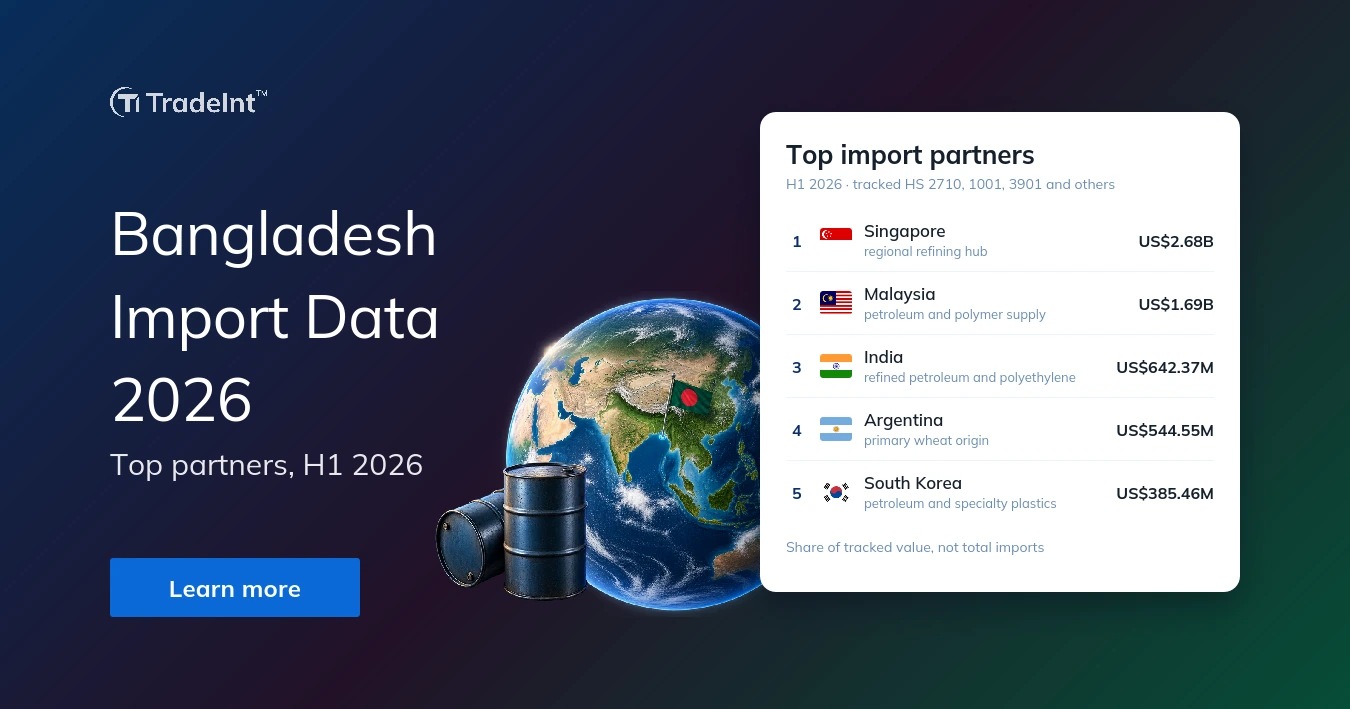
Singapore leads Bangladesh's partner table at US$2.68 billion (34.09%) as the regional refining hub supplying petroleum spirits and fuel oils, followed by Malaysia at US$1.69 billion (21.57%) with similar petroleum-line supply.
TradeInt's Bangladesh import data also showed India ranks third at US$642.37 million (8.18%), covering refined petroleum and polyethylene shipments, ahead of Argentina at US$544.55 million (6.93%) as the primary wheat origin and South Korea at US$385.46 million (4.91%) with petroleum and plastics.
China, the United States, Canada, the United Arab Emirates, and Saudi Arabia complete the top ten tracked partner countries for Bangladesh imports in H1 2026.
Top 5 Bangladesh import partners in H1 2026:
- Singapore - US$2.68 billion (34.09%): the regional refining hub delivering petroleum spirits (HS 271012), fuel oils (HS 271019), and ethylene copolymers (HS 390140) to Bangladesh's state fuel network.
- Malaysia - US$1.69 billion (21.57%): a second regional refining supplier delivering the same core petroleum and polymer HS codes at scale.
- India - US$642.37 million (8.18%): cross-border supplier of refined petroleum, fuel oils, and polyethylene with growing bilateral trade discussion around yarn import curbs.
- Argentina - US$544.55 million (6.93%): the primary wheat origin under HS 100119 and 100199 for Bangladesh's food-security stockpile.
- South Korea - US$385.46 million (4.91%): petroleum and specialty plastics supplier serving Bangladesh's manufacturing sector.
Bangladesh's Southeast Asian sourcing pattern reflects the region's dominant role in refining and re-export of petroleum products. Singapore and Malaysia together account for over 55% of Bangladesh's tracked H1 2026 imports, a concentration that leaves the country's fuel supply exposed to regional refining margins and shipping-lane disruption.
Meanwhile, bilateral trade with India remains a focus of policy attention. In August 2026, Bangladesh and India discussed lifting yarn import curbs that had constrained cross-border textile trade, with both sides reviewing regulatory frameworks that shape the broader import flow.
Highlights of Bangladesh's partner performance in 2026:
- Southeast Asian refining hubs dominate the mix: Singapore, Malaysia, and India combined reached US$5.01 billion of Bangladesh's H1 2026 tracked imports, or roughly 63.84% of value - a concentration that hinges on regional refining capacity.
- Argentine wheat covers Bangladesh's food-security flank: Argentina at US$544.55 million (6.93%) is Bangladesh's fourth-largest source and its primary wheat origin, reflecting the state's grain-stockpile procurement.
- Middle East plastics link Bangladesh to Saudi Arabia: Saudi Arabia at US$162.49 million (2.07%) covers polymer resin supply for Bangladesh's plastics and packaging sector, distinct from the refining-hub linkages further east.
✔ Bangladesh Import Data ✔ Bangladesh Export Data
TradeInt is a global trade data platform covering 200+ countries and 80+ customs sources. Learn about TradeInt →
🇧🇩 Bangladesh Global Trade Data Overview on TradeInt
Bangladesh's tracked import data covers HS 2710, 8402, 1001, 8501, 3901, and 7201 across shipment-level records with importer and origin details, historically.
Access here: Bangladesh import-export trade statistics overview
Who is the top importer in Bangladesh?
Padma Oil Company Limited leads the buyer ranking at 26.39% share as the state-owned distributor under Bangladesh Petroleum Corporation (BPC), followed by Meghna Petroleum Limited at 26.20% managing bulk petroleum for national supply, from TradeInt's list of verified importers.
Jamuna Oil Co Ltd ranks third at 8.56% as a state-affiliated marketing enterprise, ahead of Jamuna Oil Company Limited at 6.75% (primary BPC subsidiary) and Eastern Refinery Limited at 3.91% (Bangladesh's sole state-owned refinery).
Top 5 Bangladesh importers in H1 2026:
- Padma Oil Company Limited - 26.39%: state-owned distributor under BPC, managing bulk procurement, storage, and marketing of petroleum products.
- Meghna Petroleum Limited - 26.20%: major state-owned petroleum company under BPC distributing liquid fuels, lubricants, and bitumen nationwide.
- Jamuna Oil Co Ltd - 8.56%: state-affiliated oil marketing enterprise distributing refined petroleum, LPG, and industrial lubricants across Bangladesh.
- Jamuna Oil Company Limited - 6.75%: primary BPC subsidiary procuring, storing, and marketing refined petroleum products for domestic consumption.
- Eastern Refinery Limited - 3.91%: Bangladesh's sole state-owned oil refinery processing imported crude into finished domestic petroleum products.
Bangladesh's petroleum import network runs almost entirely through Bangladesh Petroleum Corporation subsidiaries, making state-owned buyers the dominant channel for refined-product procurement. Because Padma Oil and Meghna Petroleum together account for over half of the tracked H1 2026 importer value, disruption at either affects the country's fuel distribution chain.
Meanwhile, energy-supply pressure has intensified on the LNG side. According to S&P Global, Bangladesh state-run LNG buyer Petrobangla is set to receive only around half of its planned 2026 deliveries from QatarEnergy after the March 4 force majeure declaration, affecting roughly 20 of 40 planned cargoes.
Highlights of Bangladesh's importer network in 2026:
- BPC subsidiaries handle over 71% of tracked buyer value: Padma Oil, Meghna Petroleum, Jamuna Oil Co Ltd, Jamuna Oil Company Limited, and Eastern Refinery Limited combined represent 71.81% of Bangladesh's H1 2026 tracked import value.
- Force majeure keeps LNG supply constrained: Petrobangla's cargo shortfall of about 20 LNG deliveries from QatarEnergy in 2026 reshapes short-term energy sourcing, with the JKM LNG benchmark hitting US$19.44/MMBtu in August 2026 per S&P Global.
- Bangladesh's Qatar LNG dependence sits at 60%: Bangladesh received about 60% of its 2025 LNG requirement from Qatar under a 15-year supply deal signed in 2023, per S&P Global CERA data.
✔ Bangladesh Importers ✔ Bangladesh Exporters
TradeInt is a global trade data platform covering 200+ countries and 80+ customs sources. Learn about TradeInt →
🛢️ Padma Oil Company Limited Import Records on TradeInt
Bangladesh's #1 tracked importer (26.39% share), with shipment records searchable by HS code, origin country, and shipment date.
Search here: Padma Oil Company Limited historical import records
How much does Bangladesh import in 2026?
Based on TradeInt's Bangladesh import data across HS 2710, 8402, 1001, 8501, 3901, and 7201, Bangladesh's tracked import value climbed to US$7.85 billion in H1 2026, up 77.92% from US$4.41 billion in H1 2025 as heavy state procurement of refined petroleum and industrial commodities drove the surge.
On the wider macro picture, Bangladesh's total FY 2025-26 imports reached US$71.14 billion per Bangladesh Bank data, with the trade deficit widening to a three-year high of US$27.28 billion.
Bangladesh's overall trade balance deteriorated sharply through FY26 even as macroeconomic stability held. According to The Daily Star reporting Bangladesh Bank data, the trade deficit widened 34% year-on-year to US$27.28 billion as imports rose 10.5% to US$71.14 billion while exports stayed near flat at US$43.85 billion.
Meanwhile, remittances at a record US$35.6 billion in FY26 provided a substantial cushion that contained the current-account deficit to around US$1.6 billion and delivered an overall Balance of Payments surplus of US$6.6 billion. RAPID chairman Abdur Razzaque flagged in The Daily Star that the widening trade gap has not translated into productive investment because capital-machinery imports have remained weak.
Where to source Bangladesh import data and buyer intelligence?
Sourcing Bangladesh import trade intelligence starts with matching the data type to the use case, because macro trade summaries, supplier discovery, and buyer verification each need different fields and time windows.
- Global trade data platforms: TradeInt's Bill of Lading database holds 10B+ shipment records and 500M+ verified business profiles across 200+ countries, letting analysts trace Bangladesh consignments by HS code, importer name, and origin.
- Bangladesh Bureau of Statistics (BBS): the official monthly and yearly Foreign Trade Statistics release covering exports, imports, and trade balance across HS categories with authoritative baseline figures.
- Bangladesh Bank Economic Reports: the central bank's Balance of Payments data with quarterly trade-deficit updates, remittance flows, and reserve positions.
- National Board of Revenue (NBR) customs data: the source of shipment-level Bill of Lading records feeding TradeInt's Bangladesh trade database.
For counterparty verification and shipment-level history beyond aggregate statistics, request trial access to Bangladesh import records and Bill of Lading profiles on TradeInt.
Conclusion
Bangladesh import data in 2026 concentrates sharply on petroleum spirits (HS 271012) at US$5.52 billion (70.25% of the tracked HS 2710/8402/1001/8501/3901/7201 range) sourced mainly from Singapore, with wheat (HS 100119) and fuel oils (HS 271019) rounding out the top three commodity imports.
Because Bangladesh's tracked import value climbed 77.92% year-on-year in H1 2026 while the wider trade deficit widened to a three-year high of US$27.28 billion for FY 2025-26, procurement risk now sits with regional refining supply and the ongoing Petrobangla LNG shortfall from QatarEnergy.
Frequently asked questions
What is Bangladesh's main import?
The main import of Bangladesh in 2026 is petroleum products, with light petroleum oils and gasoline alone accounting for US$5.52 billion (70.25% share) of the tracked H1 2026 import value.
Who is the biggest supplier to Bangladesh?
Singapore is Bangladesh's biggest tracked supplier in 2026 at US$2.68 billion (34.09% share), driven by regional refining exports of petroleum spirits and fuel oils.
What does Bangladesh import from India?
Bangladesh imports about US$642.37 million from India across the tracked HS codes in H1 2026, with the top 6-digit codes being HS 271012 (light petroleum oils), HS 271019 (fuel oils), and HS 390140 (ethylene copolymers). India accounts for 8.18% of Bangladesh's tracked import value, ranking as the third-largest supplier after Singapore and Malaysia.
What is Bangladesh's trade deficit in 2026?
Bangladesh's trade deficit widened to US$27.28 billion in fiscal year 2025-26, a three-year high and a 34% jump from FY25 per Bangladesh Bank data. Exports reached US$43.85 billion while imports rose 10.5% to US$71.14 billion. Record remittances of US$35.6 billion kept the current-account deficit contained at around US$1.6 billion.