
Table of Contents
Venezuela oil export by country 2025: Where does Venezuela export oil the most?
According to TradeInt’s Venezuela oil export shipment data, along with verified sources from FDD & Boe Report, show that China is Venezuela’s largest oil buyer, taking around 80% of its total oil exports, equal to about 746,000 barrels per day in November. Then, the United States, through Chevron-led projects, supplied Cuba under government supply deals, Malaysia, and India.
What country buys the most oil from Venezuela?
- China– The largest buyer by volume, providing Venezuela with a stable outlet for its oil exports, while remaining a minor share of China’s overall import needs.
- United States– An important buyer for heavy crude, supporting refinery operations along the U.S. Gulf Coast, where Venezuelan oil is well-suited.
- Malaysia– Functions mainly as a regional trading and processing hub, importing Venezuelan crude for blending, storage, and re-export rather than domestic consumption.
- Cuba– A long-term partner receiving Venezuelan oil mainly to meet domestic energy needs and support economic stability.
- India– Previously a key destination valued for refining capacity, but purchases have declined significantly due to trade and compliance constraints.
| Rank | Importing Country |
Export Value (US$) or Barrels per day (bpd) |
Top Importing Company | Economic Key Drivers |
|---|---|---|---|---|
| 1 | China | 746,000 bpd | MAERSK PANAMA SA | Venezuela’s largest strategic oil buyer, absorbing heavy crude shipments to support refinery feedstock needs and long-term energy security, helping Venezuela sustain export revenues amid financing constraints and limited access to Western markets. |
| 2 | United States | 150,000 bpd | CHEVRON GLOBAL TECHNOLOGY | U.S. refineries specialize in processing heavy, high-sulfur crude like Venezuela’s, making Venezuelan oil economically valuable for Gulf Coast refining operations. |
| 3 | Malaysia | 🔒 Unlock Malaysia Oil Import Data | BEAU LINE COSMETICS | Downstream redistribution activity rather than direct consumption, reflecting Malaysia’s role as a regional oil trading and processing hub. |
| 4 | Cuba | 24,000 bpd | N/A | Primary energy lifeline, securing affordable crude supplies to support electricity generation, transportation, and domestic fuel needs amid limited access to global energy markets and ongoing financial constraints. |
| 5 | India | $443,019,191 | RELIANCE INDUSTRIES LIMITED | Imports Venezuelan crude to diversify refinery feedstock and secure heavy crude supplies for complex refineries operated by state-linked energy firms. |
Venezuela oil export industry in 2025: Production, exports, and key exporters
How much oil does Venezuela produce in 2025?
According to Reuters, Venezuela produces about 900,000–1.1 million barrels of oil per day in 2025, but this figure hides a long structural decline. Output has fallen dramatically from nearly 3.5 million bpd in 1998, before Hugo Chávez took office, to around 800,000–960,000 bpd by late 2025, representing less than 0.8% of global production.

This collapse is not driven by geology but by policy and economics.
Venezuela holds almost 20% of the world’s oil reserves, the largest globally, yet most are ultra-heavy crude in the Orinoco Belt, which is expensive to extract and requires diluents, upgraders, and constant maintenance. Nationalist and interventionist policies under the Chavista regime, combined with years of underinvestment and compounding U.S. sanctions, have left infrastructure degraded and production fragile.
In contrast, Venezuela’s conventional oil fields in the Maracaibo and Monagas basins, including long-producing fields near Lake Maracaibo and the El Furrial field in Monagas, are cheaper to operate but far smaller in scale.
As a result, Venezuela remains an oil superpower on paper, yet in 2025, its actual production reflects operational limits rather than reserve abundance.
How much oil does Venezuela export in 2025?
Venezuela exports about 750,000–966,000 barrels of oil per day in 2025, with its shipments showing a notable rebound compared with earlier years, Reuters reported.
Exports peaked at around 966,000 bpd in August and stayed above 900,000 bpd in November, reaching roughly 921,000 bpd according to tanker monitoring data.
This recovery reflects improved export logistics, stronger demand, and resumed flows despite ongoing geopolitical and operational challenges, as reported in trade analyses, shipping records, and FDD and BoE summaries.
What oil product categories does Venezuela export the most in FY2025?
Based on shipment-level data from TradeInt, Venezuela oil exports in 2025 are overwhelmingly dominated by crude oil and related petroleum products (HS 2709), generating over US$8.55 billion, which accounts for almost the entire export value. Other oil-related categories are mineral fuels & oils (HS 2710) and essential oils (HS 3304).
Key Venezuelan oil export product categories (FY2025):
- HS 2709– Crude petroleum oils are exported for refinery processing, forming the core of Venezuela’s export economy.
- HS 4017– Hard rubber and rubber waste are exported in minimal quantities for industrial or recycling use.
- HS 2710– Refined petroleum products, exported in negligible volumes compared to crude oil.
- HS 3304– Essential oils, cosmetics, and toiletries with no material impact on Venezuela’s export trade.
| Rank | HS Code | Export Product Category | Value (US$) | Quantity |
|---|---|---|---|---|
| 1 | 2709 | Petroleum oils and oils obtained from bituminous minerals; crude | $8,552,686,579 | 🔒 Unlock Venezuela Oil Trade Data |
| 3 | 4017 | Hard rubber (e.g. ebonite) in all forms, including waste and scrap | 🔒 Unlock Venezuela Oil Trade Data | |
| 4 | 2710 | Petroleum oils and oils from bituminous minerals, not crude | ||
| 5 | 3304 | Essential oils, perfumes, cosmetics & toiletries |
Who are the top Venezuelan oil exporting companies in 2025?
Venezuela’s oil exports are dominated by state-linked exporters, led by PDVSA and its affiliates, which together account for over 50% of crude value in FY2025, data driven by TradeInt’s AI-powered trade intelligence platform. The top Venezuelan oil exporter alone generates US$4.06 billion (45%) of the HS 2709 value, while the top three exporters collectively control approximately 82% of the total oil export value, highlighting strong state concentration.
| Rank | Exporter | Top HS Code | Value (US$) | Share (%) | Quantity |
|---|---|---|---|---|---|
| 1 | PDVSA PETROLEO SA | 2709 | $4,062,643,292 | 47.50% | 🔒 Unlock Venezuela Oil Trade Data |
| 2 | PDVSA PETROLEO S A | 2709 | $2,007,888,908 | 23.48% | |
| 3 | PDVSA PETROLEOLO S A | 2709 | $1,417,314,720 | 11.45% | |
| 4 | PDVSA PETROLEO Y S A | 2709 | $677,315,351 | 7.92% | |
| 5 | PETROPIAR SA | 2709 | $343,875,079 | 4.02% |
In FY2025, Venezuelan oil exports are primarily loaded at José Terminal, which handles approximately US$360.7 million in export value, followed by Amuay with US$40.7 million, reflecting a concentration around key state-controlled ports.
On the import side, data tracked by TradeInt across international customs filings reveals that shipments are mainly discharged at Pascagoula (US$972.0 million) and Corpus Christi (US$509.3 million), highlighting strong U.S.-centric export flows.

Access 200+ Global Country Import-Export Data
Real business strategy starts with real data. Learn how to leverage verified shipping data to map market demand, size competitors, and uncover hidden customer relationships.
Venezuela oil export by country 2025 | Top 5 main importer country destinations
1. China
Does Venezuela export oil to China?
Yes, China is the largest Venezuela oil export country in recent years, often taking over 600,000 barrels per day at times during the year. This made China the top export destination, accounting for the biggest share of Venezuela’s roughly 750,000–966,000 bpd export levels in 2025.
| Rank | HS Code | Value (US$) | Share (%) | Quantity |
|---|---|---|---|---|
| 1 | 2709 | $198,844,954 | 82% | 444,118,304 |
| 2 | 2713 | $44,672,140 | 18% | 399,483,655 |
China absorbed around 75–80% of Venezuelan oil exports, equivalent to roughly 740,000–750,000 barrels per day, while total Venezuelan exports averaged about 920,000 bpd.
In contrast, although China is the dominant buyer, Venezuelan crude still represented only 3–4% of China’s total oil imports, limiting China’s exposure at a systemic level.
The trade was driven by feedstock compatibility.
In fact, Venezuelan Merey 16 heavy crude fits a narrow set of complex refining configurations, mainly among independent refiners in Shandong, where switching to lighter grades raises costs and reduces yields. However, trade economics tightened in 2025 as discounts narrowed to around US$5 per barrel below Brent, down from double-digit discounts in earlier years, compressing refinery margins and capping volume growth.
Operationally, exports reflected higher friction:
- Cargoes moved via non-traditional routing and rebranding, increasing transaction risk and costs
- Purchases concentrated among independent refiners, while state-owned firms stayed cautious
- Venezuelan crude competed more directly with other heavy grades, particularly Canadian supply
- Chinese companies remained tied to projects representing about 10% of Venezuelan production, linking exports to ongoing output rather than spot demand
- Oil-backed loans of US$10–12 billion have anchored shipments to repayment schedules, not expansion
2. United States: $8.15B
How much oil did the U.S. import from Venezuela in 2025?
In FY2025, the United States imported about 7.44 billion kilograms of oil worth USD$8.15 billion from Venezuela, reflecting the full volume recorded for U.S.-bound shipments, as TradeInt’s global customs and trade intelligence data presents. This figure aggregates verified customs and shipment records to provide accurate, shipment-level visibility into international oil trade flows.
Venezuela exports extra-heavy, high-sulfur oil, which significantly limits the number of viable buyers. Many U.S. Gulf Coast refineries were designed to process this grade efficiently, allowing Venezuelan crude to be used in regular refinery operations rather than traded opportunistically.
Curious how Venezuela’s oil exports compare with those of other global countries?
🔎 Must read also: Top 10 Crude Oil Exporting Countries in the World 2023
United States Total Oil Import Value (2025): US$2.58 billion
In 2025, TradeInt’s data comparison check analyzed that Venezuela’s oil exports to the United States declined sharply compared with 2024, where total export value fell to US$2.58 billion, down from US$5.71 billion a year earlier, a drop of more than 55% year over year. Crude oil remained the dominant product, but overall shipments became more concentrated, with fewer downstream petroleum products moving to the U.S. market.
Key shifts from 2024 to 2025:
- Crude oil (HS 2709):Fell from about US$5.59B to US$2.41B, remaining the core export despite lower volumes
- Petroleum coke residues (HS 2713):Increased in value share in 2025, indicating continued refinery-linked trade
- Refined and specialty products (HS 2710, 2715, 2707):Became marginal in 2025 compared with broader participation in 2024
| Rank | HS Code | Category | Value (US$) | Quantity |
|---|---|---|---|---|
| 1 | 2709 | Petroleum oils and oils obtained from bituminous minerals; crude | $2,411,816,921 | 36,630,778 |
| 2 | 2713 | Residues of petroleum coke | $166,825,049 | 436,360 |
| 3 | 2715 | Asphalt mixtures based on natural asphalt | $4,891,414 | 11,189 |
| 4 | 2707 | Oils and other products obtained from the distillation of high-temperature coal tar | N/A | N/A |
| 5 | 2710 | Petroleum and oils extracted from bituminous minerals, excluding crude oil | N/A | N/A |
United States Total Oil Import Value (2024) from Venezuela: US$5.71 billion
In 2024, Venezuela’s oil exports to the United States were dominated by crude oil, with total import value reaching US$5.71 billion. Crude oil (HS 2709) accounted for the vast majority of shipments, over US$5 billion, supplying U.S. refineries that are configured for heavy crude processing, data supplied by TradeInt.
Secondary products, such as petroleum coke residues and limited refined petroleum products, played a much smaller role.
Top Venezuela Oil Export Products to the United States (2024):
- HS 2709 – Crude oil:US$5.59B, core supply for U.S. heavy-crude refineries
- HS 2713 – Petroleum coke residues:US$69.1M, used in industrial and refining processes
- HS 2710 – Refined petroleum oils (excluding crude):US$42.1M, limited downstream supply
- HS 2715 – Asphalt mixtures:US$3.29M, niche construction and infrastructure use
- HS 2707 – Oils from coal tar distillation:Marginal volumes, minor specialty applications
| Rank | HS Code | Category | Value (US$) | Quantity |
|---|---|---|---|---|
| 1 | 2709 | Petroleum oils and oils obtained from bituminous minerals; crude | $5,591,455,666 | 82,750,973 |
| 2 | 2713 | Residues of petroleum coke | $69,139,616 | 166,893 |
| 3 | 2710 | Petroleum oils and oils extracted from bituminous minerals, excluding crude oil | $42,132,628 | 573,676 |
| 4 | 2715 | Asphalt mixtures based on natural asphalt | $3,285,324 | 15,477 |
| 5 | 2707 | Oils and other products obtained from the distillation of high-temperature coal tar | N/A | N/A |
Did the US own oil in Venezuela?
No. Venezuela’s oil reserves remain state-owned. U.S. companies may purchase crude or operate under licenses or joint ventures, but they do not own the reserves. This is a commercial trade relationship, not ownership.
Despite holding the world’s largest proven oil reserves (303 billion barrels), Venezuela’s export volumes remain constrained by infrastructure limitations, heavy-crude complexity, and investment needs rather than resource availability.
| Rank | Country | Proven Oil Reserves (bn barrels) |
|---|---|---|
| 1 | Venezuela | 303 |
| 2 | Saudi Arabia | 267 |
| 3 | Iran | 209 |
| 4 | Iraq | 145 |
| 5 | United Arab Emirates | 113 |
| 6 | Kuwait | 102 |
| 7 | Russia | 80 |
| 8 | Libya | 49 |
| 9 | United States | 45 |
| 10 | Nigeria | 37 |

3. Malaysia: Does Venezuela export oil to Malaysia?
According to TradeInt, Venezuelan oil exports moving through Malaysia are closely linked to ship-to-ship (STS) transfers and rebranding practices, particularly during periods when sanctions restricted direct access to Asian buyers.
Reuters data shows that in November 2025, Venezuela exported roughly 921,000 bpd, with around 80% ultimately absorbed by China, often routed through Malaysian waters. This highlights Malaysia’s function as a transit and concealment node, not a consumption centre.
Key factors shaping Venezuela–Malaysia oil trade performance include:
- Transhipment dependency– Malaysian hubs facilitate STS transfers rather than refinery intake
- Sanctions friction– Vessel-level designations and tighter enforcement raise operational risk and costs
- Crude quality limits– Venezuela’s Merey crude (~16–17 API) narrows the pool of refineries able to process it efficiently
- Substitute pressure– Canadian and Mexican heavy crudes compete for the same Asian demand, tightening economics
💡 As enforcement intensifies, the Malaysian corridor has become higher-friction and less reliable, constraining volumes.
To better understand Malaysia’s role in global trade beyond oil transhipment, one must also read: Malaysia Top 5 Export Product List in the World 2024.
4. Cuba
Venezuela’s oil exports to Cuba in 2025 continued at much lower levels, with shipments averaging about 26,500 barrels per day, covering roughly 1/3 of Cuba’s daily needs, a sharp decline from past years when Venezuelan oil underpinned electricity generation, transport, and basic services.
This reduction mattered because Cuba’s energy system remains highly oil-dependent.
Oil still accounts for over 80% of power generation and more than half of total energy consumption, linking fuel availability directly to electricity, food storage, transport, and industry. As Venezuelan flows weakened, shortages became more visible across daily economic activity.
Cuba attempted to offset the decline through alternative suppliers, but the results were limited:
- Venezuela remained the single largest supplier, despite reduced volumes.
- Mexico provided supplementary shipments, without scaling up meaningfully.
- Other partners contributed only marginal amounts.
5. India
Based on TradeInt’s shipment-level trade intelligence data, Venezuela exported approximately 229.54 million kilograms of oil to India during the measured period, marking its 2nd position among Venezuela oil export by country. This confirms that oil trade between Venezuela and India did occur, but on a much smaller scale compared with U.S.-bound exports.
However, overall export performance to India remains weak despite Venezuela holding 303 billion barrels of proven reserves, the largest globally. Venezuela currently accounts for less than 1% of global oil production, with output fluctuating at around 900,000–1.03 million bpd, far below its historical capacity.
This limits available export volumes regardless of buyer interest.
Several structural factors explain the muted performance:
- Sanctions impact– U.S. secondary sanctions halted most exports to India and the EU and restricted access to diluent chemicals required to process Venezuela’s heavy crude
- Operational bottlenecks– Shortages of light crude and diluents disrupted blending and export schedules
- Licensing dependency– Indian imports depend on case-by-case U.S. Treasury approvals, preventing stable long-term contracts
Beyond the oil market: Find your industry trade insights
TradeInt provides over 8 billion verified global trade data across 200+ countries, consolidating customs records, shipment data, and exporter–importer relationship linkages into a single platform.
Book a demo session todayWhat will happen to Venezuela oil reserves in 2026?
Venezuela’s oil reserves will remain largely untapped in 2026, despite political impact.
The country still holds about 303 billion barrels of proven reserves, roughly 17% of global oil reserves, but production is expected to recover slowly. Even with leadership changes and potential easing of restrictions, damaged infrastructure, lack of investment, and technical constraints limit short-term output growth.
With that being said, Venezuela’s oil exports in 2026 are more likely to stabilize gradually rather than surge, reshaping trade flows cautiously rather than disrupting global markets.
Conclusion
In 2025, Venezuela’s oil exports underscore a stark disconnect between reserve size and export performance. Despite holding 303 billion barrels of proven reserves, Venezuela exported only around US$8.5 billion worth of oil, with Venezuela oil export by country are the United States, accounting for over US$8.15 billion and 7.44 billion kilograms of shipments. Smaller, episodic volumes reached India (≈229.5 million kg), while Malaysia, Vietnam, and Belgium played indirect or project-based roles.
TradeInt’s shipment-level data indicate that Venezuela’s oil trade is constrained by the complexity of heavy crude, infrastructure limitations, and regulatory access, resulting in exports being concentrated in a few refinery-compatible markets.
Explore verified shipment data and talk to a trade expert on TradeInt
FAQ
1. Which countries import the most Venezuelan oil?
China is the largest importer of Venezuelan crude oil, accounting for over 80% of exported oil from Venezuela, followed by the United States, India, and Malaysia, based on TradeInt’s latest oil export data & other verified trade insight sources.
2. Who has more oil reserves, Venezuela or Saudi Arabia?
Venezuela has more proven oil reserves than Saudi Arabia, with about 303 billion barrels compared to Saudi Arabia’s 267 billion barrels, based on global reserve estimates shown in the image.
See how Venezuela’s oil reserves translate into real import-export flows with TradeInt’s global trade intelligence.
3. Which country buys the most oil from Venezuela?
China buys the most Venezuelan crude oil, averaging 746,000 bdp in 2025, then the United States imports over US$8.15 billion worth, according to TradeInt’s U.S. import data, with 150,000 bdp in fiscal year 2025.
Check out the biggest United States oil importers on the global trade data platform
4. Venezuela the richest oil country in the world?
Venezuela holds the largest proven oil reserves (303 billion barrels) but produces less than 1% of global output, limiting its oil income.
Need deeper access to Venezuela’s import-export trade profile overview? Access Venezuela’s Trade Data Overview
Latest Global Trade Insights
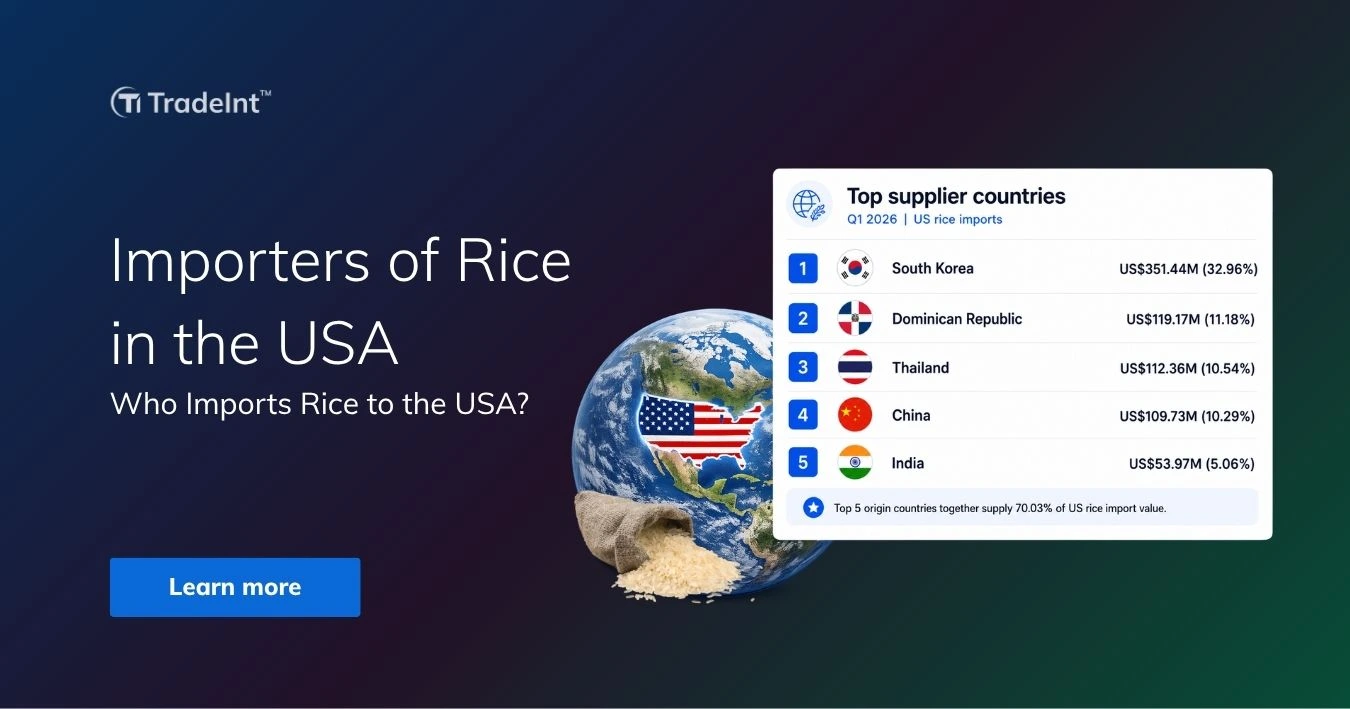
Importers of rice in USA: Who imports rice to the USA?
Key takeaways about top rice importers in the USA 2025 to 2026 DAESANG AMERICA INC leads importers of rice in the USA in Q1 2026 at US$170.99 million (16.04% share
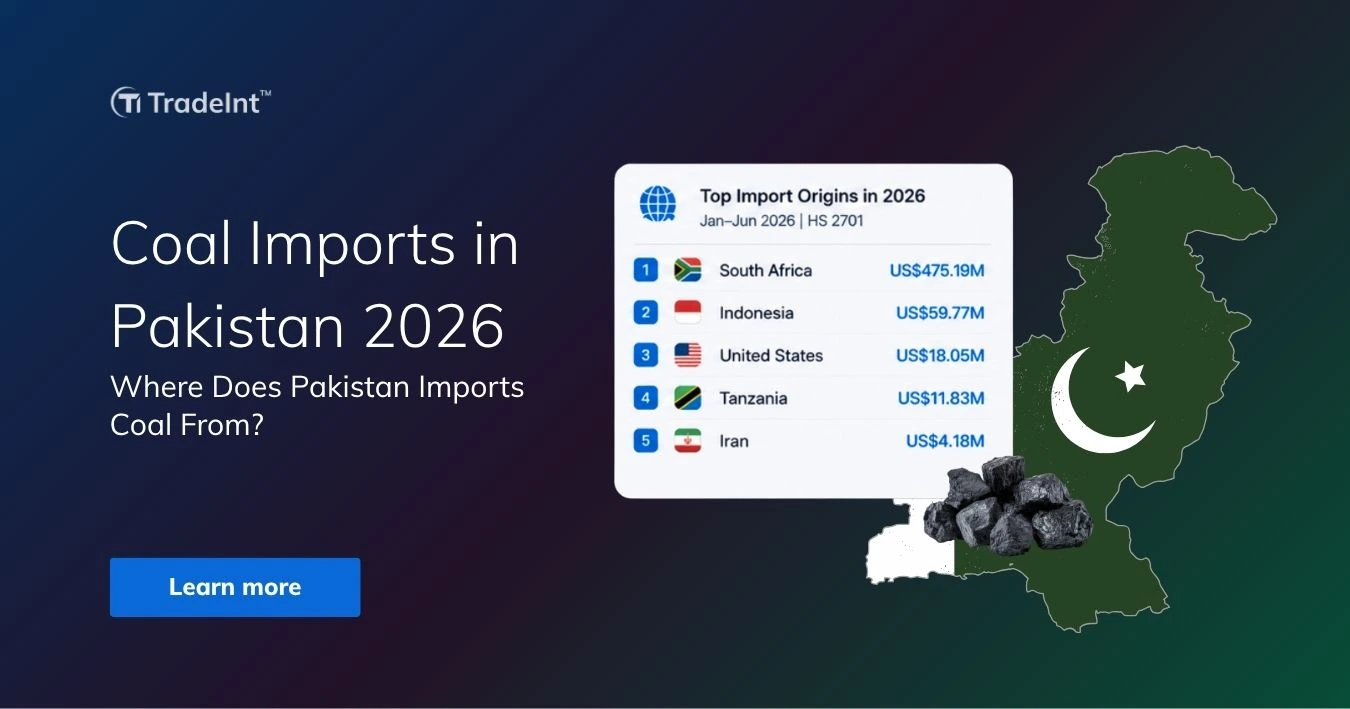
Coal imports in Pakistan 2026: Top coal source countries
Coal imports in Pakistan: What the 2026 data shows South Africa dominates coal imports in Pakistan at US$475.19 million across the January to June 2026 period, supplying more than eight
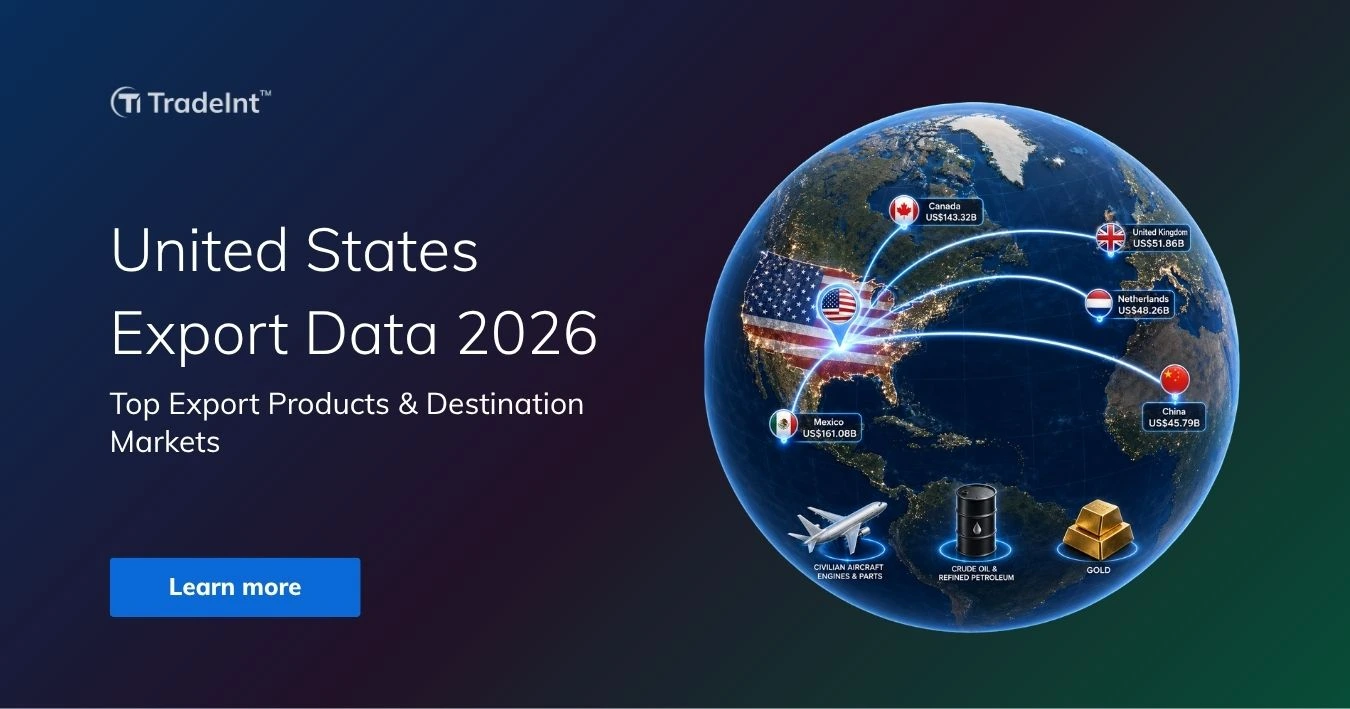
US export data 2026: Export products & destination markets
Table of Contents US export data insights from Jan to May 2026: Notable insights Civilian aircraft, engines, and parts are the top US exports at US$67.46 billion, ahead of crude
