Top 10 Brazil Exports by Country with highest value 2024-2025
From soybeans to oil, see the top 10 Brazil exports by country markets and the forces driving them. Get market insights that could shape your next move

In 2024, electrical and electronic (E&E) products dominated Malaysia’s overall global exports, with the biggest market share accounting for nearly 40%. It reached an impressive value of RM 533 billion (USD 121.19 billion), which highlights Malaysia’s role as a major player in the world’s semiconductor supply chain and high-tech manufacturing.

Pie chart illustrating Malaysia’s top 2024 export products. Electrical and Electronics (E&E) products lead with 39.9%, followed by Others (36.9%), Petroleum products (8.4%), Palm oil (5.3%), Chemical products (4.9%), and another chemical-related category (4.6%).
TradeInt is a global trade data platform providing access to over 10 billion verified import and export records. Its coverage spans over 200 countries and more than 80 customs data sources.
This article provides a snapshot of Malaysia’s leading export products. Use TradeInt to explore more detailed trade records and continue tracking this market as new data becomes available. Search Malaysia export records →
Malaysia’s Electronics and Electrical (E&E) sector has emerged as the nation’s most significant export driver in 2024, with a large range of products from semiconductors and integrated circuits to telecommunications equipment and consumer electronics. The country is the sixth-largest exporter of these products and contributes 7% to the world’s semiconductor trade flows.
These statistics highlight Malaysia’s position as a leading supplier of E&E and especially semiconductors, which are the most crucial component, accounting for 67% of the sector’s total value according to SME Bank reports. Over the years, Malaysia has demonstrated its specialized expertise in semiconductor manufacturing and its ability to serve increasingly complex global demand patterns.
According to MATRADE, in 2024, the United States was the largest importer of Malaysia’s E&E products, with a value of $26B, making up nearly one-fifth of the country’s total figure. Singapore and China ranked second and third, respectively, with nearly identical values. Notably, the top five buyers of Malaysia’s E&E products are primarily located in the Asia-Pacific region, except the United States.
| Rank | Country | Estimated E&E Import Value by Country from Malaysia (2024) | Key Reasons |
|---|---|---|---|
| 1 | United States | $26.0 billion | Driven by demand for semiconductors, integrated circuits |
| 2 | China | $25.4 billion | Key market for electrical machinery and components |
| 3 | Singapore | $17.6 billion | Hub for regional re-exports, electronics assembly |
| 4 | Hong Kong | $14.3 billion | Major transit point to Greater China and Asia |
| 5 | Taiwan | $8.0–$9.0 billion | Significant growth, supplies tech and manufacturing hubs |
Data source: Malaysia Global Trade Performance for Year 2024 and December 2024 by MATRADE
It has also evolved from a manufacturing base (13% of global back-end operations are also done in Malaysia, including tasks like chip testing and packaging) to a critical node in global technology supply chains. It supplies semiconductors to many major developed economies, including the US, EU, Taiwan, and Canada.
Additionally, a lot of major semiconductor companies operate here (Intel, GlobalFoundries, Texas Instruments, Infineon, and NXP Semiconductor). Most importantly, Intel ($7 billion expansion) and Texas Instruments ($3.1 billion investment) have committed large investments in Malaysia to expand their advanced 3D chip packaging and manufacturing capabilities.
📦 Who are the major supplier and buyers of Malaysia’s E&E sector?
Check who your competitors are trading with via TradeInt’s Global Trade Search tool here
The evolution of Malaysia’s E&E export products over the years, according to Malaysian Investment Development Authority (MIDA), is illustrated by TradeInt in the picture below:
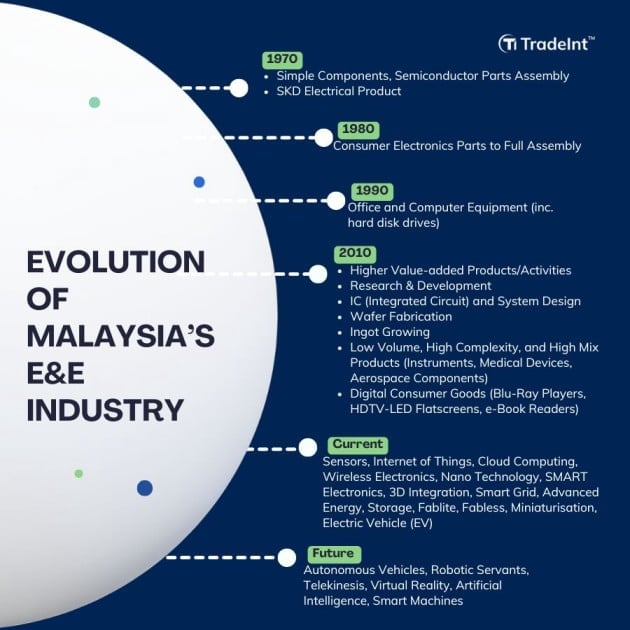
Image Caption: Timeline infographic showing the evolution of Malaysia’s Electrical and Electronics (E&E) industry from the 1970s to the future, highlighting shifts from simple component assembly to advanced technologies like IoT, AI, and autonomous vehicles.
As Deloitte recently projected global semiconductor sales to reach a new all-time high in 2025, Malaysia’s semiconductor industry is well-positioned to experience unprecedented growth.
In 2024, Malaysia’s petroleum products reached RM127.37 billion in export value, and represented 8.4% of the country’s total figure. According to the US Energy Information Administration, Malaysia is the second-largest oil and gas producer in ASEAN and the fifth-largest liquefied natural gas (LNG) exporter globally.
Malaysia is well-positioned as an important supplier of petroleum products, especially for Southeast Asian markets, with a large variety of products including crude oil, refined petroleum, and LNG. It also stands out with vast reserves, particularly in Sarawak and offshore fields. Among them, Energy Asia highlighted Sarawak for possessing approximately 60% of Malaysia’s natural gas reserves and being responsible for 90% of the country’s LNG exports.
| Region | Volume (Trillion cubic feet) | Proportion of Malaysia's natural gas |
|---|---|---|
| Sarawak | ~46 | 60% |
| Peninsular Malaysia | 20.25 | 26% |
| Sabah | 11 | 12% |
Data source: Statista (as of late 2021)
Data from the OEC showed that in 2024, the top 5 biggest importers of Malaysia’s crude oil were all located in the Asia-Pacific region. Thailand emerged as the largest importer, accounting for about 31.2% of the total value, and was followed by Australia (20.3%) and Japan (16.5%). Brunei and India ranked fourth and fifth, each with a market share of around 10%.
Similarly, Malaysia’s refined petroleum exports were predominantly directed to the Asia-Pacific region. Singapore emerged as the largest importer, receiving nearly one-fourth of the total exports, while Indonesia closely followed with an 18.5% share, which was slightly higher than Australia’s figure of nearly 17%. Meanwhile, Vietnam and Bangladesh’s proportions are quite moderate, respectively 6.2% and 5%.
According to data from WITS, Japan was the largest importer of Malaysia’s LNG in 2024, accounting for over 42% of the total export value. China ranked second with a 25.16% share, closely followed by South Korea, whose figure was just 2% lower. Singapore came fourth with 6.23%, while India rounded out the top five with a minimal 0.07% share.
| Rank | Country | Estimated E&E Import Value by Country from Malaysia (2024) | Key Reasons |
|---|---|---|---|
| 1 | United States | $26.0 billion | Driven by demand for semiconductors, integrated circuits |
| 2 | China | $25.4 billion | Key market for electrical machinery and components |
| 3 | Singapore | $17.6 billion | Hub for regional re-exports, electronics assembly |
| 4 | Hong Kong | $14.3 billion | Major transit point to Greater China and Asia |
| 5 | Taiwan | $8.0–$9.0 billion | Significant growth, supplies tech and manufacturing hubs |
Data source: Malaysia Global Trade Performance for Year 2024 and December 2024 by MATRADE
As reported by Reuters, Shell predicts Asia to lead the growth in energy demand, especially LNG, due to the region’s rapid industrialization and urbanization, and this trend may push Malaysia’s petroleum export potential upward.
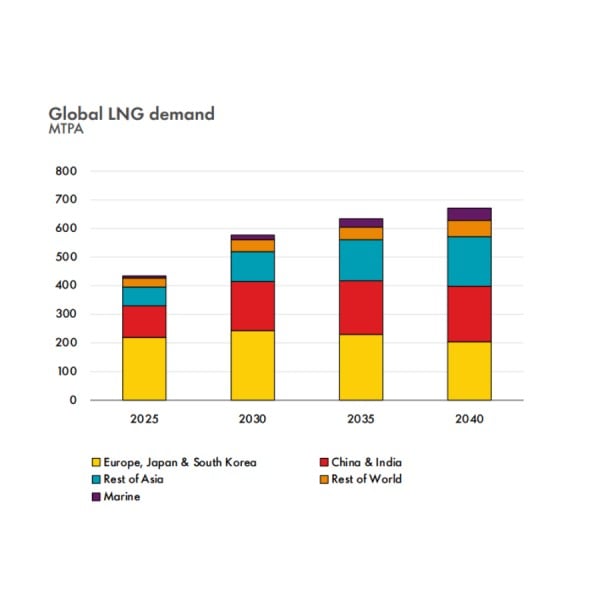
Image Source: Shell LNG Demand Prediction
However, the overall outlook for petroleum exports in 2025 still seems rather murky. In earlier months, while E&E continues to drive most of the country’s export growth, petroleum products saw a notable 9.3% drop, as noted by The Malaysian Reserve. This trajectory is driven by both volatility in oil prices and the global shift towards renewable sources and decarbonization, and the latter is likely defining the trade trend of this sector’s future.
🛢️ The crude oil supply chain is highly interlinked with petroleum products, with over 80% of crude oil globally refined into petroleum derivatives, such as gasoline, diesel, and jet fuel.
You may also read: Top 10 Crude Oil Exporting Countries 2023 & What May Cause Oil Price Instability
In response, initiatives from the Malaysian government to bolster this sector have shown a clear focus on efficiency, sustainability, and industry reforms. For example, apart from its goal to raise production to 2 million barrels per day through several key projects to enhance infrastructure, the Malaysian government also lays out the National Energy Policy (NEP) 2022-2040. The policy promotes a cleaner energy mix, energy security, and affordability while encouraging green technologies and workforce upskilling in the energy sector.
Palm oil has long been a cornerstone of Malaysia’s agricultural exports. According to Statista, palm oil was the most valuable segment among other agricultural products, with a figure of nearly RM 80 billion. This source also pointed out that with 5.61 million hectares under cultivation, Malaysia is the second-largest global exporter, following Indonesia.
In 2023, the Malaysian Palm Oil Board noted that India was the largest importer of Malaysian palm oil, purchasing $2.84 billion worth. China followed with $1.47 billion in imports, remaining the top buyer in Asia-Pacific. Turkey ranked as the top transcontinental country buyer with $880 million in imports. Other notable but smaller importers included the Netherlands, the Philippines, and Japan.
In January, Malaysia exported 792,613 MT of palm oil and related products to Asia-Pacific — a 20% increase YoY. Palm oil led with 38.44%, followed by palm kernel cake, oleo, and other palm-based derivatives (refer to the table below).
| Products | January 2024 | January 2023 | Change (MT) | Change (%) |
|---|---|---|---|---|
| Palm Oil | 304,727 | 224,560 | 80,167 | 35.70 |
| Palm Kernel Cake | 226,230 | 118,431 | 107,798 | 91.02 |
| Other Palm Products | 131,600 | 193,683 | (62,083) | (32.05) |
| Palm-Based Oleo | 100,864 | 89,397 | 11,468 | 12.83 |
| Palm Kernel Oil | 14,576 | 11,338 | 3,238 | 28.56 |
| Finished Products | 12,975 | 11,280 | 1,695 | 15.03 |
| Biodiesel | 1,641 | 14,119 | (12,478) | (88.38) |
| Grand Total | 792,613 | 662,809 | 129,805 | 19.58 |
Data source: MPOB
Palm oil’s export potential is largely driven by its versatile uses across different industries, from food, cosmetics, and biofuels to other industrial demand. From the country buyer list above, we can see one striking advantage of Malaysia’s palm oil: its ability to meet halal requirements. This is highly due to Malaysia having a well-established halal certification system, managed by the Department of Islamic Development Malaysia (JAKIM). This certification is a crucial factor for success in Muslim markets. It is coupled with a supply chain that emphasizes traceability and quality control, thus boosting the product’s appeal to this group of consumers.
The country is also actively diversifying export markets to target rising demands from Sub-Saharan Africa, the Middle East and North Africa (MENA), and ASEAN countries. This approach helps reduce dependency on traditional buyers and minimises risks relating to regulatory changes.
In terms of challenges, one of the most significant hurdles is environmental policies. To be more specific, Malaysia faces environmental scrutiny over deforestation and an alleged lack of sustainability practices, especially from major markets like the EU. In response, Malaysia has advanced its Malaysian Sustainable Palm Oil (MSPO) certification to version 2.0 to ensure its outputs align with stricter international standards and EU regulatory requirements.
Besides palm oil, Malaysia is also a large supplier of various chemical products, from organic and inorganic chemicals, fertilizers, and petrochemicals to specialty industrial compounds. In 2024, this sector’s value reached RM 73.57 billion, and has contributed 4.9% to the country’s total figure.
The chemical industry benefits from Malaysia’s status as an oil and gas producer. Petrochemical complexes are established near oil and gas fields to leverage petroleum feedstock for value-added products such as organic chemicals, plastics, and specialty chemicals.
In 2023, OEC‘s data showed that Malaysia’s chemical product exports were predominantly directed towards Asia, with the exception of the Netherlands, which ranked third. The distribution of exports among the top five markets was relatively balanced, unlike the more pronounced variations seen in Malaysia’s crude oil, refined petroleum, and LNG export markets.
Thailand emerged as the largest importer, accounting for 12.4% of Malaysia’s chemical exports. China and the Netherlands held nearly identical shares of approximately 10.7% each, securing second and third positions. Singapore followed closely in fourth place with a 9% share, while Indonesia rounded out the top five with a share of just over 6%.
A recent New Straits Times article noted that chemical product exports from Malaysia may still have a moderately positive outlook, alongside other focal sectors such as semiconductors, palm oil, and LNG. Despite minor month-on-month fluctuations, the Malaysia External Trade Statistics Bulletin for April 2025 showed increases in chemical exports to major markets, including Singapore, Italy, and the Netherlands.
In addition, the government has introduced long-term frameworks, including the Chemical Industry Roadmap 2030 (CIR2030) and the National Industrial Master Plan 2030 (NIMP2030). Both of them aim to turn Malaysia into a leading destination in ASEAN for chemical industry foreign direct investment (FDI) via prioritizing high-value specialty chemicals development, as well as sustainability and ESG principles.
In fifth place, machinery and equipment exports have been a consistent contributor to Malaysia’s economy. This category includes a wide range of products, such as manufacturing machinery, industrial equipment, specialized machinery, and parts with individual functions.
According to data from the Observatory of Economic Complexity (OEC), the biggest importer in this sector was Singapore, whose share was over 36% in 2023. This market also has enormous potential for growth in the coming time, as it has been regarded by Bloomberg as a semiconductor powerhouse. It holds 10% of global chip production and approximately 20% of its total chip-making gear.
In 2023, the top five importers of this product segment spread across multiple continents. As highlighted by the OEC, the United States was the largest market, accounting for over 20% of Malaysia’s machinery exports. Singapore ranked second with nearly 18%, reflecting its strong industrial base and growing potential. Singapore has been recognized by Bloomberg as a semiconductor powerhouse, producing 10% of global chips and around 20% of the world’s chip-making equipment, which positions it for further growth in machinery imports. This market was followed by China – another major Asian economy, with a share of over 10%.
Germany, the largest buyer in the European Union, stood out as the fourth-largest destination for Malaysia’s machinery exports. Hong Kong, with a share of 3.74%, ended up in 5th position.

Image Caption: Assorted industrial machinery parts, including gears, rollers, and drive components, laid out on a black wooden pallet.
Looking ahead, this landscape is expected to continue its growth trajectory. For instance, statistics released in February 2025 by the Ministry of Investment, Trade, and Industry showed that January’s figure saw a roughly 7.8% year-on-year increase. This is supported by the rising demand for high-value tools to facilitate the development and adoption of AI, robotics, and Industrial Internet of Things (IIoT). Thanks to this, Malaysia hopes to position itself as a high-tech manufacturing base.
🏗️ Steel accounts for a significant portion of machinery, equipment, and parts material composition, consuming approximately 16% of the world’s total steel production.
You may also read: Top 10 Steel Exporting Countries 2023 & the Latest Challenges
Since January 2024, Malaysia has seen consistent year-on-year export growth for 16 months, which highlights strong momentum in this landscape. With key export sectors such as E&E products, agricultural goods, and machinery mainly driving growth, Malaysia’s outlook for 2025 remains optimistic. The country’s advancement is also reflected in its rise to 33rd place in the Global Innovation Index 2024, up three spots from the previous year. This improvement underscores Malaysia’s shift toward a tech-driven, industrialized economy as it positions itself as a reliable supplier of advanced and value-added products.
However, RHB Research warns that ongoing global uncertainties and potentially weaker demand, especially in sectors tied to the US and China, could adversely impact Malaysia’s trade performance in the coming months.
We are honored to have received prestigious accolades, including the Quality Choice and Happiest Users awards from Crozdesk, as well as recognition as a Top Performer on SourceForge and Slashdot. Explore our reviews on reputable review sites:
– G2: https://www.g2.com/products/tradeint/reviews
– SourceForge: https://sourceforge.net/software/product/TradeInt/
– Slashdot: https://slashdot.org/software/p/TradeInt/
– Crozdesk: https://crozdesk.com/software/tradeint
– Product Hunt: https://www.producthunt.com/products/tradeint
Trade Intelligence Global Pte. Ltd. is a distinguished leader in global trade solutions, delivering exceptional results for businesses worldwide. With a focus on excellence, innovation, and client success, Trade Intelligence Global empowers businesses to thrive in today’s interconnected global economy. To find out more, visit https://tradeint.com.
From soybeans to oil, see the top 10 Brazil exports by country markets and the forces driving them. Get market insights that could shape your next move
Explore what are the main exports of Brazil in 2025, like soybeans, oil, and more. Understand production, global demand, and strategies behind Brazil's exports.
Learn more about Malaysia top 10 export by country and gain insights into the sector's future growth, key products, opportunities, and projections in 2025.
Explore Malaysia's latest palm oil export products statistics, key factors influencing trade performance, and what market trends signal for the future outlook.
Which country is the largest producer of pepper in the world? Vietnam leads exports at US$761.98 million in 2026, ahead of Indonesia and Peru under HS 0904.
Indonesia furniture export data for Q1 2026 shows other furniture leading at US$252.53M and seats at US$200.29M, the US the top partner. Full data on TradeInt.