If you’re in trade, logistics, or global strategy, knowing which country exports the most isn’t just trivia – it’s insight. Understanding who controls global exports is essential, especially in today’s volatile economy, where trade wars flare and supply chains shift overnight.
This article explores the top 10 exporting nations in 2024, what they ship, where they’re shipping to, and what that means for your business in 2025.
- China – US$3.58 trillion, the world’s largest exporter, driven by electronics, machinery, and manufacturing goods
- United States – US$2.08 trillion
- Germany – US$1.68 trillion
List of Top Exporting Countries (2024)
According to TradeInt’s largest exporting country trade database in 2024, global exports are dominated by a small group of industrial and trade-hub economies, led by Asia, North America, and Europe. Based on aggregated customs and shipment data, the top exporting countries in the world in 2024 are:
China – US$3.58 trillion, the world’s largest exporter, driven by electronics, machinery, and manufacturing goods
United States – US$2.08 trillion, supported by high-value industrial, aerospace, and technology exports
Germany – US$1.68 trillion, Europe’s export leader, with strong automotive and machinery shipments
Netherlands – US$735.52 billion, benefiting from its role as a major European re-export and logistics hub
Japan – US$707.39 billion, led by vehicles, machinery, and electronics
South Korea – US$683.13 billion, driven by semiconductors and advanced manufacturing
Italy – US$674.87 billion, known for machinery, fashion, and industrial goods
France – US$626.2 billion, supported by aerospace, chemicals, and luxury products
Mexico – US$617 billion, benefiting from near-shoring and North American supply chains
Singapore – US$504.8 billion, a key global trade and transshipment hub

TradeInt is a global trade data platform providing access to over 10 billion verified import and export records. Its coverage spans over 200 countries and more than 80 customs data sources.
This article provides an overview of the world’s leading exporting countries. Use TradeInt to explore more detailed trade records and continue tracking this market as new data becomes available. Search global export records →
Explore Country-Focused Import & Export Trade Data
Data coverage spans products, trading parntners, shipment records, and HS Code classifications, supporting structured analysis across multiple markets Turkey Trade Data Malaysia Trade Data Indonesia Trade Data Vietnam Trade Data Brazil Trade Data Mexico Trade Data South Africa Trade Data China Trade Data
According to the UNCTAD report, global trade reached a record level of $33 trillion in 2024, representing a 3.7% increase compared to 2023. Below is an overview of the growth in exports among the leading exporting countries this year.
The UNCTAD report highlighted that East and South Asia — led by China, India, and ASEAN countries — are becoming the world’s new export hubs. This trend is evident in the above-average global growth rates, particularly in high-tech sectors such as electronics, industrial machinery, and pharmaceuticals. The concentration of most exporting countries in the world within Asia underlines a post-pandemic “Asianization” of global trade.
Top 1 Export Country: China | Export Value: $3.58 trillion USD
Continuing its dominance, China remains the highest export country in the world, with goods exports totaling approximately $3.58 trillion in 2024 — a 5.92% increase compared to 2023. The country contributed around 15.1% of the global export value, meaning nearly one-sixth of the world’s exported goods originate from China.
Key export products
China’s export growth stems not only from volume but also from high-tech value. High-tech products now account for over 30% of China’s total exports, a clear outcome of Beijing’s “export structure upgrading” strategy. This shift is crucial in maintaining China’s position as the country with the highest exports, even amid increasing global market volatility.
China export activity ranks no.1, supplying over 20% of South Africa’s imports in 2025, led by US$59.6B n electronics (HS 85) and US$59.6B in machinery (HS 84)
📖 Read more about China’s Export to South Africa 2025 breakdown: Top 5 Countries from Which South Africa Import Products 2025
China’s Top Export Commodities 2024
China’s Top Export Commodities 2024
Major export markets
2024 marked a pivotal year for China’s market expansion. For the first time, Belt and Road Initiative (BRI) countries accounted for 50.3% of China’s total export value.
Asia absorbed 48.2% of Chinese exports, with ASEAN maintaining its status as China’s largest trading partner for the fifth consecutive year, thanks to growing supply chain collaboration, e-commerce trade, and agreements like the RCEP.
Top individual markets included the United States (14.7%), Hong Kong (8.1%), Vietnam (4.5%), Japan (4.3%), and South Korea (4.1%), showing China’s strong presence in familiar markets among the top trading countries in the world.
Opportunities and Challenges for 2025
China is leveraging digital transformation across BRI and RCEP nations to grow exports in high-tech sectors like microchips and digital infrastructure. A 0% tariff policy for select developing countries is also helping China expand into Africa, South Asia, and the Pacific, solidifying its influence among the world’s top trading countries.
However, 2025 brings serious challenges. The escalating U.S.-China trade war has triggered steep tariffs—up to 145%—on key exports like electronics and EVs. The end of U.S. Tax exemptions for small Chinese parcels could cut exports to the U.S. by 75%, threatening China’s role as the highest export country in the world.
Read more about US Tariff by Donald Trump 2025
👉🏻 Must read: Trump Reciprocal Tariff 2025 Update
China's export strategy for 2025
To sustain its standing among the top exporting nations, China’s 2025 export strategy revolves around two pillars: market diversification and technological advancement. The country is accelerating its push into the Middle East, Africa, and Latin America, aiming to lessen dependency on the U.S. Meanwhile, investments in research and development (R&D) and high-tech products (semiconductors, electric vehicles, renewable energy solutions) are significantly ramped up.
U.S. Tariffs have catalyzed Chinese enterprises to broaden their global export footprint while heavily investing in innovation to maintain competitiveness. Moreover, the recent devaluation of the Chinese yuan (CNY) has emerged as a tactical short-term measure to boost export performance.
Top 2 Export Country: United States | Export Value: $2.09 trillion USD
Ranked second in the top 10 exporting countries for 2024, the United States recorded total goods exports of $2.08 trillion, achieving a modest growth rate of 1.9% compared to 2023.
Key export commodities
Major exports of the U.S in 2024 included aerospace equipment, industrial machinery, chemicals, and electronic components. Specific highlights were transportation equipment (over $255 billion), chemicals ($252 billion), and advanced technology products such as chips, computers, and semiconductors.
This demonstrates the U.S.’s unique advantage not in sheer volume like China but in supplying critical goods within the global value chain.
U.S. 2025 exports are driven by high-value industrial and technological products, with demand concentrated in sectors such as aerospace, chemicals, semiconductors, and advanced machinery across key global markets.
💡 See how U.S. exports perform in a key market like Turkey: Turkey Biggest Trade Partners in 2025: Latest Insights & Expert Evaluation
US Exports 2024
United States Exports By Category in 2024
Major export markets
In 2025, the United States is set to benefit from a global trend where countries increase imports to reduce trade surpluses and avoid U.S. tariffs. For example, Vietnam’s purchase of over 200 Boeing planes and higher demand from ASEAN, Japan, South Korea, and India for U.S. agricultural products and technology reflect this shift.
Yet, the U.S. faces major risks. New protectionist tariffs on Chinese EVs, chips, and aluminum could spark Chinese retaliation, repeating past trade tensions over soybeans and aircraft. Ongoing tariff uncertainty and rising geopolitical tensions are discouraging long-term export investments.
US Exports by Country
United States Major Export Markets By Country
U.S.'s export strategy for 2025
In 2025, the U.S. will focus on high-value sectors like energy, aerospace, technology, and agriculture while tightening export controls on China. Liquefied natural gas (LNG) will serve as a diplomatic tool, with major projects aimed at Asia and Europe. Exports of aerospace, semiconductors, and machinery are expected to surge, driven by rising infrastructure needs in India, Vietnam, and Japan.
To remain among the most exporting countries in the world, the U.S. will prioritize high-tech exports to allies, protect supply chains, and boost agricultural exports—soybeans, corn, and meat—through initiatives like the $34 million FMD program.
💡Want to know who are importing your products?
Use TradeInt free global importers search tool to find out more
Top 3 Export Country: Germany | Export Value: $1.68 trillion USD
According to Destatis, Germany’s total exports reached around $1.684 trillion in 2024, marking a slight 1.1% decrease from 2023. Despite the slowdown, Germany maintained a $250 billion trade surplus, reaffirming its position as one of the top 3 leading exporting countries globally.
Key exporting merchandise
Transportation equipment (HS 87) remained Germany’s leading export sector, accounting for 16.9% of total export value, equivalent to $284.1 billion. Other notable export categories included:
- Industrial machinery (HS 84): $271.5 billion (+16.1% compared to 2023)
- Electrical equipment (HS 85): $180.6 billion (+10.7% compared to 2023)
- Pharmaceuticals (HS 30): $124.2 billion (+7.4% compared to 2023)
Major export markets
2024 marked the 10th consecutive year that the United States remained Germany’s largest export market, with export value reaching $175.59 billion. Notably, Poland surpassed China—with $101.44 billion compared to China’s $97.78 billion—becoming one of Germany’s top export partners. Other major markets included France ($125.64 billion), the Netherlands ($118.84 billion), and the United Kingdom ($87.45 billion). This trend reflects Germany’s strategy to diversify its export markets and reduce reliance on China.
Germany's Major Export Markets 2024
Germany’s Major Export Markets 2024
Opportunities and Challenges for 2025
According to Germany’s annual economic report, its exports are projected to decline by 0.3% in 2025, mainly due to rising trade tensions and reduced competitiveness, particularly from new U.S. tariffs. If realized, it would mark the 3rd consecutive year of Germany export contraction.
Despite challenges, global demand for eco-friendly and high-tech products is surging, opening new growth areas in renewable energy equipment, electric vehicles, and industrial robotics for Germany. Beyond traditional markets, India, ASEAN, and Latin America are emerging as attractive destinations, especially for machinery, pharmaceuticals, and advanced technology sectors.
However, high energy costs and a shortage of skilled labor are eroding Germany’s competitiveness. Sluggish demand from China and a global rise in trade protectionism—especially from the U.S.—continue to pressure key industries like automotive and industrial machinery.
Germany’s export strategy for 2025
To stay among the top trading countries in the world, Germany’s 2025 strategy focuses on “greening” its supply chains, expanding renewable energy technologies, and reinforcing supply chain resilience within the EU.
Germany is also accelerating free trade agreement (FTA) negotiations with Chile, Mercosur, Mexico, and aims to grow exports in healthcare, machinery, and electric vehicles to India and ASEAN markets. A potential FTA with the U.S. is a key priority to safeguard its competitive advantage as a country with highest exports in Europe.

Top 4 Export Country: Netherlands | Export Value: $735 billion USD
With total exports reaching approximately $735.5 billion in 2024, the Netherlands firmly secured its position among the top exporting countries, ranking fourth globally. Although growth compared to 2023 was moderate, it highlighted the country’s stable resilience as global supply chains gradually recover.
Key export products
The Netherlands showcased a highly diversified export structure in 2024. Mineral fuels and refined products led at $105.7 billion, followed by industrial machinery at $99 billion, and electronics at $63.6 billion. Notably, optical equipment, medical devices ($48 billion), and pharmaceuticals ($39.3 billion) reflected a clear shift towards high-value, high-tech exports, strengthening the Netherlands’ role among the top exporting nations.
Netherlands Exports By Category
Netherlands Exports By Category
Major export markets
Germany remained the top destination in 2024 with $160.84 billion, while five of the ten largest markets were EU countries. Despite efforts to diversify exports to the U.S. ($41.47 billion) and China ($22.30 billion), the internal European market remains dominant. Exports to the U.K. ($44.89 billion) stayed strong post-Brexit, showcasing Dutch adaptability in regulations and logistics.
Netherlands Major Export Markets By Country
Netherlands Major Export Markets By Country
Opportunities and Challenges for 2025
As a logistics hub centered around the Rotterdam–Schiphol–Antwerp corridor, the Netherlands plays a crucial role among the biggest trading countries in the world. Post-pandemic shifts toward supply chain resilience and sustainability create new diversification opportunities, especially in trade with the U.S., China, and Southeast Asia.
However, with 65–70% of exports bound for EU countries, the Netherlands remains vulnerable to regional economic slowdowns. High labor and energy costs, combined with a shortage of technical workers, continue to erode competitiveness even among the most exporting countries in the world.
Netherlands’ export strategy for 2025
Starting April 1, 2025, the Netherlands expanded export controls on advanced semiconductor manufacturing equipment, including testing and measurement tools, to prevent sensitive technology from falling into unauthorized hands.
To reduce dependency on the EU, the Netherlands is actively strengthening trade ties with Southeast Asia and other non-EU markets through free trade agreements and bilateral partnerships.
💡 Wish to learn the fundamentals of Global Customs Data, understand how to use it to achieve business goals, and apply it across global trade operations?
📊 Read this article:
Navigating the World of Customs Data: A Comprehensive Guide
Top 5 Export Country: Japan | Export Value: $707 billion USD
Japan’s Major Export Markets 2024
Japan’s Major Export Markets 2024
In 2024, Japan’s exports reached $707.39 billion, a slight increase from 2023’s estimated $693 billion. However, it was not enough to reverse the country’s trade deficit, which stood at $35.28 billion. While a weaker yen provided some support for exporters, it also raised input costs, intensifying the race for higher value-added production.
Japan Top 3 Key export commodities 2024
- Non-railway transportation equipment (HS 87): $150.89 billion (21% of total exports)
- Industrial machinery and boilers (HS 84): $125.73 billion (18%)
- Electrical and electronic equipment (HS 85): $101.05 billion
Other important categories included optical and medical devices, steel, organic chemicals, and precious metals, reflecting the depth and diversity of Japan’s industrial base.
Major export markets
The United States remained Japan’s largest market at $141.52 billion, followed by China ($124.63 billion) and South Korea ($46.38 billion). East and Southeast Asia are increasingly crucial buffers, helping Japan diversify risks away from Western markets.
Opportunities and Challenges for 2025
Japan’s export growth in 2025 will be driven by rising demand for hybrid vehicles, industrial robots, and energy-efficient technologies. Industrialization in ASEAN countries presents expanded markets for Japanese machinery and production equipment.
However, challenges loom. A weaker yen boosts exports temporarily but raises import costs. Fierce competition from South Korea and China, especially in semiconductors and electric vehicles, demands faster innovation from Japanese firms.
Japan’s export strategy for 2025
Japan’s 2025 export strategy focuses on a dual approach: securing traditional markets like the U.S. and Asia while expanding into emerging economies such as India, Vietnam, and Africa. Key priorities export products include semiconductors, next-generation batteries, robotics, and medical devices.
Japan is also strengthening ties through multilateral agreements like RCEP, CPTPP, and bilateral FTAs with the EU to build a sustainable export framework.
Top 6 Export Country: Korean | Export Value: $683 billion USD
South Korea achieved a new record in exports, reaching $683.8 billion in 2024, an 8.2% increase over 2023 and surpassing its previous peak in 2022. This growth highlights the strength of Korea’s tech-driven economy, climbing two spots in the global rankings (WTO).
Key export products
Electronics and semiconductors (HS 85) led exports with $212.9 billion, accounting for 31% of total value, fueled by surging demand for premium memory chips like DDR5 and HBM—semiconductor revenue alone jumped 43.9%. Other major export sectors included:
- Transportation equipment (HS 87): $91.87 billion
- Industrial machinery (HS 84): $80.45 billion
- Mineral fuels (HS 27): $52.62 billion
- Plastics (HS 39) and steel (HS 72): each exceeding $24 billion.
Traditional sectors like shipbuilding, cosmetics, and agri-food products also posted double-digit growth, showing South Korea’s increasingly diversified export base.
South Korea Exports By Category
South Korea Exports By Category
Major export markets
China and the U.S. remained South Korea’s largest partners, each accounting for about 20% of total exports. Shipments to China reached $133 billion (+6.6%), while U.S. exports hit a new record of $127.8 billion (+10.5%) for the seventh consecutive year.
Other growing markets included:
- Vietnam: $58.3 billion (~9% share)
- India and ASEAN: over 4% growth
- Latin America and the Middle East: 17.8% and 4.8% growth respectively.
South Korea’s trade network now spans both advanced tech hubs like the U.S. and vibrant consumer markets like ASEAN, reflecting a clearly multi-directional trade strategy among the top exporting nations.
South Korea’s Export Strategy for 2025
South Korea’s 2025 export strategy focuses on driving technological innovation in semiconductors, clean energy, and biotechnology, aiming to strengthen leadership in HBM chips and expand its AI ecosystem.
In parallel, Korea is boosting free trade agreements (FTAs) and promoting green exports, such as LNG carriers, advanced batteries, and hydrogen technologies, targeting to surpass $700 billion in exports and secure a spot among the world’s top 5 exporting countries.
Top 7 Export Country: Italy | Export Value: $675 billion USD
In 2024, Italy’s total exports reached $674.87 billion, showing a slight increase over 2023 despite ongoing global economic uncertainties.
Key export products
Italy’s top three export pillars in 2024 were:
- Industrial machinery and nuclear reactors (HS 84): $116.02 billion (17% of total exports), highlighting Italy’s strong technical expertise.
- Pharmaceuticals (HS 30): $55.55 billion, driven by rising global demand for high-quality medicine.
- Transportation equipment (HS 87): $47.01 billion, led by premium brands like Ferrari and Lamborghini.
Italy also recorded strong exports in electronics ($45.8 billion), jewelry ($25.7 billion), and plastics ($24.25 billion), reflecting its diverse industrial base.
Major export markets
Italy remains one of the top exporting nations, backed by a broad trade network across Europe:
- Germany ($76.82 billion), the United States ($70.16 billion), and France ($67.37 billion) were its top three markets.
- Other key European partners like Spain, Switzerland, the United Kingdom, and Belgium collectively accounted for over 60% of Italy’s total exports.
Italy Exports By Country
Italy Exports By Country
Italia’s export strategy for 2025
Italy’s 2025 strategy emphasizes innovation and green transition, prioritizing high-value sectors like biotechnology, medical equipment, fashion, and premium food products. It’s also strengthening ties with emerging markets in ASEAN, Latin America, and the Middle East, while accelerating free trade agreements (FTAs) to lower barriers and protect its global export competitiveness.
Top 8 Export Country: France | Export Value: $626 billion USD
France continues to affirm its status as one of the largest exporting countries in the world, reaching $626.2 billion in exports in 2024. Although exports declined slightly by 1.8% compared to 2023, this country’s export market structure remains stable and strongly oriented toward Europe.
France's Key Export Commodities 2024/2025
France's Key Export Commodities 2024/2025
Top 9 Export Country: Mexico | Export Value: $617 billion USD
In 2024, Mexico’s export value reached a record $617.09 billion, up 4.1% compared to 2023, far exceeding expert expectations. With nearly 90% of its exports coming from manufactured goods, Mexico continues to solidify its place among the list of biggest exporters in the world, especially as global supply chains shift away from China.
Key export products
Leading Mexico’s export portfolio was the automotive sector, generating $193.9 billion—over 31% of total exports. Electronics, computer equipment, medical devices, and semiconductors also posted strong growth, further reinforcing Mexico’s technological export capacity.
Major export markets
Over 84% of Mexico’s exports went to the United States, making it America’s top trading partner in 2024 and a strong competitor to China in the high-tech export segment. According to U.S. Census Bureau data, Mexico’s high-tech exports to the U.S. totaled $102.49 billion—up 35.2% year-over-year and only $10 billion behind China.
This rapid rise is fueled not only by geographic proximity but also by surging FDI into advanced sectors like semiconductors, electronics, biotechnology, and electric vehicles.
Mexico’s export strategy for 2025
Mexico’s 2025 strategy focuses on strengthening domestic capacity and expanding markets by promoting technological self-sufficiency and increasing local production.
Simultaneously, Mexico is negotiating new FTAs with the EU, Japan, ASEAN, and the Middle East, aiming to reduce U.S. dependency and establish itself as the new technology manufacturing hub of the Americas.
Top 10 Export Country: Singapore | Export Value: $504 billion USD
Singapore’s total exports reached $504.8 billion in 2024, marking a 6.2% increase compared to $475.5 billion in 2023. Despite its small size and population, Singapore remains firmly among the top 10 exporting countries in the world.
Key export products
Singapore’s export structure highlights its status as a high-tech economy and global logistics hub:
- Electrical and electronic equipment (HS 85) led the way with $175.8 billion, accounting for nearly 35% of total exports.
- Machinery, semiconductors, and computers (HS 84) followed with $91.6 billion.
- Mineral fuels (HS 27) contributed $56.2 billion.
- Medical, technical, and optical devices (HS 90) added another $25.2 billion.
This strong product portfolio helped Singapore maintain a $47.3 billion trade surplus, even amid oil price fluctuations and supply chain disruptions.
Major export markets
China, Hong Kong, and Malaysia were Singapore’s largest export destinations in 2024, accounting for 14%, 10.9%, and 10.4% of exports respectively. Other key markets included the United States (8.7%), Indonesia (7.9%), and Taiwan (4.8%). Notably, 78.2% of Singapore’s exports went to Asian countries, reinforcing its role as a major regional trade connector.
Singapore's Major Export Markets 2024
Singapore's Major Export Markets 2024
Strategic Lessons for Global Businesses in 2025
In today’s trade landscape, joining the export game isn’t just about offering good prices, it’s also about securing your place in global value chains.
In today’s global market, where biggest exporters are those that lead innovation, data, and supply chain agility, businesses must see themselves not just as sellers—but as indispensable links in the global supply system.
That’s where platforms like TradeInt come in. TradeInt empowers businesses to navigate this landscape and discover:
- Which sectors are experiencing rapid export growth
- Which regions are facing supply shortages
- Which competitors are declining in market share
- And where your company could plug into critical global supply chains
🛡️ In the race of international trade, data is no longer optional — it’s a competitive weapon.
Explore TradeInt now and empower your global expansion strategy with the data tools trusted by exporters worldwide.
Experience Global Supply Chain Intelligence
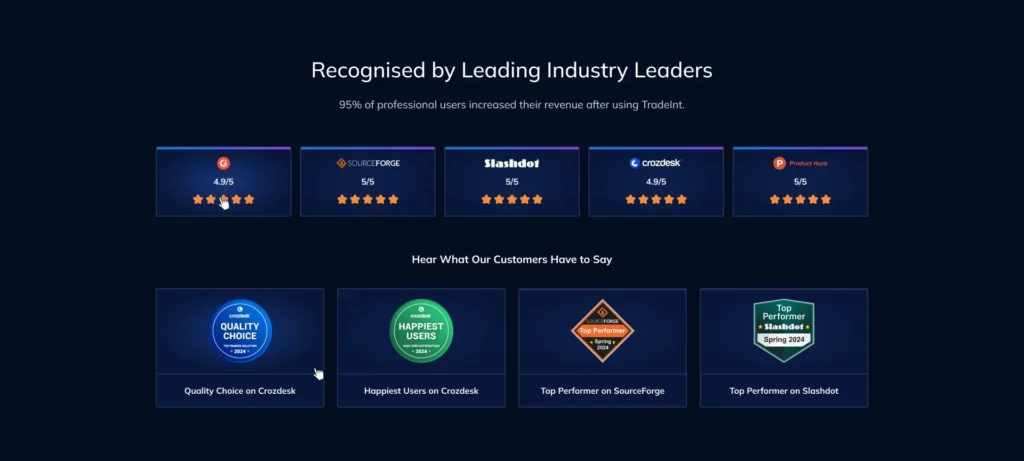
We are honored to have received prestigious accolades, including the Quality Choice and Happiest Users awards from Crozdesk, as well as recognition as a Top Performer on SourceForge and Slashdot. Explore our reviews on reputable review sites:
– G2: https://www.g2.com/products/tradeint/reviews
– SourceForge: https://sourceforge.net/software/product/TradeInt/
– Slashdot: https://slashdot.org/software/p/TradeInt/
– Crozdesk: https://crozdesk.com/software/tradeint
– Product Hunt: https://www.producthunt.com/products/tradeint
About Trade Intelligence Global Pte. Ltd.
Trade Intelligence Global Pte. Ltd. is a distinguished leader in global trade solutions, delivering exceptional results for businesses worldwide. With a focus on excellence, innovation, and client success, Trade Intelligence Global empowers businesses to thrive in today’s interconnected global economy. To find out more, visit https://tradeint.com.