Top 10 Largest Exporting Countries 2024/2025: Free Demo
Global exports hit US$33T in 2024. See the top 10 largest exporting countries, export values, key products, and 2025 trade outlooks.

In the ever-evolving global economy, understanding which country imports the most is crucial for businesses, investors, and policymakers alike. As international trade patterns shift, knowing the largest importing country and the top importing countries 2024 can help you stay ahead in supply chain strategies and market opportunities. This article explores the largest importing countries in the world and highlights key trends shaping global imports this year.
The U.S led global imports with a total value of approximately USD 3,966 billion in 2024, followed by China with around USD 3,127 billion, and Germany at about USD 1,914 billion. The US’ imports were driven mainly by key partners such as Mexico, China, and Canada, with major imported goods including machinery, electronics, and vehicles.
Early in 2025, Port Technology reported that global trade growth is forecast to slow to 3.2% in 2025, with the International Monetary Fund projecting 3.3% in 2026 and stabilizing around that level through 2027. This slowdown is attributed to ongoing geopolitical tensions, tariff uncertainties, and supply-chain realignments, which are expected to weigh on trade volumes and economic growth worldwide.
TradeInt is a global trade data platform providing access to over 10 billion verified import and export records. Its coverage spans over 200 countries and more than 80 customs data sources.
This article provides a snapshot of the world’s leading importing countries. Use TradeInt to explore more detailed trade records and continue tracking this market as new data becomes available. Search global import records →
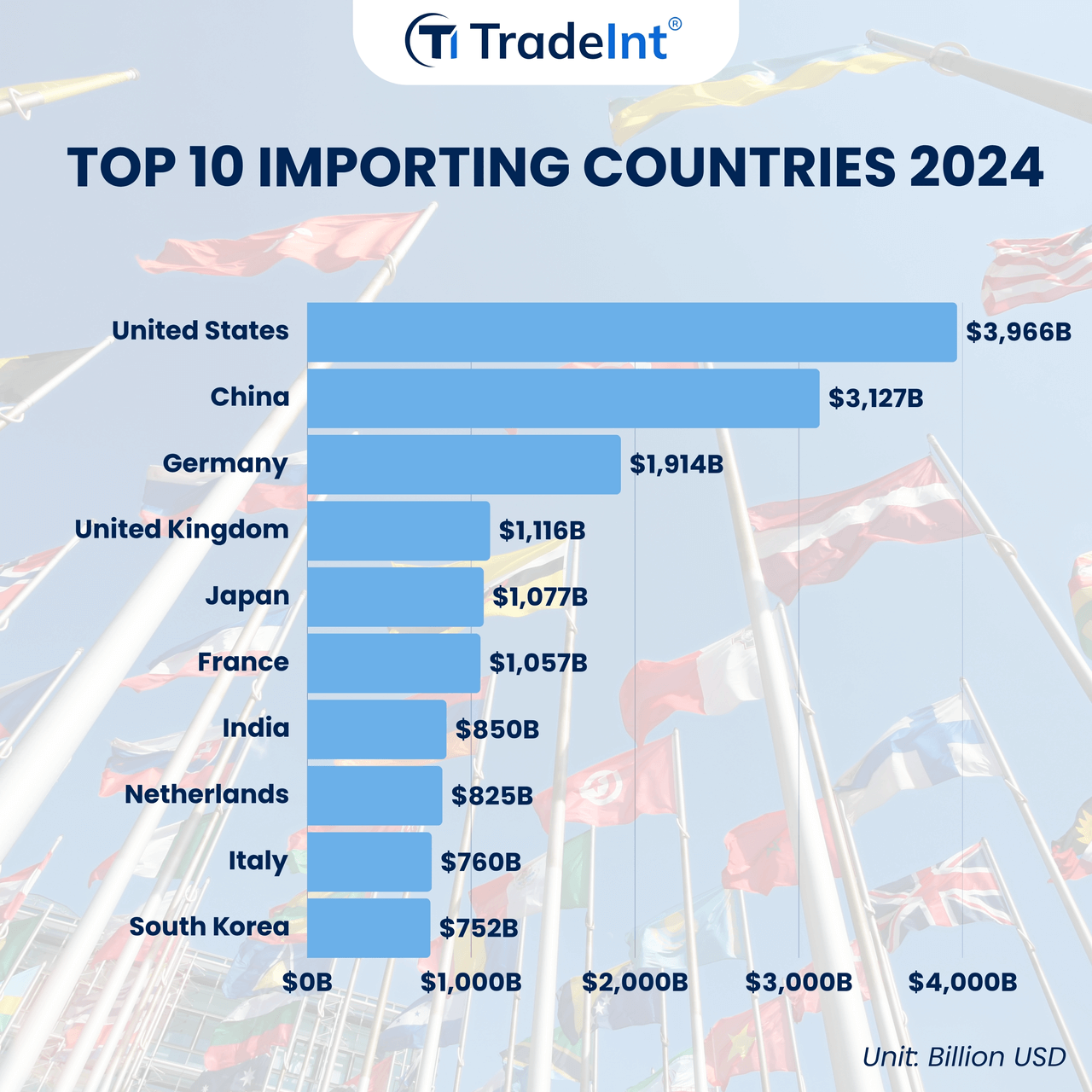
Global merchandise imports totaled over $26 trillion in 2024, reflecting a steady recovery and structural shift in global consumption patterns. Below is an overview of the top 10 importing countries this year based on total import value.
While developed economies like the United States, Germany, and Japan continue to lead global imports, emerging Asian markets—including China, India, and South Korea—are playing an increasingly significant role. This trend reflects the region’s expanding middle class, rapid industrialization, and growing appetite for high-value goods, such as electronics, energy, and advanced manufacturing inputs.
The presence of five Asian economies in the top 10 list underscores a broader shift toward an “Asian-driven” global demand landscape, complementing the region’s longstanding strength in exports.
The United States remains the largest importing country in the world in 2024, with total imports reaching approximately $3,966 billion. This marks a 4.1% increase from 2023 and accounts for over 14% of total global import value. For businesses looking to identify which country imports the most, the U.S. consistently tops the list due to its strong consumer base, diversified economy, and reliance on international supply chains.
The growth in U.S. imports this year was largely driven by sustained domestic demand, especially in sectors such as electronics, pharmaceuticals, and clean energy technologies. Infrastructure investments under the Inflation Reduction Act and ongoing digital transformation efforts also played a significant role in boosting imports of high-tech components and machinery. At the same time, the country’s expanding appetite for EVs, medical equipment, and manufactured goods further solidified its position among the top importing countries in 2024.
| Category | Import Value (US$ Billion) | Share of Total Imports (%) |
|---|---|---|
| Electrical machinery, equipment | 486.2 | 13.30% |
| Vehicles (including parts and EVs) | 432.7 | 11.80% |
| Pharmaceuticals | 309.5 | 8.50% |
| Machinery (including computers) | 298.6 | 8.20% |
| Crude oil and mineral fuels | 264.4 | 7.20% |
| Optical, technical, medical apparatus | 176.2 | 4.80% |
| Furniture, lighting, prefab buildings | 145.7 | 4.00% |
| Plastics and plastic articles | 132.9 | 3.60% |
| Apparel and footwear | 128.5 | 3.50% |
| Toys, games, and sporting goods | 112.3 | 3.10% |
Source: www.tradeint.com
In 2024, the United States continued to import heavily from a diverse set of trading partners. While China remains a major supplier, Mexico and Canada have steadily gained ground thanks to USMCA agreements and nearshoring trends. Southeast Asia also plays an increasingly important role, especially Vietnam and India, which are benefiting from shifting supply chains.
| Country | Share of U.S. Imports (%) |
|---|---|
| China | 14.90% |
| Mexico | 14.20% |
| Canada | 12.40% |
| European Union* | 10.70% |
| Vietnam | 5.60% |
| Japan | 4.30% |
| South Korea | 3.90% |
| Germany | 3.50% |
| India | 3.20% |
| Taiwan | 2.80% |
The rise of Mexico and India as leading trade partners illustrates the growing momentum of nearshoring and “China+1” strategies among U.S. importers. Electronics, auto parts, and consumer goods are key segments driving this shift.
Looking ahead, the United States will continue to be the most importing country in the world, but not without facing key challenges. Trade policy uncertainty—especially with the potential return of higher tariffs under a new U.S. administration—could impact sourcing decisions. At the same time, stricter environmental import regulations and labor compliance standards are prompting importers to reassess their long-standing supplier relationships.
🗣️ Wondering how global markets react to sudden policy shifts like U.S. tariffs?
You may be interested in reading: How 35 Countries Responded to the 2025 U.S. Tariffs and what it means for your next move
On the opportunity side, demand for electric vehicle batteries, AI hardware, and clean energy infrastructure is creating new avenues for global exporters. Countries that can meet U.S. regulatory standards and offer scalable, reliable supply are likely to gain import market share in 2025.
For businesses analyzing the top importing countries 2024, the U.S. stands out not just for its size, but also for its evolving needs—making it a vital focus for exporters of both high-tech and consumer goods.

Image source: www.tradeint.com/search (click to visit website)
📦 Want to know who is also importing your products? Are you falling behind your competitors?
In 2024, China ranked as the second-largest importing country in the world, with total merchandise imports reaching approximately $3,127 billion. This represents a 3.4% increase compared to the previous year, reinforcing China’s dual role as both a global export powerhouse and a major demand center for foreign goods. For anyone seeking to understand which country imports the most after the United States, China stands out not just in size but in the strategic nature of its imports.
China’s import structure mirrors its ongoing industrial transition. In 2024, the country significantly increased imports of semiconductors, chipmaking tools, high-precision machinery, and clean energy components, particularly for use in the EV and solar sectors. These products are central to China’s goal of climbing the global value chain and strengthening its self-reliant tech ecosystem.
Consumer-driven imports also showed strong performance. The country’s urban middle class continued to seek out luxury goods, premium food items, beauty products, and health supplements from overseas, especially from Europe, Japan, and North America. In parallel, China’s manufacturing industries remained heavily reliant on imported crude oil, natural gas, iron ore, and industrial metals — a reflection of its massive infrastructure, energy, and export operations.
Looking at China’s top import commodities in 2024, it becomes clear how the country is fueling both its domestic consumption and industrial advancement. Semiconductors and chip equipment alone accounted for nearly one-fourth of total import value, underscoring China’s dependence on global tech ecosystems. Meanwhile, traditional staples such as fuel and ore remain indispensable to powering China’s production base. The rising value of imported pharmaceuticals and medical devices further signals a shift toward health-focused growth, especially as the population ages.
| Category | Import Value (US$ Billion) | Share of Total Imports (%) |
|---|---|---|
| Semiconductors and electronic circuits | 425.6 | 15.90% |
| Crude oil and refined fuels | 392.1 | 14.60% |
| Iron ore and industrial metals | 280.9 | 10.50% |
| Integrated machines & chip equipment | 195.2 | 7.30% |
| Luxury consumer goods | 173.6 | 6.50% |
| Agricultural products (soy, grains) | 162.7 | 6.10% |
| Vehicles and vehicle parts | 158.3 | 5.90% |
| Pharmaceuticals and medical equipment | 140.2 | 5.20% |
| Plastics and chemicals | 133.4 | 5.00% |
| Optical and technical instruments | 122.1 | 4.60% |
Source: www.tradeint.com
China’s key suppliers in 2024 reflect both tradition and transformation. Japan, South Korea, and Germany remained leading partners, providing essential equipment and industrial inputs for China’s tech and automotive sectors. At the same time, resource exporters such as Australia, Russia, and Brazil remained major sources of energy and minerals. The United States, despite ongoing trade friction, continues to be among China’s top sources for aircraft, semiconductors, and agricultural goods.
Meanwhile, China deepened its engagement with regional trade blocs. Under the Regional Comprehensive Economic Partnership (RCEP), imports from Vietnam, Malaysia, and other ASEAN countries expanded — particularly in electronics, food processing inputs, and consumer goods. These shifts reflect China’s strategic rebalancing toward more localized and politically aligned supply chains.
| Country | Share of China’s Imports (%) |
|---|---|
| Japan | 9.80% |
| South Korea | 8.70% |
| Germany | 7.30% |
| Australia | 6.90% |
| United States | 6.20% |
| Brazil | 4.50% |
| Russia | 4.10% |
| Malaysia | 3.80% |
| Vietnam | 3.40% |
| India | 2.90% |
China is expected to maintain strong import demand in 2025, especially in high-tech sectors like semiconductors, electric vehicles, and clean energy. The country’s need for advanced machinery, medical technologies, and green infrastructure will continue to attract exporters from around the world. Consumer demand for premium goods and healthcare products is also likely to grow, supported by rising incomes and shifting lifestyles. Regional trade within Asia will gain momentum thanks to agreements like RCEP.
On the other hand, China faces mounting pressure from U.S. trade restrictions and tech export controls, which may limit its access to critical components. Domestic challenges, including a slowdown in real estate, deflation risks, and cautious consumer spending, could dampen import growth in some sectors. Moreover, China’s push for self-reliance may gradually reduce demand for certain imported goods in favor of homegrown alternatives.
For exporters assessing which country imports the most advanced technologies and industrial inputs, China remains one of the top importing countries in 2024. However, success in this market will require flexibility, local insight, and awareness of shifting trade policies.
Germany ranked as the third-largest importing country in the world in 2024, with goods imports totaling approximately $1,914 billion. While often recognized for its export strength, Germany is also one of the most importing countries in the world, reflecting its central role in global supply chains and high dependence on foreign energy and industrial inputs.
Germany’s import portfolio aligns with its advanced manufacturing base and energy needs. The country imported a significant volume of machinery, electronics, automotive components, and precision instruments to support its industrial sectors. At the same time, the energy crisis of recent years prompted a major shift in sourcing strategies, leading to increased imports of liquefied natural gas (LNG), oil, and renewable energy equipment from more diversified suppliers.
In 2024, Germany also saw rising imports of semiconductors and battery-related materials, driven by its expanding electric vehicle industry. Pharmaceuticals, medical devices, and high-grade chemicals continued to flow into the country, serving both consumer markets and production facilities. The overall import structure reflects Germany’s position as a production hub that transforms imported inputs into high-value exports.
| Category | Import Value (US$ Billion) | Share of Total Imports (%) |
|---|---|---|
| Energy (oil, gas, LNG) | 278.5 | 16.50% |
| Machinery and equipment | 225.1 | 13.30% |
| Electrical and electronic components | 194.6 | 11.50% |
| Automotive parts and vehicles | 187.2 | 11.10% |
| Pharmaceuticals and medical devices | 141.9 | 8.40% |
| Chemicals and plastics | 129.8 | 7.70% |
| Semiconductors and optical equipment | 115.3 | 6.80% |
| Food and agricultural products | 98.7 | 5.80% |
| Metals and industrial materials | 84.5 | 5.00% |
| Textiles and apparel | 61.4 | 3.60% |
Source: www.tradeint.com
Germany’s major import partners are primarily located within the European Union, underscoring the country’s deep integration with regional markets. The Netherlands, France, and Italy continued to supply Germany with refined fuels, machinery, and processed goods. China remained Germany’s largest non-EU source of imports, particularly in electronics and manufacturing equipment. The United States also played a vital role, especially in supplying pharmaceuticals, aircraft, and technology components.
As Germany shifts toward renewable energy and digital transformation, trade with countries like South Korea and Japan also strengthened, especially for battery inputs and advanced electronic systems. Imports from Eastern Europe, including Poland and the Czech Republic, continued to grow, supporting automotive and machinery production.
| Country | Share of Germany’s Imports (%) |
|---|---|
| Netherlands | 9.20% |
| China | 8.50% |
| France | 7.80% |
| United States | 6.90% |
| Italy | 6.40% |
| Poland | 5.20% |
| Czech Republic | 4.70% |
| Belgium | 4.40% |
| Japan | 3.60% |
| South Korea | 3.10% |
Germany’s strength in global trade is not limited to imports. In 2024, it also remained one of the top exporting countries in the world, with key export sectors continuing to drive value. Transportation equipment (HS 87) was Germany’s leading export segment, contributing 16.9% of total exports, equivalent to $284.1 billion. This was followed by:
These categories highlight Germany’s competitiveness in high-value manufacturing, engineering, and innovation-led industries.
Germany’s role as one of the top importing countries in 2024 is likely to persist into 2025, supported by sustained demand for industrial components, medical goods, and clean energy systems. The country’s ambitious targets for decarbonization are driving new import flows in wind turbine parts, hydrogen infrastructure, and EV battery materials. Its strong reliance on international suppliers also creates opportunities for exporters in pharmaceuticals, electronics, and precision machinery.
However, Germany faces growing challenges. High energy costs and labor shortages are straining domestic manufacturers and increasing pressure on cost structures. Trade protectionism in the U.S. and slower demand from China are impacting traditional trade patterns, especially in automotive and industrial sectors. Additionally, rising geopolitical tensions and the fragmentation of global supply chains are forcing German companies to rethink sourcing strategies and diversify away from single-country dependencies.
In a changing trade environment, Germany remains not only a top exporter but also one of the largest importing countries in the world. For suppliers worldwide, the German market offers both scale and sophistication—but success will depend on the ability to meet high technical standards and adapt to evolving policy and economic conditions.
To stay among the top trading countries in the world, Germany’s 2025 strategy focuses on greening its supply chains, expanding renewable energy technologies, and reinforcing supply chain resilience within the EU.
Germany is also accelerating free trade agreement (FTA) negotiations with Chile, Mercosur, and Mexico, while targeting export growth in sectors like healthcare, machinery, and electric vehicles to key emerging markets such as India and ASEAN. A potential FTA with the United States is also a high priority, as it could help Germany maintain its competitive edge as the country with the highest exports in Europe.
🔎Wish to search Germany/export-data/hs-code/87 to explore Germany’s latest import trade records by sector?
Use our Global Trade Search Tool for free to find out more
With a total import value surpassing $1,116 billion in 2024, the United Kingdom firmly held its place among the top importing countries in the world. Despite the trade complications following Brexit, the UK has continued to maintain robust trade ties with both EU and non-EU nations.
| Country | Share of UK Imports (%) |
|---|---|
| Germany | 12.40% |
| China | 9.80% |
| United States | 9.10% |
| Netherlands | 8.60% |
| France | 6.50% |
The UK’s import structure remained highly diversified. Leading import categories included industrial machinery, electronics, automobiles, pharmaceuticals, and refined fuels. The country also imported substantial amounts of consumer goods, food, and clothing. Notably, pharmaceuticals and biotech-related products saw a spike in demand amid efforts to boost domestic healthcare capacity.
Energy remained a strategic import, particularly natural gas and crude oil, as the UK reduced its reliance on North Sea reserves. Additionally, EV components and green tech imports increased due to the country’s transition toward a low-carbon economy.
The United Kingdom’s largest import partners included Germany, the Netherlands, China, the United States, and France. While intra-EU trade remains vital, imports from Asia — particularly electronics and machinery from China, Japan, and South Korea — gained ground. India also emerged as a growing partner in textiles and chemicals
In 2024, Japan ranked fourth among the top importing countries in the world, with total imports reaching approximately $886 billion. While Japan is often recognized as a tech export powerhouse, its import patterns also offer critical insights into global supply and demand dynamics. As an island nation with limited natural resources, Japan relies heavily on imports for both energy and raw materials, positioning it among the most importing countries in the world.
Japan’s import structure is shaped by its resource constraints and advanced industrial needs. Energy imports remain the largest component, including liquefied natural gas (LNG), crude oil, and coal, which are vital for power generation and heavy industry. As Japan continues its energy transition, imports of hydrogen, wind turbine parts, and other green technology inputs are gradually increasing.
On the industrial front, Japan imported a wide range of high-precision machinery, semiconductors, and raw materials used in automotive and electronics manufacturing. Food and agricultural imports, such as beef, seafood, and cereals, also remained high due to limited domestic production capacity.
| Category | Import Value (US$ Billion) | Share of Total Imports (%) |
|---|---|---|
| LNG, crude oil, coal | 197.3 | 22.30% |
| Semiconductors and electronics | 132.4 | 14.90% |
| Industrial machinery | 117.1 | 13.20% |
| Agricultural products and seafood | 89.6 | 10.10% |
| Chemicals and pharmaceuticals | 83.2 | 9.40% |
| Metals and industrial materials | 75.3 | 8.50% |
| Automotive parts | 63.7 | 7.20% |
| Food and beverages (processed) | 48.5 | 5.50% |
| Textiles and apparel | 37.6 | 4.20% |
| Renewable energy inputs | 29.3 | 3.30% |
Japan’s imports are sourced from a geographically diverse range of partners. Energy imports come primarily from Australia, the Middle East, and the United States. Meanwhile, semiconductors and electronics are largely imported from South Korea, Taiwan, and China. Japan also imports significant volumes of food and consumer goods from the United States, Europe, and Southeast Asia.
| Country | Share of Japan’s Imports (%) |
|---|---|
| China | 18.20% |
| United States | 11.40% |
| Australia | 10.10% |
| South Korea | 9.80% |
| Taiwan | 8.70% |
| Germany | 6.50% |
| Thailand | 5.90% |
| Malaysia | 4.60% |
| Indonesia | 3.20% |
| Vietnam | 2.90% |
Japan is expected to maintain its position as one of the most importing countries in the world in 2025. Opportunities include increased imports of clean energy components and advanced manufacturing inputs that align with its industrial policy goals. Rising demand for premium food products and pharmaceuticals also presents a strong market for exporters.
However, Japan faces challenges related to currency volatility, aging population dynamics, and regional supply disruptions. Its strong dependency on energy imports leaves it vulnerable to geopolitical tensions, while rising competition from neighboring Asian markets could impact price and availability of industrial inputs.
Japan’s approach to import diversification and sustainability will play a key role in shaping its trade profile as it continues to be one of the largest importing countries in 2025.
France imported approximately $1,057 billion worth of goods in 2024, reaffirming its rank among the top importing countries globally. Its strategic position within the EU and its diverse industrial economy fuel strong import activity across multiple sectors.
| Country | Share of France’s Imports (%) |
|---|---|
| Germany | 13.10% |
| Italy | 9.50% |
| China | 8.20% |
| Belgium | 7.80% |
| United States | 6.40% |
France’s key import categories included industrial equipment, refined fuels, automobiles, pharmaceuticals, and luxury consumer goods. The country also imported significant quantities of electronics, agricultural goods, and construction materials.
High-end segments such as cosmetics and fashion items saw growing inbound flows due to rising re-export demand and robust domestic consumption. Imports of machinery and electrical components supported industrial and renewable energy expansion.
Germany remained France’s largest trading partner, followed by Italy, Belgium, and China. The United States remained a strong supplier of pharmaceuticals and tech equipment. France also deepened trade with Spain and North African nations in energy and agriculture.
India imported $850 billion in 2024, reflecting its expanding economy and rising consumption across energy, infrastructure, and technology sectors. The country has become one of the fastest-growing among the largest importing countries.
| Country | Share of India’s Imports (%) |
|---|---|
| China | 15.40% |
| United Arab Emirates | 7.90% |
| Saudi Arabia | 6.60% |
| United States | 6.20% |
| Russia | 5.80% |
India’s top imports included crude oil, gold, electronics, fertilizers, and machinery. Imports of lithium-ion batteries, solar panels, and electronic parts also grew due to manufacturing initiatives and green energy adoption.
China remained India’s largest import partner, especially in electronics and industrial inputs. The UAE and Saudi Arabia supplied most of the oil, while the U.S. gained ground in supplying technology, defense equipment, and medical goods.
The Netherlands recorded $825 billion in imports in 2024, maintaining its role as a critical logistics and import hub in Europe. Its world-class port and transport infrastructure support high volumes of inbound trade, much of which is re-exported.
| Country | Share of Netherlands’ Imports (%) |
|---|---|
| Germany | 16.20% |
| Belgium | 9.80% |
| China | 8.50% |
| United States | 7.20% |
| France | 6.90% |
Main import commodities included mineral fuels (oil and gas), electrical equipment, industrial machinery, medical instruments, and food products. The country also imported chemicals, plastics, and clothing at scale to support its manufacturing and processing industries.
Germany, Belgium, and China were the Netherlands’ primary suppliers, with strong flows from the U.S. and France. As a transit hub, the Netherlands handles massive volumes destined for other EU countries, reflecting its central role in European trade networks.
Italy imported $760 billion worth of goods in 2024, reflecting its role as a major European economy with high demand for energy, industrial equipment, and intermediate goods to support its strong manufacturing and automotive sectors.
| Country | Share of Italy's Imports (%) |
|---|---|
| Germany | 16.50% |
| France | 8.70% |
| China | 7.80% |
| Netherlands | 5.90% |
| Spain | 5.20% |
Italy’s key imports included crude oil, natural gas, pharmaceuticals, machinery, and vehicles. The country also brought in electronic equipment, plastics, and agricultural commodities, such as coffee, cocoa, and grains. Imports of lithium and critical minerals increased alongside Europe’s green energy transition.
Germany remained Italy’s top import partner, followed by France, China, and the Netherlands. Other key sources included Spain, the United States, and Belgium, especially for refined energy, chemicals, and industrial components.
South Korea imported $752 billion worth of goods in 2024, maintaining its position as a tech-intensive economy with strong reliance on global supply chains for energy, electronics, and industrial inputs.
| Country | Share of Korea’s Imports (%) |
|---|---|
| China | 19.60% |
| United States | 10.30% |
| Japan | 9.40% |
| Saudi Arabia | 7.80% |
| Australia | 6.70% |
South Korea’s main imports included crude oil, LNG, semiconductors, machinery, and automotive components. The country also brought in chemicals, food products, and metals. Imports of lithium, cobalt, and other battery inputs expanded due to EV manufacturing growth.
China remained Korea’s top import source, followed by the U.S., Japan, and Saudi Arabia. The UAE, Australia, and Indonesia also saw growing volumes, particularly in the energy and mining sectors.
The beginning of 2025 has already revealed key trends reshaping the global import landscape. There is a sharp rise in demand for electronics and green technologies, including EV batteries, semiconductors, and renewable energy components. Major economies such as the United States—the largest importing country—the European Union, India, and Japan are driving this shift, reflecting broader commitments to sustainability and digital transformation.
Meanwhile, global food security concerns and extreme weather events are pushing many nations, particularly in China, Europe, and the Middle East, to increase agricultural imports. Another notable trend is the strategic realignment of sourcing patterns: companies are actively diversifying suppliers to mitigate geopolitical risks, avoid tariffs, and strengthen supply chain resilience. The reshuffling of global trade routes is particularly evident following new free trade agreements and regional blocs like the RCEP and CPTPP.
Understanding and adapting to these trends is vital for businesses aiming to stay competitive in a rapidly changing trade environment.
The current shifts in global imports are opening up remarkable opportunities worldwide. As major economies diversify their sourcing networks, emerging markets like India, South Korea, and various African nations are becoming significant new destinations for global trade. Nearshoring trends—where companies bring supply chains closer to home—are also fueling import growth in countries like Mexico, Poland, and Vietnam.
The global push toward high-tech industrialization presents vast opportunities in sectors such as EV production, clean energy, smart infrastructure, and digital services. Businesses that can align their offerings with these growing needs stand to gain substantially.
Leveraging real-time trade data is more crucial than ever. Platforms like TradeInt enable companies to track global HS codes, monitor competitors’ shipments, and spot sourcing trends before they become mainstream. By understanding what the largest importing countries in the world are buying, from whom, and at what price, businesses can make smarter, faster, and more strategic decisions.
🔍 Want to know where the top importing countries in 2025 are sourcing your product category?
🔍 Which country surprised you on this list? Where do you see the upcoming trade surge before it’s too late?
🔍 Ready to turn global import data insights into export opportunities?
TradeInt helps you track global HS codes, monitor competitors’ shipments, and spot sourcing trends in real time. Start navigating the data and decide your next market move.
🌏 Looking to make smarter trade decisions for your business?
Global exports hit US$33T in 2024. See the top 10 largest exporting countries, export values, key products, and 2025 trade outlooks.
Global trade intelligence analyzes customs records, Bills of Lading, and HS codes to show how goods move across markets and who is actively trading.
Top 10 largest importing countries 2025 led by the United States (US$2.54T), China (US$2.43T), and South Africa (Us$1.73T). Import data insights.
Top 10 largest exporting countries 2025, ranked by export value & top trade partners. China leads at $3.41T, followed by South Africa $1.92T & the U.S. $1.61T.
TradeInt is one of the largest import export database, hitting 8 Billion records in 2025 (increased 3 Billion since 2020). Optimize your supply chain today.
Learn more about Malaysia top 10 export by country and gain insights into the sector's future growth, key products, opportunities, and projections in 2025.