Key takeaways: Indian Pulses Import Data 2026
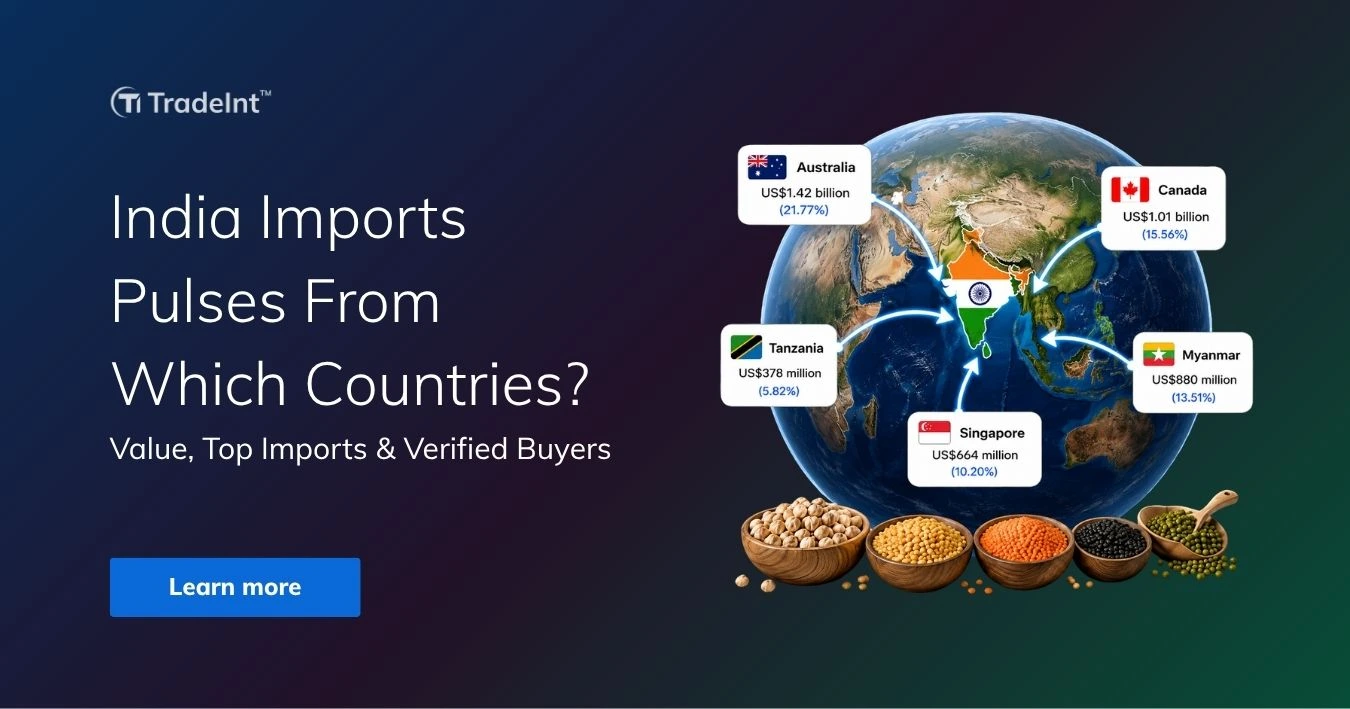
- Australia leads India imports pulses from which countries in Q1 2026 at US$1.42 billion (21.77%), driven by record desi chickpea and lentil harvests, followed by Canada (US$1.01 billion) and Myanmar (US$880 million).
- Dried shelled chickpeas (HS 071320, Chana) lead India's pulses import basket at US$1.45 billion (22.33%), with pigeon peas (HS 071360, Tur) at US$1.42 billion (21.83%) and Urad/Moong (HS 071331) at US$1.31 billion (20.07%).
- The top 5 suppliers (Australia, Canada, Myanmar, Singapore, Tanzania) together represent 66.86% of total India pulses import value in Q1 2026, with Australia's basket nearly 99% concentrated in chickpeas and lentils, and Canada's almost entirely in lentils (Masur) and dried peas.
Which countries does India import pulses from, based on Q1/2026 data?
From TradeInt's India HS 0713 trade data, India mainly imports pulses from Australia, Canada, and Myanmar in Q1 2026, valued at US$1.42 billion, US$1.01 billion, and US$880 million, respectively. Combined, the top 10 supplying countries account for roughly 85% of the total India pulses import value, with the remaining flow split across smaller East African, European, and Oceanic origins.
Top 5 countries India imports pulses from in Q1 2026:
- Australia: US$1.42 billion (21.77% share). Anchors India's chickpea lane, with 76.64% of its outbound basket concentrated in dried shelled chickpeas (HS 071320, Chana), the deepest single-product specialisation across all top supplier countries.
- Canada: US$1.01 billion (15.56% share). Splits its export basket almost evenly between lentils and dried peas, securing India's largest Masur (lentil) and yellow-pea fulfillment channel from the Saskatchewan production base.
- Myanmar: US$880 million (13.51% share). Concentrates 95.47% of shipments in Urad/Moong (HS 071331) and pigeon peas (HS 071360, Tur), the two staple varieties facing structural domestic shortage in India.
- Singapore: US$664 million (10.20% share). Operates as a transshipment node redistributing mixed pulse cargoes across all five major HS 0713 sub-codes, with no single product exceeding 33% of its mix.
- Tanzania: US$378 million (5.82% share). India's leading East African pigeon-pea origin, with HS 071360 alone covering 77.50% of its outbound flow on a counter-seasonal harvest cycle.

TradeInt is a global trade data platform providing access to over 10 billion verified import and export records. Its coverage spans over 200 countries and more than 80 customs data sources.
This article provides an overview of India’s pulse imports. Use TradeInt to explore more detailed trade records and continue tracking this market as new data becomes available. Search India pulse import records →
📊 Understand the latest India Import Export Trends in Q1 2026
Crude petroleum leads India's imports at US$29.64 billion, with China the largest supplier, while refined petroleum tops exports at US$12.08 billion, and the US is the top destination. These TradeInt articles breakdown India's trade to import and export by top products and partners.
Read more: India Export Data Q1 2026 | India Import Data Q1 2026
Top 1 - Australia: US$1.42 billion
Australia supplied India with US$1.42 billion of pulses during Q1 2026, drawn from TradeInt's database. Dried shelled chickpeas (HS 071320, Chana) led at US$1.09 billion or 76.64% of the basket, followed by lentils (HS 071340, Masur) at US$311 million and dried peas (HS 071310) at US$14.69 million.
Main pulse India imports from Australia in Q1 2026:
- HS 071320 - Dried shelled chickpeas (Chana): US$1.09 billion (76.64%) - Reflects Australia's record 2025-26 desi chickpea harvest and steady Indian retail demand for besan and Chana dal applications.
- HS 071340 - Dried shelled lentils (Masur): US$311.36 million (21.95%) - Mirrors Australia's record lentil production this season, with Indian buyers absorbing the additional supply at softer landed prices.
- HS 071310 - Dried shelled peas: US$14.69 million (1.04%) - A minor flow, used mainly as a protein blend ingredient and feed input where Indian processors substitute against domestic shortages.
- HS 071350 - Broad beans and horse beans: US$2.09 million (0.15%) - A niche feed and specialty food channel sitting outside the core Indian dal staples.
- HS 071331 - Urad and Moong beans: US$1.94 million (0.14%) - A trace inflow, since Australian agronomy concentrates on chickpea and lentil rather than gram pulses central to Indian cooking.
Australia's outsized role this quarter reflects bumper harvest economics. According to iGrain India's January 2026 report, Australia exported 388,832 tonnes of desi chickpeas in November 2025 alone, with India receiving 230,982 tonnes of that shipment.
Lentil flows tracked a similar pattern. Total Australian lentil exports surged to 270,152 tonnes in November 2025 from 45,311 tonnes in October, with India absorbing 154,083 tonnes in a single month.
✔ Lite ✔ Pro ✔ Premium ✔ EnterpriseTradeInt is a global trade data platform covering 200+ countries and 80+ customs sources. Learn about TradeInt →
📦 Unlock India Pulses Import Records by Exporter and HS Code on TradeInt
TradeInt's pulses database surfaces shipment-level exporter names, ports, and HS subheading breakdowns across Myanmar, Canada, Australia, and other supplier lanes, with multiple entry points by product, HS code, or company.
Reveal now: India pulses past import records search by product
Top 2 - Canada: US$1.01 billion
Q1 2026 saw Canada supply India with US$1.01 billion of pulses, almost entirely concentrated in two products. Lentils (HS 071340, Masur) led at US$513.65 million (50.67%), dried peas (HS 071310) followed at US$480.25 million (47.37%), with chickpeas a distant third at US$5.95 million, as captured in TradeInt's dataset.
Main pulse imports from Canada to India in Q1 2026:
- HS 071340 - Dried shelled lentils (Masur): US$513.65 million (50.67%) - Canada's Saskatchewan-led red and green lentil belt anchors India's Masur dal pipeline for north and west Indian retail.
- HS 071310 - Dried shelled peas: US$480.25 million (47.37%) - Yellow peas dominate this line, channelled into besan blending and snack-food processors across Indian metros.
- HS 071320 - Dried shelled chickpeas (Chana): US$5.95 million (0.59%) - A marginal share since Canadian chickpea agronomy is comparatively narrow versus its lentil-pea core.
- HS 071331 - Urad and Moong: US$5.91 million (0.58%) - A minor placeholder line, with Canada not a structural Urad source for Indian cooking demand.
- HS 071360 - Pigeon peas (Tur): US$4.53 million (0.45%) - A residual flow, since Tur cultivation is concentrated in tropical and sub-tropical zones rather than Canadian prairies.
Top 3 - Myanmar: US$880 million
TradeInt's records show Myanmar supplied US$880 million in pulses to India during Q1 2026, with Urad and Moong (HS 071331) dominating at US$612.27 million (69.56%), pigeon peas (HS 071360, Tur) at US$228.05 million (25.91%), and kidney beans at US$22.00 million. The mix tracks long-standing bilateral commitments on Urad and Tur lifting.
Main India pulses import data from Myanmar in Q1 2026
- HS 071331 - Urad and Moong beans: US$612.27 million (69.56%) - The single-largest variety, used for Urad dal, Moong dal, and packaged staple lines across North and East Indian consumption hubs.
- HS 071360 - Pigeon peas (Tur, Arhar): US$228.05 million (25.91%) - Anchors India's Tur dal supply during the off-season window when domestic Maharashtra and Karnataka stocks tighten.
- HS 071333 - Kidney beans (Rajma): US$22.00 million (2.50%) - Supplies the Indian retail Rajma segment, particularly in northern markets where domestic production is concentrated.
- HS 071335 - Cowpeas (Lobia): US$9.15 million (1.04%) - A regional protein line popular in southern and western Indian cuisines, sourced opportunistically.
- HS 071320 - Dried shelled chickpeas: US$6.55 million (0.74%) - A minor flow, since Indian chickpea procurement skews toward Australia and Canada for scale.
Myanmar's pulse trade with India runs on bilateral commitments rather than open-market arbitrage. According to UnderStand UPSC's policy briefing, India and Myanmar extended the pulses import agreement for five years beyond 2025-26 to secure Urad and Tur supply.
The 2021 framework set 2.5 lakh tonnes of Urad and 1 lakh tonne of Tur per year, with the extension likely adding another lakh tonne of Tur. India's national pulse demand sits at 28-29 million tonnes against 24-25 million tonnes of domestic output.
Top 4 - Singapore: US$664 million
Singapore is positioned as India's fourth-largest pulse origin in Q1 2026, supplying US$664 million across a balanced mix. Urad and Moong (HS 071331) led at US$216.08 million (32.51%), pigeon peas (HS 071360, Tur) followed at US$160.67 million (24.18%), and chickpeas (HS 071320, Chana) at US$126.05 million, from TradeInt's transaction-date records for the quarter.
Main India pulses import data from Singapore in Q1 2026:
- HS 071331 - Urad and Moong beans: US$216.08 million (32.51%) - The lead category in the basket, often re-exports of Southeast Asian and African origin consolidated through Singapore.
- HS 071360 - Pigeon peas (Tur): US$160.67 million (24.18%) - Channels Tur volumes from East African producers via Singapore's container clearance and quality grading hubs.
- HS 071320 - Dried shelled chickpeas (Chana): US$126.05 million (18.97%) - Routes chickpea consignments from Australian and Black Sea origins through Singapore's transshipment network.
- HS 071340 - Dried shelled lentils (Masur): US$85.81 million (12.91%) - Bundles smaller Canadian and Australian lentil parcels for India-bound rolled cargoes.
- HS 071310 - Dried shelled peas: US$63.18 million (9.51%) - Aggregates pea-class shipments at the lowest concentration tier across the basket.
Singapore's role differs structurally from that of primary growers. As stated in the Government of India's India-Singapore Trade Brief, Singapore is a high-throughput transshipment, financial, and trade-routing hub rather than a pulse-producing economy, with re-exports forming the bulk of its outbound agri-commodity flows.
Product mix mirrors the routing role. Unlike Australia's chickpea concentration or Canada's lentil-pea split, Singapore distributes across all major HS 0713 subheadings, reflecting exposure as a transshipment hub to multiple origin lanes within a single quarter.
What stands out about Singapore's transshipment flow to India:
- Origin-agnostic mix: Outflow spans five HS subheadings with no single line exceeding one-third, reflecting consolidated cargo rather than domestic agronomy.
- Logistics arbitrage: Indian importers route consignments via Singapore to capture container availability and shorter clearance windows on African and Australian cargoes.
- Re-export consolidation: A large share of Singapore-flagged India pulses import data records are originally African or Southeast Asian harvests repacked through Singaporean intermediaries.
Top 5 - Tanzania: US$378 million
Tanzania anchored India's East African pigeon-pea pipeline at US$378 million during Q1 2026. Tur (HS 071360) alone covered US$293.68 million or 77.50% of its outbound flow, followed by dried shelled chickpeas (HS 071320, Chana) at US$83.35 million and kidney beans (HS 071333) at US$1.86 million, drawn from TradeInt's dataset.
Main pulse India imports from Tanzania in Q1 2026:
- HS 071360 - Pigeon peas (Tur, Arhar): US$293.68 million (77.5%) - The defining product, with Tanzanian Tur harvested counter-seasonally to Indian domestic crops, smoothing supply through the lean monsoon months.
- HS 071320 - Dried shelled chickpeas (Chana): US$83.35 million (22%) - A secondary line from Tanzania's central regions, channelled into besan and snack-food processing.
- HS 071333 - Kidney beans (Rajma): US$1.86 million (0.49%) - A small flow into Indian retail Rajma demand, sourced opportunistically.
- HS 071339 - Other dried shelled beans: US$45,532 (0.01%) - A negligible specialty line, sitting outside India's mass-consumption staples.
- HS 071390 - Other dried leguminous vegetables: US$11,833 - The smallest residual line in Tanzania's outbound profile.
✔ Lite ✔ Pro ✔ Premium ✔ EnterpriseTradeInt is a global trade data platform covering 200+ countries and 80+ customs sources. Learn about TradeInt →
🌍 Get Tanzania's Pulse Export Statistics Overview on TradeInt
TradeInt's Tanzania trade summary shows annual export value, top HS2 product sectors with share breakdowns, exporter ranking, and three-year YoY growth, helping pulse buyers benchmark Tanzania's pigeon-pea outflow within its wider trade profile.
Access now: Tanzania import export statistics and customs trade overview
Key points about Tanzania's pulse trade with India:
- Single-product dominance: Tur alone accounts for over three-quarters of Tanzanian pulse export value to India in Q1 2026, the deepest concentration after Australia's chickpea share.
- Counter-seasonal harvest fit: Tanzanian harvest timing complements Indian Tur cycles, anchoring the East African pigeon-pea lane as a structural gap-filler.
- African corridor competition: Mozambique, Rwanda, and other East African origins compete with Tanzanian Tur volumes for the same pool of Indian buyers.
Why does India import pulses?
India imports pulses because national consumption persistently outpaces domestic production by 3 to 4 million tonnes annually. According to India Pulses and Grains Association data via India Business Trade, national pulse demand sits at 28 to 29 million tonnes while output ranged between 24 and 25 million tonnes in the 2024-25 crop year.
In fact, pulses underpin Indian non-cereal protein intake.
The same India Business Trade analysis notes that pulses account for roughly a quarter of non-cereal protein for Indian consumers, with five crore farmers and their families dependent on the cultivation cycle covering Chana, Tur, Urad, Masur, and Moong.
On the other hand, India's import share of pulse consumption climbed from 9% in 2020-21 to 23.1% in 2024-25 before easing in FY26 on stronger domestic output.
Which pulses are imported to India?
India's Q1 2026 pulse imports are led by dried shelled chickpeas (HS 071320, Chana) at US$1.45 billion (22.33%), pigeon peas (HS 071360, Tur) at US$1.42 billion (21.83%), and Urad/Moong (HS 071331) at US$1.31 billion (20.07%). Lentils (Masur) and dried peas complete the top five HS subheadings.
Top pulse India imports in Q1 2026
- HS 071320 - Dried shelled chickpeas (Chana): US$1.45 billion (22.33%) - The highest-value subheading, anchored by Australian and Tanzanian inflows, is central to besan, Chana dal, and Kabuli retail.
- HS 071360 - Pigeon peas (Tur, Arhar): US$1.42 billion (21.83%) - The most demand-inelastic line, with structural shortages tightening retail Tur dal pricing during Indian off-season months.
- HS 071331 - Urad and Moong beans: US$1.31 billion (20.07%) - Concentrated heavily in Myanmar and Singapore sourcing, central to Urad dal and Moong dal household consumption.
- HS 071340 - Dried shelled lentils (Masur): US$1.17 billion (17.93%) - Dominated by Canadian and Australian harvest cycles, with FY26 volumes correcting after FY25 record imports.
- HS 071310 - Dried shelled peas: US$856.65 million (13.15%) - The pricing-sensitive line, with yellow pea volumes contracting in FY26 on softer landed prices and improving domestic Chana availability.
✔ Lite ✔ Pro ✔ Premium ✔ EnterpriseTradeInt is a global trade data platform covering 200+ countries and 80+ customs sources. Learn about TradeInt →
🌾 Access India's Import Export Trade Summary on TradeInt
TradeInt's India trade summary surfaces annual import value, top HS2 product sectors with share breakdowns, importer ranking, and three-year YoY growth in one view, framing where pulses (HS 0713) sit within India's wider US$717.91 billion import basket in 2024.
Browse now: India trade statistical summary by year on TradeInt
Who are the top India pulses buyers in Q1/2026?
India's pulses import buyers are led by Viterra India Private Limited (Netherlands, 7.90% share), Louis Dreyfus Company India Private Limited (Australia, 4.41%), and Superior Agro Crops Private Limited (Myanmar, 3.34%), based on Q1 2026 transaction-date records captured in TradeInt's dataset.
Primary Indian pulses buyers in Q1/2026:
- Viterra India Private Limited (Netherlands): 7.90% share - The largest single buyer, executing high-volume consolidated imports across multiple HS 0713 subheadings into India.
- Louis Dreyfus Company India Private Limited (Australia): 4.41% share - A global agri-trading house channelling Australian-origin lentil and chickpea cargoes through Indian discharge ports.
- Superior Agro Crops Private Limited (Myanmar): 3.34% share - A specialist trading enterprise concentrated on Urad and Tur consignments from Myanmar suppliers into Indian dal mills.
- RDC Agro Ventures Private Ltd: 2.68% share - A growing distributor sourcing international pulses to reinforce Indian buyer-supplier networks.
- ETC Agro Processing India Private Limited (Australia): 2.15% share - A processing-focused operator handling cleaning, refining, and marketing of Australian-origin pulse inflows.
✔ Lite ✔ Pro ✔ Premium ✔ EnterpriseTradeInt is a global trade data platform covering 200+ countries and 80+ customs sources. Learn about TradeInt →
📥 Download India Trade Sample Data
TradeInt offers free preview samples of India's HS 0713 customs records, helping importers, exporters, and analysts review the data fields, time ranges, and country coverage before subscribing to the full Bill of Lading database.
Download sample data here: India trade data sample
Conclusion
India import pulses from which countries?
India's total pulse imports under HS 0713 reached approximately US$6.52 billion in Q1 2026, with Australia (US$1.42 billion, 21.77%), Canada (US$1.01 billion, 15.56%), and Myanmar (US$880 million, 13.51%) collectively covering over half of all pulses import by India during the quarter.
TradeInt's data confirms two concurrent structural drivers: Australia and Canada supply the broader Chana and Masur basket on the back of record 2025-26 Southern Hemisphere harvests, while Myanmar's long-standing bilateral framework secures the structurally undersupplied Urad and Tur lines.
Contact TradeInt for a customised demo
Frequently asked questions
What are the top 5 pulses in India?
India's top 5 pulse imports by value in Q1 2026, drawn from TradeInt's dataset, are dried shelled chickpeas (HS 071320, Chana) at US$1.45 billion (22.33%), pigeon peas (HS 071360, Tur) at US$1.42 billion (21.83%), Urad and Moong (HS 071331) at US$1.31 billion (20.07%), lentils (HS 071340, Masur) at US$1.17 billion (17.93%), and dried peas (HS 071310) at US$857 million (13.15%).
What is the import duty on pulses in India?
Import duty on pulses in India varies by subheading as of FY26. According to India Business Trade, Tur (pigeon peas) and Urad (black gram) continue under duty-free import provisions, while lentils (Masur) carry a 10% duty and yellow peas carry a 30% duty.
Where does India import pulses from?
India imports pulses from Australia, leading at US$1.42 billion (21.77%), supplying predominantly Chana (dried shelled chickpeas), followed by Canada at US$1.01 billion (15.56%) for Masur and dried peas, and Myanmar at US$880 million (13.51%) for Urad and Tur.
Other relevant articles about Import & Export in India
- India export data: Top exports analysis in Q1/2026
- India import data Q1 2026: Top import partners & categories
- India imports coal from which countries? Top partners
- India imports edible oil from which countries in Q1/2026?
- India imports gold from which countries in Q1/2026?
- India imports lithium from which country? Top suppliers
- India imports fertilizer from which countries in Q1 2026?
- India imports crude oil from which countries in Q1 2026?
- India imports petrol from which countries? Top sources 2026
- India exports onion to which country? Top partners & trends
- India imports urea from which countries in Q1 2026?
- India exports rice to which countries? Top partners & buyers