Top 10 Largest Coffee Exporting Countries (2025 data update)
Explore the top 10 largest coffee-exporting countries in the world. See who leads the global market and how their exports shape international coffee trends.

In 2023, Vietnam’s export turnover of agricultural and seafood products reached USD 32.5 billion, up 5.3% compared to 2022. Exports to the Asian market achieved an impressive growth of 14.7%, while other markets like Europe and America saw declines.
– Asia: USD 19.5 billion, up 14.7%
– Europe: USD 4.6 billion, down 7.6%
– America: USD 4.1 billion, down 15.2%
– Africa: USD 1.05 billion, up 25%
China and the United States are Vietnam’s largest export markets for agricultural and seafood products, with export turnovers of USD 9.8 billion and USD 3.3 billion, respectively.
– Fruits and Vegetables: USD 5.6 billion, up 66.7%
– Rice: USD 4.7 billion, up 35.3%
– Cashew Nuts: USD 3.6 billion, up 18.1%
– Coffee: USD 4.2 billion, up 4.6%
– Seafood: USD 9.0 billion, down 17.8%
– Rubber: USD 2.9 billion, down 12.8%
– Cassava and Cassava Products: USD 1.3 billion, down 7.3%
– Pepper: USD 910 million, down 6.2%
– Tea: USD 208 million, down 12%
The turbulent year of 2023 significantly impacted the global agricultural and seafood markets. However, thanks to timely support policies and smart solutions, Vietnam successfully overcame challenges and maintained stable export activities for key commodities.
TradeInt is a global trade data platform providing access to over 10 billion verified import and export records. Its coverage spans over 200 countries and more than 80 customs data sources.
This article provides a snapshot of Vietnam’s agricultural and seafood exports. Use TradeInt to explore more detailed trade records and continue tracking these markets as new data becomes available. Search Vietnam agricultural and seafood export records →
Rice production grew by 1.9% compared to 2022, reaching 43.5 million tons. Rice export turnover reached an impressive USD 4.7 billion, up 35.3% compared to the previous year. Particularly, fragrant rice and high-quality rice are increasingly favored, expanding their market share in demanding markets like Australia and Europe.
The export turnover of rice reached USD 4.7 billion, up 35.3% compared to 2022. Rice production reached 43.5 million tons, up 1.9% compared to the previous year. The average export price of rice in 2023 was USD 575/ton, up 18.3% compared to 2022. Fragrant rice, ST rice, and Japonica rice were the high-value rice types exported strongly this year. The rice export market was diversified, with the Philippines, Indonesia, and China being the three largest markets.
In 2023, Vietnam’s rice export achieved significant success, ensuring benefits for rice farmers and balancing between exports and domestic consumption. Thanks to effective export management, the domestic prices of rice and paddy were stabilized, and international commitments were well implemented.
However, Vietnam’s rice export activities still face many challenges, such as increasing production costs due to higher agricultural input prices, putting pressure on businesses while export prices have not risen correspondingly. Additionally, Vietnamese rice exports face fierce competition from other suppliers like Thailand, Myanmar, Pakistan, and high international freight rates due to geopolitical developments in Europe and the Middle East.
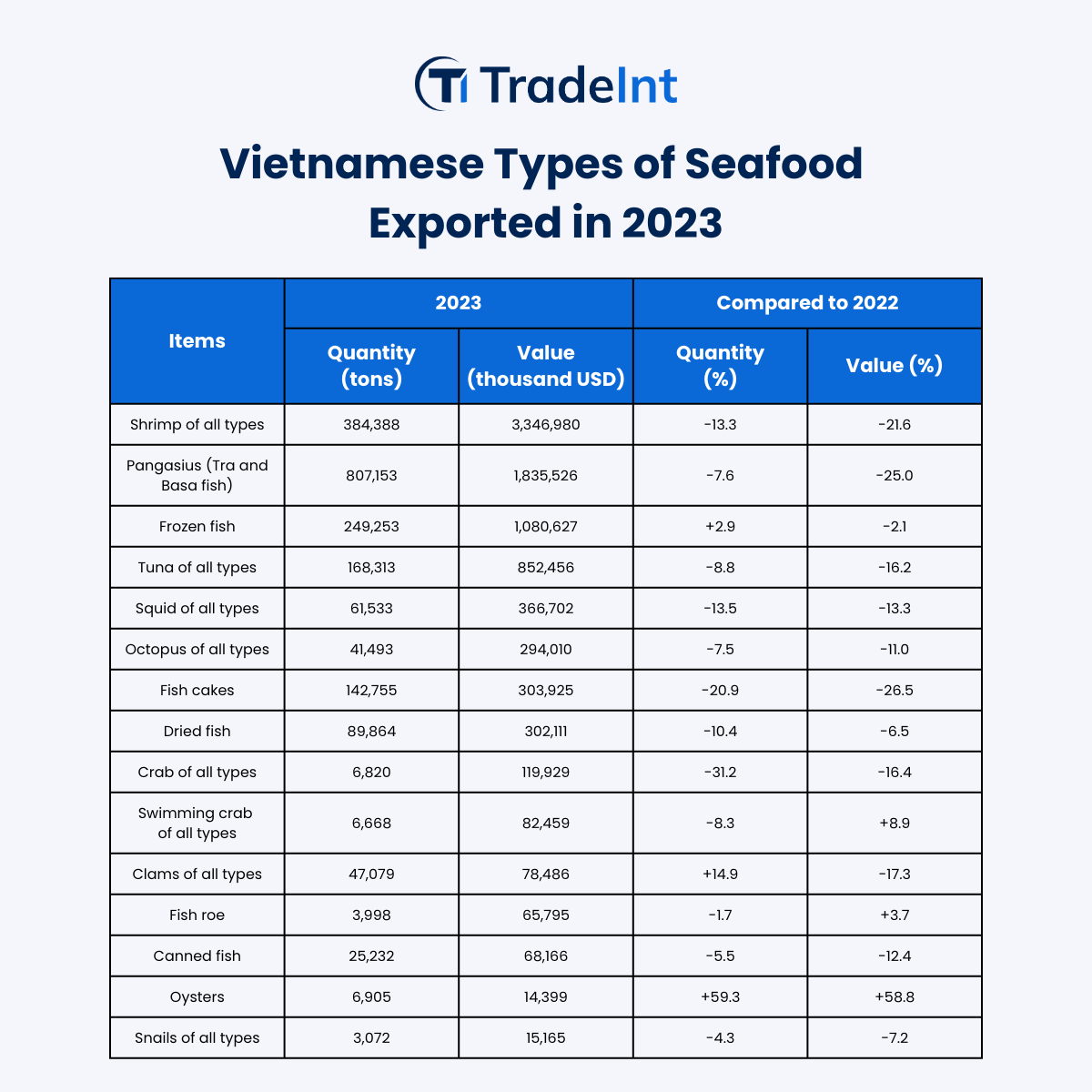
Seafood export turnover reached nearly USD 9 billion, down 17.8% compared to 2022. This decline was mainly due to competitive pressure and high inventory levels in major markets, along with inflation reducing consumer demand. The total seafood production in 2023 is estimated at 9.31 million tons, up 2.2% compared to 2022. Of which:
– Fish: 6.61 million tons, up 1.8%
– Shrimp: 1.36 million tons, up 5%
– Other seafood: 1.34 million tons, up 1.7%
In 2023, seafood exports to almost all markets decreased compared to 2022.
– CPTPP: USD 2.42 billion, down 16%
– USA: USD 1.56 billion, down 27%
– EU: USD 869 million, down 29%
– China: USD 1.3 billion, down 15%
– Japan: USD 1.52 billion, down 11%
While exports to the USA and EU dropped sharply due to high inventory levels and inflation, the Chinese market saw increased import demand, but lower import prices led to reduced export turnover. Additionally, China’s amendment of the Wildlife Protection Law in 2023 disrupted lobster imports from Vietnam.
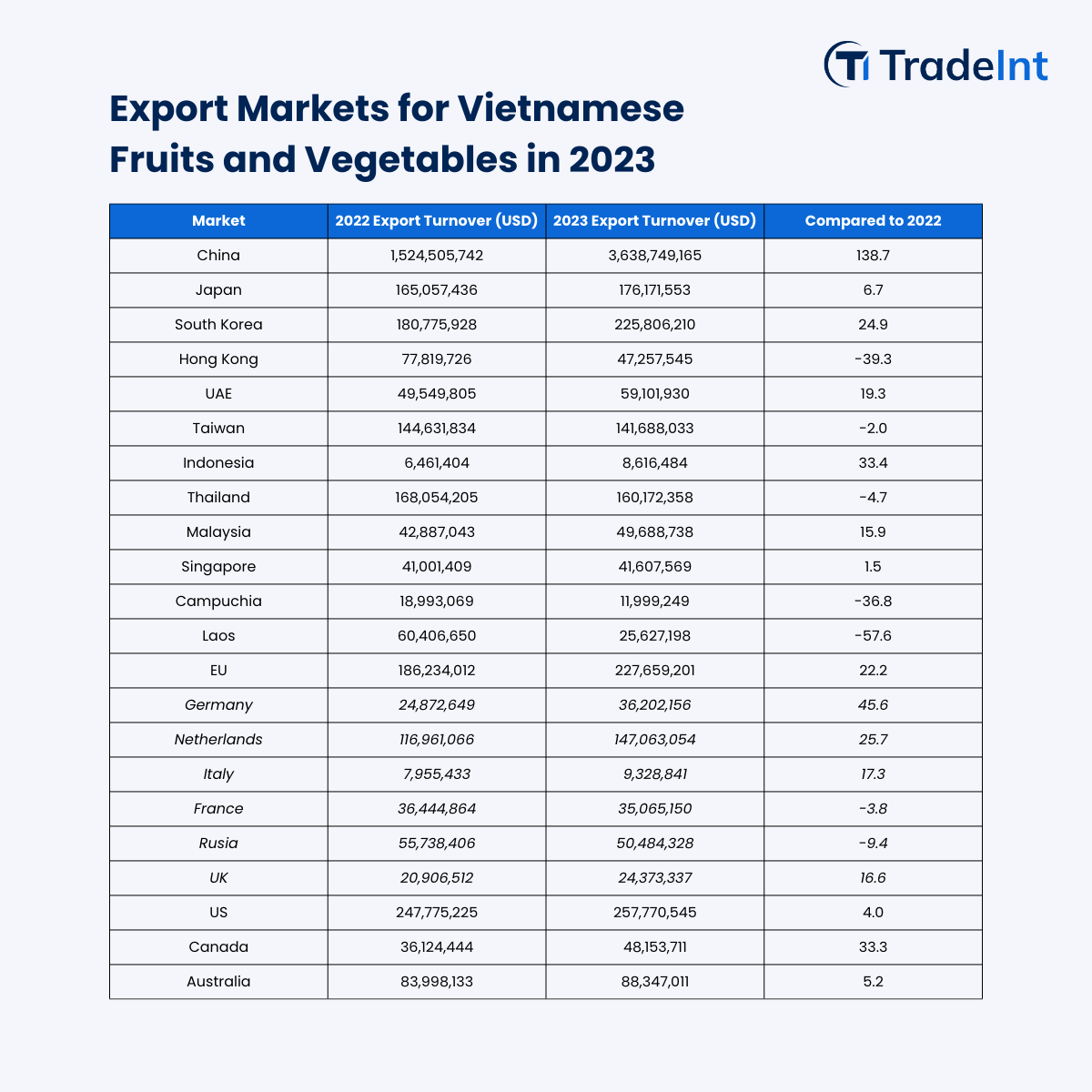
In 2023, Vietnam’s fruit and vegetable exports saw impressive growth. Export turnover of fruits and vegetables reached USD 5.6 billion, up 66.7% compared to 2022. Major items like durian, jackfruit, mango, and passion fruit all recorded high growth, especially durian with a 430% increase, reaching USD 2.24 billion. Accordingly, the production of many major fruits in 2023 increased compared to 2022:
– Mango: reached 1,004 thousand tons, up 3.2%
– Orange: reached 1,842 thousand tons, up 4.5%
– Durian: reached 1,056 thousand tons, up 17.8%
– Longan: reached 655 thousand tons, up 2.6%
– Banana: up 2.5% to 2,527 thousand tons
– Grapefruit: up 4.2% to 1,027 thousand tons
– Coconut: up 2.4% to 1,963 thousand tons
– Lychee: reached 376 thousand tons, slightly up compared to 2022
China continues to be the largest consumer market with a turnover of USD 3.6 billion, accounting for 65% of Vietnam’s total fruit and vegetable exports. The growth in fruit and vegetable exports to China in 2023 has shown the adaptation efforts of Vietnamese production and export-import businesses. Currently, Vietnam has 13 types of agricultural and fresh fruits allowed to export to China, including dragon fruit, watermelon, lychee, longan, banana, mango, jackfruit, rambutan, mangosteen, black jelly, chili, durian, sweet potato, and passion fruit. Besides China, Vietnam’s fruit and vegetable export turnover also recorded positive growth in other markets thanks to the advantages of Free Trade Agreements (FTAs).
– China: The largest fruit and vegetable consumption market, reaching USD 3.6 billion, up 138.7% compared to 2022, accounting for 65% of total fruit and vegetable export turnover.
– USA: Reached USD 257.7 million, up 4% compared to 2022.
– South Korea: Reached USD 225.8 million, up 24.9% compared to 2022.
– EU: Reached USD 227.6 million, up 22.2% compared to 2022. The Netherlands and Germany are the two main export markets in this region.
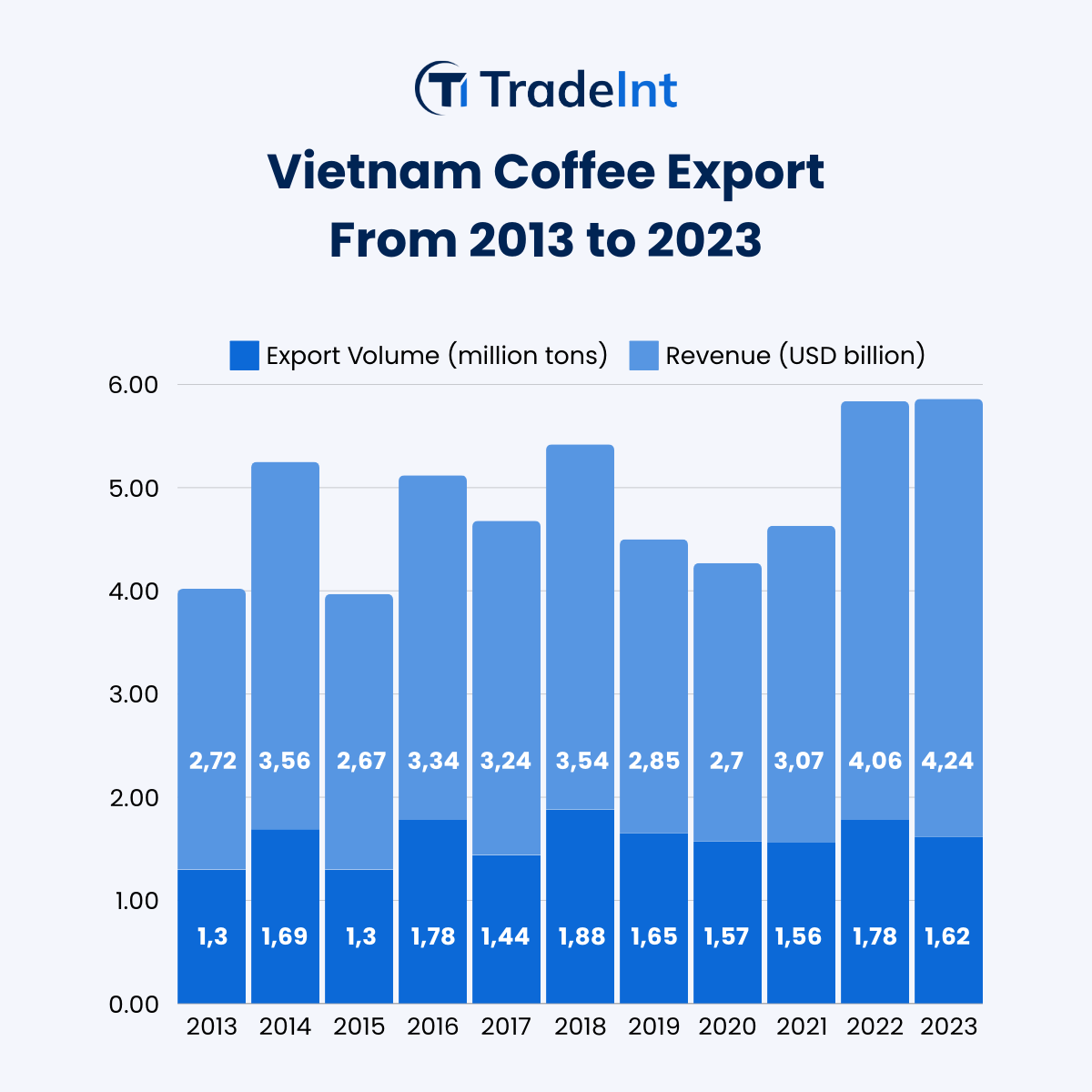
In 2023, the situation of Vietnam’s coffee import and export recorded many positive developments. Vietnam continues to maintain its position as the world’s second-largest coffee exporter, after Brazil. Total coffee export turnover reached 1.62 million tons, valued at USD 4.24 billion, down 8.7% in volume but up 4.6% in value compared to 2022. The average export price reached USD 2,614/ton, up 14.5% compared to the previous year, thanks to the price increase of Robusta coffee.
– Robusta coffee: Accounts for the largest proportion in the coffee export structure (78.5%), reaching USD 3.2 billion, up 2.8% compared to 2022. The average export price reached USD 2,253/ton, up 14% compared to 2022.
– Arabica coffee: Both volume and export prices decreased, by 32.8% and 9.3%, respectively.
– EU: Accounts for 35% of total coffee export volume, reaching USD 1.48 billion, slightly down 0.7% compared to 2022. Many markets in the EU achieved high growth rates, such as Denmark, the Netherlands, and Portugal.
– Japan: Reached USD 319 million, up 14.9%.
– China: Reached USD 152 million, up 10.3%.
– USA: Reached USD 293 million, down 4.1%.
– Russia: Reached USD 245 million, down 1.7%.
Additionally, some emerging markets like Indonesia, Algeria, Myanmar, and New Zealand also recorded significant growth compared to 2022.
Maintaining quality and enhancing trade promotion activities have helped Vietnamese coffee increase its value in the international market. Coffee export businesses need to continue improving production processes, meeting high-quality standards to expand the market and increase added value for coffee products.
In 2023, cashew nut exports reached 644 thousand tons, valued at USD 3.64 billion, up 24% in volume and 18.1% in value compared to 2022. W320, W240, and W180 cashew nuts accounted for the largest proportion in the export structure. The USA and China are the two largest import markets for Vietnamese cashew nuts, with turnovers of USD 886 million and USD 683 million, respectively.
Natural rubber exports in 2023 reached over 2.1 million tons, valued at USD 2.9 billion, slightly down 0.1% in volume and 12.8% in value compared to 2022. This decline was due to a 12.7% drop in the average export price. China continues to be the largest import market for Vietnamese natural rubber.
In 2023, cassava and cassava product exports reached 2.95 million tons, valued at USD 1.3 billion, down 9.1% in volume and 7.3% in value compared to the previous year. Cassava starch accounted for the largest proportion in the export structure, reaching USD 1.07 billion. China is the largest import market for cassava and cassava products.
Pepper exports in 2023 reached 266 thousand tons, valued at USD 910 million. Export volume increased by 16.3% compared to the previous year, but turnover decreased by 6.2%. Pepper exports to major markets decreased, except for Turkey, Saudi Arabia, and Australia.
Tea exports reached nearly 120 thousand tons, valued at over USD 208 million, down 18% in volume and 12% in value compared to 2022. Pakistan, Taiwan, and Russia are the three largest markets for Vietnamese tea. The Vietnamese tea industry faces many challenges and needs to diversify its markets, improve product quality, and enhance production linkage for sustainable development.
The year 2023 has shown the remarkable resilience and adaptability of Vietnam’s agricultural and seafood sectors. However, to maintain and promote growth in the future, the industry needs to focus on several key factors:
By leveraging opportunities and addressing challenges, Vietnam’s agricultural and seafood sectors have the potential for strong growth and significant contributions to the country’s economic development.
If you’re interested in exploring more about Vietnam Trade Data, you can visit the following links:
These links provide valuable insights into Indonesia’s export and import trends, helping you understand the country’s trade dynamics in depth.
To learn more about the topics discussed in this blog post, you can explore the following additional resources:
TradeInt is a global trade data platform and a distinguished leader in global trade solutions, delivering exceptional results for businesses worldwide. Focused on excellence, innovation, and client success, Trade Intelligence Global empowers businesses to thrive in today’s interconnected global economy. To find out more, visit https://tradeint.com.
Indonesia’s major exports include mineral fuels, oils, electrical machinery, textiles, and agricultural products like palm oil.
China, the United States, Japan, and Singapore are among Indonesia’s largest trading partners, facilitating significant export and import activities.
Challenges include high tariffs in key export markets, infrastructure deficiencies, regulatory complexities, and stiff competition from neighboring countries.
The pandemic initially disrupted supply chains and reduced global demand, but Indonesia saw recovery in sectors like electronics and agriculture as global markets stabilized.
Trade agreements, such as ASEAN agreements and bilateral deals with major economies, help Indonesia access markets with reduced tariffs and streamlined trade regulations.
Trade agreements, such as ASEAN agreements and bilateral deals with major economies, help Indonesia access markets with reduced tariffs and streamlined trade regulations.
Policies like the Omnibus Law on Job Creation aim to simplify regulations and attract foreign investment, potentially boosting trade and economic growth.
Indonesia’s strategic location in Southeast Asia positions it as a gateway to both ASEAN markets and global trade routes, enhancing its trade potential.
Resources like Trade International provide comprehensive data on Indonesia’s export-import trends, offering insights into historical data, current statistics, and data coverage across various sectors.
Emerging markets in Africa and the Middle East present opportunities for Indonesian exports, especially in sectors like renewable energy and digital services.
Explore the top 10 largest coffee-exporting countries in the world. See who leads the global market and how their exports shape international coffee trends.
Top largest producers of mushroom in world 2025: Vietnam (US$40.5M), Malaysia (US$30.4M), Indonesia (US$12.0M) lead global mushroom exports by TradeInt data.
Learn which is the largest beef export countries in the world 2025 & explore the key factors behind its dominance production, outlook, and global demand trends.
Brazil export coffee hit US$47.53 billion in 2025 from 8.76 billion kg of shipments. Explore TradeInt’s data-driven analysis on market trends, prices, & forecasts.
Find the answer to the question "India imports palm oil from which country?" and uncover India's outlook on importing this product from its key suppliers.
Discover the biggest palm oil exporting countries, their key export products, major destination markets, and the direction in which they are evolving.