Table of Contents
Overview of India's palm oil imports
India’s demand for palm oil remains consistently high, with 60% of its total consumption met through imports. In early 2025, India briefly turned to alternative oils. However, after five sluggish months, India imports palm oil surged again in April 2025. In May 2025, it imported 586.611 tons of palm oil, representing a 141.2% increase compared to April. Palm oil imports in June rose by more than 60% compared to May to reach 955,683 tons, the highest recorded since July 2024. This dramatic increase reflects a surge in demand due to the upcoming festive season and growing consumer demand.
In the coming months, palm oil imports in India are expected to remain high due to festive restocking demand. Another particular reason is that in July, palm oil is usually sold at a lower price compared to other types. This oil also has greater price competitiveness compared to other vegetable oils.
| Year | Soya bean | Sunflower | Rapeseed | Palm oil |
|---|---|---|---|---|
| 1980 | 48.5 | 5.3 | 9.9 | 1 |
| 2000 | 75.5 | 19.8 | 24.7 | 10 |
| 2023 | 139.7 | 28.2 | 41.5 | 26.9 |

To ensure a stable supply for the high local demand, the Indian government has maintained a reduced basic import duty of 10% on crude edible oils (including palm oil). The low import duty sustains the import flow and signals a more favorable export market for exporters.
Importing palm oil to India remains an exciting field with many opportunities. However, with shifting priorities and policies, it’s important to partner with a trusted importer for a sustainable deal.
👉 Looking for a palm oil importer in India? Check out TradeInt’s trade search records of active palm oil trading businesses.
Which top 5 countries India imports the most palm oil from in 2024?
According to TradeInt’s global trade database, in 2024, India’s top palm oil import partners in 2024 are predominantly Indonesia and Malaysia, which together account for over 84% of the total import market share.
Top 5 Palm Oil Import Partners in 2024
- Indonesia: 37% market share, valued at $5.159 billion.
- Malaysia: 39% market share, valued at $4.435 billion.
- Thailand: 07% market share, valued at $1.259 billion.
- Papua New Guinea: 12% market share, valued at $355 million.
- Philippines: 64% market share, valued at $73 million.
| Rank | Country | Share | Value (USD$ million) | Top 3 HS codes (6-digit) | Top 3 Export Companies |
|---|---|---|---|---|---|
| 1 | Indonesia | 45.37% | 5,159 |
|
|
| 2 | Malaysia | 39% | 4,435 |
|
|
| 3 | Thailand | 11.07% | 1,259 |
|
|
| 4 | Papua New Guinea | 3.12% | 355 |
|
|
| 5 | Philippines | 0.64% | 73 |
|
|
# Top 1: Indonesia -45.37%
How much palm oil does Indonesia export, and why does Indonesia export the most to India?
Indonesia’s palm oil exports to India had an import value of $6.66 billion in 2022. This value decreased to $5.43 billion in 2023 and $5.16 billion in 2024, before seeing a renewed demand in the first half of 2025 with an import value of $1.02 billion.
Indonesia exports the most palm oil to India because India is a major market and relies heavily on imported edible oils. Key factors driving this trend include India’s food processing industry demand, favorable Indonesian export policies, and bilateral trade facilitation between the two countries. These factors are balanced by issues like weather, global demand, and currency fluctuations.
| Year | Import Value (USD$ billion) | Key notes | Top 3 India Importing Companies |
|---|---|---|---|
| 2022 | $6.66 billion |
|
|
| 2023 | $5.43 billion |
|
|
| 2024 | $5.16 billion |
|
|
| H1 2025 | $1.02 billion |
|
Indonesia has been the dominant supplier for over a decade. In July 2025, India and Indonesia signed a landmark three-year memorandum of understanding (MoU) between the Indian Vegetable Oil Producers Association and the Indonesian Palm Oil Association.
This MoU includes:
- Technical exchange and R&D collaboration
- Promotion of certified sustainable palm oil
- Policy coordination and market intelligence sharing
- Commitments to food security and reliable supply
The pact aims to ensure a future-ready, predictable, mutually beneficial supply chain, thus acting as a stabilizing incentive for bilateral trade
However, Indonesia raised its CPO export duties to 10% (from 7.5%) in mid-2025 to support domestic biofuel and replanting programs. This raised export duty can diminish the price competitiveness of Indonesia’s palm oil exports compared to those from Malaysia in India.
Indonesia leads the global palm oil market, but its export volume of palm oil products in 2024 was 29.54 million tons, a decline of 8.3% from the previous year, accroding to the Indonesian Palm Oil Association (GAPKI).
For full insights on the global top palm oil exporters: Top 5 Global Palm Oil Exporting Countries in H1 2025
# Top 2: Malaysia - 39%
How much USD worth of palm oil does Malaysia export to the world throughout 2024?
As the world’s second-largest palm oil producer, Malaysia continues to be a crucial source for India import of palm oil, ranking second. Its output reached 192.97 million kilograms worth approximately USD 4.43 billion in 2024, according to TradeInt’s global trade database, accounting for 24% of global production.
| Month | Value |
|---|---|
| 2024 January | 445.67 |
| 2024 February | 220.91 |
| 2024 March | 245.17 |
| 2024 April | 327.27 |
| 2024 May | 320.35 |
| 2024 June | 440.88 |
| 2024 July | 434.16 |
| 2024 August | 🔒 Schedule a free demo to unlock full trade records |
| 2024 September | 🔒 Schedule a free demo to unlock full trade records |
| 2024 October | 🔒 Schedule a free demo to unlock full trade records |
| 2024 November | 🔒 Schedule a free demo to unlock full trade records |
| 2024 December | 🔒 Schedule a free demo to unlock full trade records |
Malaysia’s share in Indian palm oil imports rose from 30% in 2023 to 35% in H1 2025. This upward trend is supported by bilateral collaboration between the two countries and Malaysia’s ability to match market preferences:
- Bilateral collaboration: In 2025, the Malaysian Palm Oil Council (MPOC) signed a collaboration agreement with the Indian Vegetable Oil Producers’ Association (IVPA). This agreement promotes the nutritional and sustainability profile of Malaysian palm oil and aims to boost mutually beneficial trade and cooperation
- Market preference: Indian refiners prefer Malaysian refined and fractionated palm oil products for their consistency and quality
The demand from key sectors like FMCG and food service continues to drive palm oil imports, especially during India’s festive periods. Despite facing stiff competition from Indonesia, Malaysia benefits from lower export levies (around $140/MT compared to Indonesia’s $221/MT) and more aggressive sustainability practices, especially in markets like the EU.
However, in the future, India aims to reduce dependence on imports for palm oil by boosting local production, which creates a daunting challenge for exporters from Malaysia.
With Malaysia's total palm oil export revenue reaching over RM94 billion in 2023, many businesses simply focus on the headline figure. But do you know which specific products are truly dominating this massive market and driving demand?
You may read: Malaysia Top 7 Palm Oil Export Products Worldwide
# Top 3: Thailand - 11.07%
With a share of over 11%, Thailand is the third-biggest supplier of palm oil to India in 2024, trailing Indonesia and Malaysia.
The outlook for 2025 remains positive for continued trade, with Thailand benefiting from India’s strong palm oil demand and a competitive trade environment. Thailand has proven to be a reliable alternative as Indonesia’s prices increase due to CPO export duties, and Malaysia faces occasional volume constraints during seasonal fluctuations.
Although Indonesia and Malaysia remain dominant suppliers, Thailand’s role as a secondary supplier is growing.
# Top 4: Papua New Guinea - 3.12%
Papua New Guinea was the fourth-biggest supplier for India’s palm oil imports.
According to the USDA, Papua New Guinea is among the world’s top 10 biggest producers of palm oil, with 2024/2025 production reaching 830,000 tons. Despite having a smaller share, it has the potential to gradually become a key supplier of palm oil to match India’s high demand, as its palm oil yields, despite certain fluctuations, have seen an upward trajectory (According to the US Department of Agriculture)
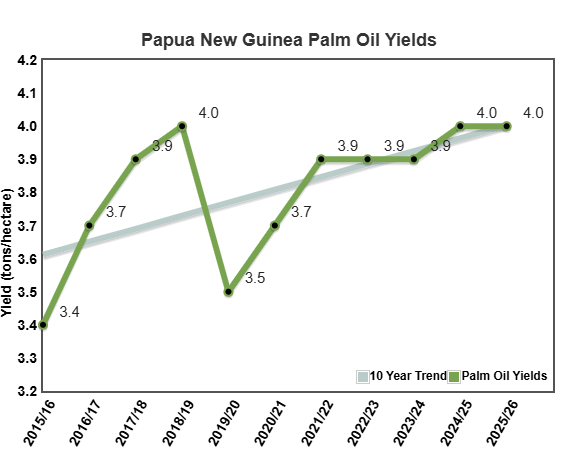
The market potential for Papua New Guinea palm oil in India remains strong, supported by India’s position as the world’s largest palm oil importer and growing demand in its food processing and FMCG sectors. India’s favorable import duty also paves the way for suppliers from Papua New Guinea.
# Top 5: Philippines - 0.64%
The Philippines finished 5th among the top countries that India imports palm oil from. It has a much more moderate market share in exporting palm oil to India, at 0.64%, valued at nearly $73 million.
India’s imports of palm oil from the Philippines saw a rebound starting in 2022, after a downward trajectory during earlier years.
| Year | Export value (USD Million) |
|---|---|
| 2021 | 6.526 |
| 2022 | 21.835 |
| 2023 | 39.380 |
| 2024 | 72.935 |
The potential for expanding India’s import of palm oil from the Philippines is rather moderate due to its limited supply. The Philippines itself has restricted palm oil production: around 100,000 tons in 2024/2025, and ranked 19th in terms of palm oil production. Almost all domestically produced palm oil serves local demand, and the country itself relies on imports.
Therefore, the most prominent challenge is supply fluctuations, driven by its dependence on imported raw materials for palm oil processing and competition from larger suppliers like Indonesia and Malaysia.
How to craft the perfect palm oil import strategy with TradeInt?
The global palm oil market, including India’s imports, remains highly volatile due to shifting policies, market dynamics, and seasonal supply fluctuations. Therefore, the strategy to navigate the question of “India imports palm oil from which country” involves more than just volume. Price trends, seasonal changes, government policies, and bilateral cooperation all shape the strategy.
Global volatility in the palm oil sector requires businesses to stay adaptive and well-informed. From pricing shifts to regulatory adjustments, having access to updated and helpful insights is critical.
TradeInt empowers palm oil importers in India to:
- Track trade flows and supplier performance
- Analyze pricing trends and duties
- Identify new market niches and opportunities
With updated trade records and insightful analysis, TradeInt helps you make smarter, data-driven decisions in one of the world’s most dynamic commodities markets.