As global supply chains realign and emerging economies assert new priorities, Indonesia export to India is entering a pivotal chapter. Despite a 14.54% decline in Indonesian exports to India in Q1 2025, a dip shaped by regulatory shifts and commodity price pressures, the core architecture of this trade relationship remains structurally sound.
What matters now is not just what Indonesia exports, but how its evolving trade strategy intersects with India’s demand for energy, infrastructure inputs, and industrial resilience.
This deep dive by TradeInt unpacks the top-performing product groups, key demand drivers, and emerging shifts to watch in one of Asia’s most strategically aligned trade corridors.
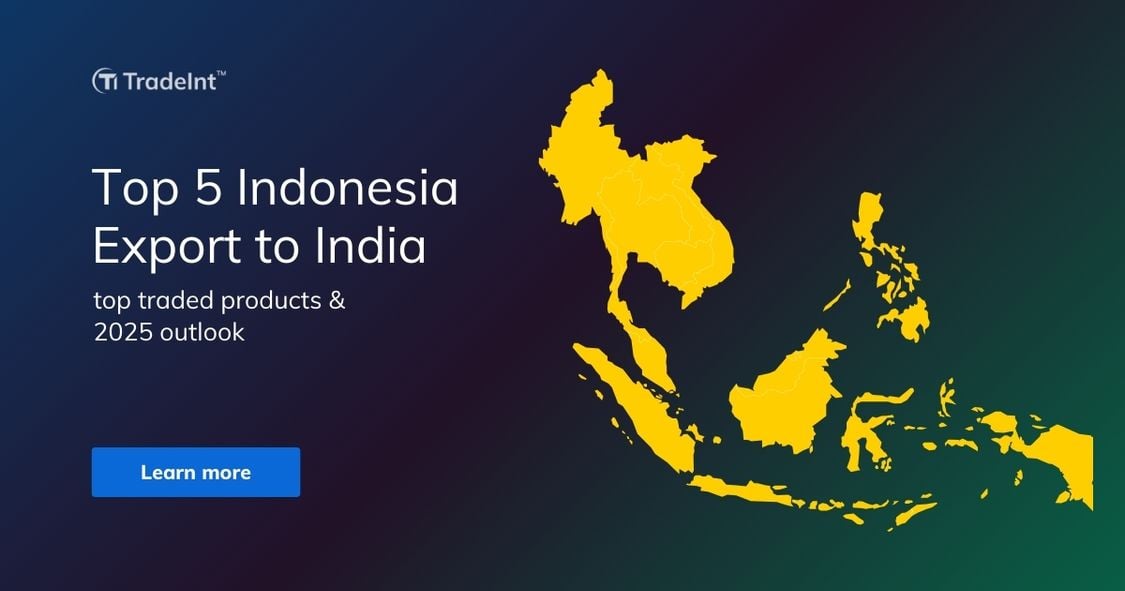
What are the top 5 Indonesia export to India by product category in Q1 2025?
In Q1 2025, the top 5 Indonesia exports to India were led by coal briquettes (30.74%), followed by palm oil (19.22%), stainless steel (4.87%), copper ore and concentrate (4.78%), and jewelry including gold and silverware (4.24%). Coal remained the largest export despite softer demand as India expanded local output, while palm oil shipments rebounded with tariffs reductions and rising Indian demand.
Top 5 Indonesia export to India in Q1 2025:
- Coal briquettes – 30.74% (largest share, though pressured by oversupply and falling prices)
- Palm Oil – 19.22% (rebounded with price competitiveness and tariff cuts)
- Stainless steel – 4.87 (grew as Indian demand outpaced local production)
- Copper ore and concentrate – 4.78% (expected decline due to Indonesia’s processing ban)
- Jewelry, gold, silverware – 4.24% (stable demand from India’s jewelry industry and consumer market)
#Top 1 Export: Coal and briquettes (30.74%) - Indonesia’s Energy Leverage
Coal remains Indonesia’s largest export to India, with $6.327 billion in trade value in 2024, making up 30.74% of total exports. But 2025 brought a structural test: an 11-million-ton YoY drop in exports triggered by India’s domestic coal push and Indonesia’s introduction of a minimum reference price (HBA), pegged at ~$128/ton, well above the global benchmark.
Why it still matters:
- Thermal coal fuels over 50% of India’s electricity grid, and Indonesian grades remain among the most adaptable to Indian furnace specs.
- Heavy industry: Coal supports steel and cement production across India’s vast infrastructure landscape.
Due to the high export volume, there is a large number of companies specializing in importing coal and briquettes from Indonesia into India.
👉🏻 If you are looking for a list of import partners with proven experience, try using TradeInt’s Global Trade Search tool
2025 developments:
- In Q1 2025, coal exports dropped by 11 million tons YoY due to new regulations.
- Indonesia introduced a minimum reference price (HBA) for coal in March 2025 (~$128/ton), while global benchmark prices such as Newcastle coal fell to ~$105/ton.
- India reduced coal imports from Indonesia by 15% (6 million tons) between January–April 2025, partly due to its push for domestic coal self-sufficiency.
Outlook: Despite these short-term headwinds, coal remains integral to India’s industrial roadmap. Indonesia continues to dominate India’s thermal coal imports, although competition from cheaper markets like Australia and domestic Indian production may pressure volumes.
#Top 2 Export: Palm Oil (19.22%) - Meeting India's Food Security and Biofuel Needs
Palm oil, Indonesia’s second-largest export to India (19.22%), sits at the crossroads of food policy and clean energy transition. India imports 23–25 million tons annually, with palm oil accounting for over a third of its edible oil consumption.
Sector penetration:
- F&B: Vital in processed food, snacks, instant noodles, and fried products.
- Retail: Staple cooking oil across Indian households.
- Personal care: Soaps, lotions, cosmetics.
- Biofuels: Gaining ground in India’s renewable energy policies.
2025 Challenges and Projections:
- Indonesia is prioritizing domestic consumption through biodiesel blending mandates (B40 in 2025).
- Palm oil export growth is expected to remain modest: from 23M tons (2024/25) to 24M tons (2025/26).
While export volumes may not surge, consistent demand from India’s food processing, retail, and biofuel sectors will continue to anchor palm oil as a strategic export commodity.
India’s robust demand for palm oil has been evident in its steadily rising
💡 If you’re only seeing surface stability, or you’re curious how demand is quietly reshaping trade, you may want to explore India’s palm oil import export trend here.
#Top 3 Export: Stainless steel (4.87%) - Infrastructure-Grade Trade
With India’s industrial ambitions expanding, stainless steel has become a quiet powerhouse in bilateral trade, $6B+ of annual demand and counting. Indonesia’s stainless steel exports (4.87% share) are strategically placed to serve that need.
Use cases across industries:
- Construction: Stainless steel is used in building facades, fixtures, and infrastructure projects.
- Automotive: Components and parts manufacturing depend on stainless steel alloys.
- Consumer electronics and machinery: High-quality steel inputs for durable goods and industrial machinery.
Which countries are directly competing with Indonesia in the export of stainless steel to India?
🔍 Find out with TradeInt’s global trade record database on India’s steel import landscape
Supply-Side advantage:
- Indonesia’s JV with POSCO will raise steel capacity to over 6M tons/year by 2026.
- The IMIP Group’s $56.9B investment solidifies Indonesia as a long-term stainless steel hub.
- Foreign direct investment is encouraged via 50–100% tax exemptions for investors over $33M.
Outlook: Indonesia’s stainless steel capacity growth will help supply India’s construction boom, while also enabling more value-added downstream products in future trade.
#Top 4 Export: Copper ore and concentrate (4.78%) - Fueling India’s Electrification Ambitions
Copper’s role in India’s clean energy transition, from solar panels to electric motors, cannot be overstated. With 4.78% of exports from Indonesia focused on copper ore and concentrate, this segment is both strategically important and geopolitically sensitive.
Sectors driving demand in India:
- Electronics: Motors, transformers, circuit boards.
- Construction: Plumbing, HVAC, roofing.
- Renewables: Wind and solar infrastructure.
Due to this policy, companies trading this product may encounter significant challenges in expanding their businesses.
💡 Schedule a free demo consultation with our trade experts to learn how to leverage an advanced trade intelligence platform, and businesses can adapt and grow their market share.
2025 Policy Disruption:
- Indonesia’s push for mineral downstreaming led to export restrictions on unprocessed ores.
- Temporary export quotas have been granted to producers like Freeport, but long-term consistency remains uncertain.
Indian Demand Pillars:
- Electrical grid upgrades and renewables.
- Urban housing and EV infrastructure.
Future outlook:
Copper will remain essential to India’s energy and infrastructure growth. TradeInt recommends monitoring policy adjustments and developing partnerships with Indonesian producers investing in domestic smelting.
#Top 5 Export: Jewelry, gold, and silverware (4.24%) - High-Margin, High-Growth Potential
The last major product category in Indonesia export to India is precious metals and jewelry, particularly gold and silver items. This group ranked fifth with a notable value of $0.860 billion, representing over 4.2% of the total figure.
Despite its rather moderate share, this category supports India’s development as one of the world’s leading hubs for jewelry manufacturing. Indonesia is expected to have the fastest compound annual growth rate (CAGR) in its jewelry market between 2023 and 2028. This growth rate is projected to outpace that of larger economies like China and the United States, even though Indonesia had the smallest jewelry market among the three in 2023.
The positive outlook and predicted strong growth of India’s jewelry industry is likely to drive the upward trajectory of Indonesia’s export value and volume in this category.
India jewelry industry - Market size and CAGR compared to China and the U.S.
Growth factors for Indonesian exports:
- Rising domestic jewelery output
- Competitive pricing and design innovation
- Strong demand from Indian wholesalers and jewelry exporters.
Outlook: Indonesia’s value added exports in this sector, especially processed, branded and design forward items, are expected to grow in tandem with India’s global positioning in jewelry production.

TradeInt is a global trade data platform providing access to over 10 billion verified import and export records. Its coverage spans over 200 countries and more than 80 customs data sources.
This article provides a snapshot of Indonesia’s exports to India. Use TradeInt to explore more detailed trade records and continue tracking this market as new data becomes available. Search Indonesia India export records →
Beyond Volumes: The 2025 Trade Equation
Q1 2025’s 14.54% dip in exports tells a short-term story. The long-term narrative is the alignment between Indonesia’s value-added export ambitions and India’s multi-sector demand.
What’s shaping this corridor:
- Resource complementarity: Indonesia supplies what India builds on, from coal to copper to CPG-grade palm oil.
- Policy convergence: Both nations are doubling down on manufacturing, infrastructure, and clean energy.
Bilateral intent: The $50B trade target by end-2025 is not just rhetoric. It’s already shaping investment and supply chain choices.
Why is Trade Intelligence becoming Essential?
In a volatile global economy, staying informed on trade flow shifts, tariffs changes, pricing trends, and active suppliers/importers can mean the difference between capturing or losing market share.
With TradeInt, you will get:
- HS-code level insights by quarter
- Real-world global trade tracking of policy-sensitive commodities
- Active company-level trae insights and intelligence
- Eporter/importer list generation from verified import export records
- Performance and pricing benchmarks