Importers of rice in USA: Who imports rice to the USA?
Top importers of rice in USA Q1 2026 are: DAESANG AMERICA (16.04%), MAPEI CARIBE (11.03%) lead. South Korea, Thailand, India anchor origins. TradeInt analysis.

The main imports of Malaysia are electronic integrated circuits (HS 8542) at US$22.19 billion, refined petroleum oils (HS 2710) at US$5.63 billion, and automatic data processing machines (HS 8471) at US$3.04 billion, based on TradeInt's records.
Furthermore, smartphones, computer parts, crude petroleum, gold, semiconductor devices, semiconductor-making machinery, and gas turbines complete the top of Malaysia's import products list.
Top 5 main imports of Malaysia in Q1 2026:
| Rank | 4-Digit HS Code | Product Name | Value (US$) | Value % | Top Importer in Malaysia |
|---|---|---|---|---|---|
| 1 | 8542 | Electronic integrated circuits and microassemblies used in electronic components. | $22,185,214,950 | 24.22% | INTEL TECHNOLOGY SDN BHD |
| 2 | 2710 | Refined petroleum oils and preparations obtained from bituminous minerals, other than crude. | $5,632,245,173 | 6.15% | SHELL MALAYSIA TRADING SDN BHD |
| 3 | 8471 | Automatic data processing machines, magnetic or optical readers, and components thereof. | $3,042,931,845 | 3.32% | BYTEDANCE SYSTEM SDN BHD |
| 4 | 8517 | Telephone sets, smartphones, and other apparatus for transmitting or receiving voice/data. | $3,028,978,101 | 3.31% | APPLE MALAYSIA SDN BHD |
| 5 | 8473 | Parts and accessories suitable for use solely with computers and office machinery. | $2,163,734,263 | 2.36% | DELL GLOBAL BUSINESS CENTER SDN BHD |
| 6 | 2709 | Petroleum oils and oils obtained from bituminous minerals, crude. | $1,833,763,656 | 2.00% | PENGERANG REFINING COMPANY SDN BHD |
| 7 | 7108 | Gold, unwrought or in semi-manufactured forms, or in powder form. | $1,771,200,710 | 1.93% | MKS PAMP MALAYSIA SDN BHD |
| 8 | 8541 | Semiconductor devices, transistors, photosensitive semiconductor devices, light-emitting diodes, and crystals. | $1,337,657,242 | 1.46% | PACTECH ASIA SDN BHD |
| 9 | 8486 | Machines and apparatus used principally for the manufacture of semiconductor devices. | $1,274,453,966 | 1.39% | LAM RESEARCH INTERNATIONAL SDN BHD |
| 10 | 8411 | Turbojets, turbopropellers, and other gas turbines, and parts thereof. | $1,055,596,294 | 1.15% | GE ENGINE SERVICES MALAYSIA SDN BHD |
Data Source: Official TradeInt Malaysia Import Data and Bill of Lading Database
Period: January-March 2026
TradeInt is a global trade data platform providing access to over 10 billion verified import and export records. Its coverage spans over 200 countries and more than 80 customs data sources.
This article provides an overview of Malaysia’s imports. Use TradeInt to explore more detailed trade records and continue tracking this market as new data becomes available. Search Malaysia import records →
Browse transaction-date Bill of Lading entries for Malaysia's largest import, electronic integrated circuits (HS 8542), with past supplier names and shipments on TradeInt's global trade database.
Access here: Verified historical Malaysia HS 8542 import shipment records
Malaysia brings in chips and wafers, packages and tests them, then re-exports the finished product. That is why the same product line tops both sides of its trade.
According to The Malaysian Reserve citing DOSM, Malaysia's electrical and electronics manufacturing expanded 15.6% year-on-year in early 2026 on sustained global semiconductor demand, which directly lifts the chip and component imports that feed those plants.
China is the largest importer to Malaysia at US$23.48 billion, followed by Singapore at US$10.60 billion and Taiwan at US$9.56 billion in Q1 2026, according to TradeInt's Malaysia Import Data and Bill of Lading database.
The United States, South Korea, Japan, Indonesia, Thailand, Vietnam, and Australia complete the top ten source countries supplying Malaysia, from TradeInt's records.
Top 5 importers of Malaysia in Q1 2026:
| Rank | Country | Value (US$) | Value % | Top 4-Digit HS Code Imported | Top Supplier |
|---|---|---|---|---|---|
| 1 | China | $23,484,440,309 | 25.63% | 1. 8542 | MICRON SEMICONDUCTOR XIAN CO LTD |
| 2 | Singapore | $10,597,583,887 | 11.57% | 1. 8542 | MICRON SEMI ASIA OPS PTE LTD |
| 3 | Taiwan, China | $9,557,380,255 | 10.43% | 1. 8542 | MICRON SEMICONDUCTOR XIAN CO LTD |
| 4 | United States | $6,570,208,629 | 7.17% | 1. 8542 | INTEL CORPORATION |
| 5 | South Korea | $4,955,894,275 | 5.41% | 1. 8542 | AMKOR TECHNOLOGY KOREA INC |
| 6 | Japan | $4,241,932,705 | 4.63% | 1. 8542 | SANDISK TECHNOLOGIES INC |
| 7 | Indonesia | $3,530,640,433 | 3.85% | 1. 3823 | PT KLK DUMAI |
| 8 | Thailand | $3,432,851,759 | 3.75% | 1. 8542 | TECHMAN ELECTRONICS THAILAND CO LTD |
| 9 | Vietnam | $2,708,128,105 | 2.96% | 1. 8517 | WELLWIDE INTERNATIONAL HOLDING LIMITED |
| 10 | Australia | $1,960,517,914 | 2.14% | 1. 2711 | GLNG OPERATIONS PTY LTD |
Data Source: Official TradeInt Malaysia Import Data and Bill of Lading Database
Period: January-March 2026
✔ Lite ✔ Pro ✔ Premium ✔ Enterprise
TradeInt is a global trade data platform covering 200+ countries and 80+ customs sources.Learn about TradeInt →
Malaysia's 2025 external trade hit $646.3 billion (RM3.061 trillion), crossing RM3T for the first time, up 6.3% year-over-year. Exports of $338.4 billion beat imports of $307.9 billion. The milestone signals a structurally larger trade economy, with trade-to-GDP among ASEAN's highest, rivaling Belgium's GDP scale.
Read more: Malaysia Trade Data 2025 | Malaysia Import Export Statistics
From Malay Mail citing DOSM, China drove the single largest share of Malaysia's May 2026 import rise at RM11.3 billion, well ahead of Singapore (RM5.6 billion) and Taiwan (RM3.7 billion), the same top three seen in the quarterly partner table.
The same release notes that geopolitical tensions in West Asia weighed on some consumer-goods imports, a reminder that partner concentration leaves the basket exposed to regional shocks beyond Asia.
Here are some worth-noting highlights of Malaysia's export partners:
Malaysia's tracked import value moved through a full cycle across 2025 before easing into early 2026, according to TradeInt's trade trends analysis. Malaysia's quarterly import value peaked in Q2 2025 at US$170.51 billion, a 12.50% quarter-on-quarter gain, then stepped down to US$125.03 billion in Q4 2025 and US$91.61 billion in Q1 2026.
| Timeline | Value (US$) | QoQ % | Description |
|---|---|---|---|
| Q1 2025 | $151.57B | -3.96% | Moderate contraction tracking slightly lower contract values during February. |
| Q2 2025 | $170.51B | 12.50% | Significant double-digit expansion driven by sharp import increases in April and May. |
| Q3 2025 | $170.27B | -0.14% | Minimal sequential cooling stabilizing near preceding quarterly trade performance levels. |
| Q4 2025 | $125.03B | -26.57% | Sharp downturn reflecting severe import value contractions across November and December. |
| Q1 2026 | $91.61B | -26.73% | Continued contraction tracking lower inbound asset volumes into the new fiscal year. |
Data Source: Official TradeInt Malaysia Import Data and Bill of Lading Database
Period: January-December 2025, January-March 2026
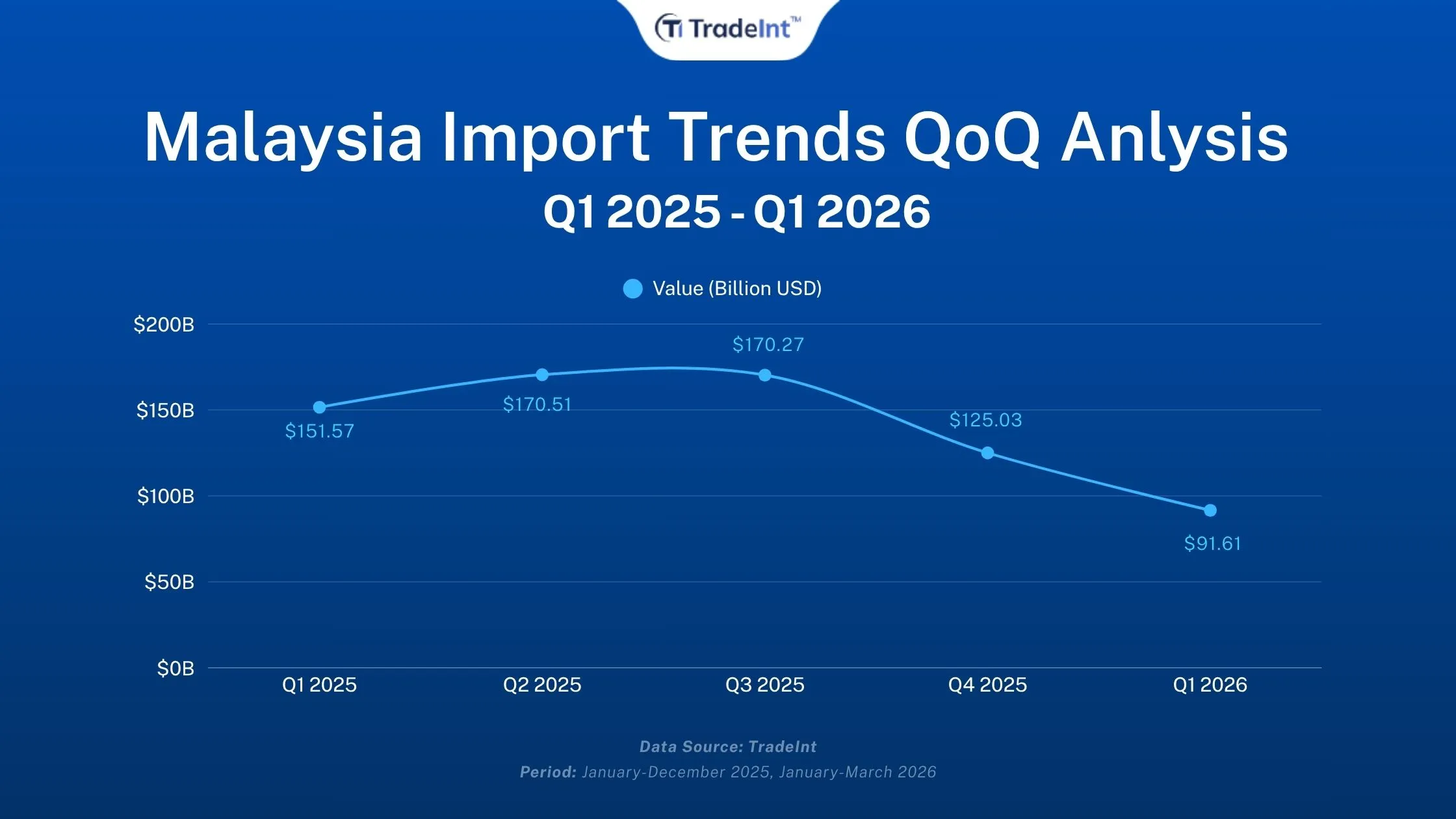
Malaysia Import Trends QoQ Analysis from 2025-2026
Observation: Malaysia's total import value increased to the highest in Q3 2025, then slowly dropped to Q1 2026
According to the Department of Statistics Malaysia's April 2026 release (DOSM), Malaysia's imports rose 20.0% year-on-year to RM154.0 billion (~US$37.6B) in April 2026, and the May 2026 release showed imports up 14.1% to RM143.6 billion (~US$35.0B). What stands out is the split by end use.
Reading Malaysia's 2026 import market through the official breakdown, three structural signals stand out:
At the state level, reporting from The Star shows Penang led Malaysia for both imports and exports in May 2026, the clearest sign that the country's import demand is concentrated where its semiconductor plants sit, as total trade reached RM327.6 billion (~US$79.9B).
✔ Lite ✔ Pro ✔ Premium ✔ Enterprise
TradeInt is a global trade data platform covering 200+ countries and 80+ customs sources.Learn about TradeInt →
Follow how Malaysia's inbound trade moved in the past with top HS codes, partners, and shipment records in TradeInt's Malaysia import overview.
Explore now: Malaysia import-export trade statistics overview by HS code and year
You can use Malaysia import data on TradeInt to find export opportunities by identifying which Malaysian companies regularly buy a given product, then approaching them directly as potential customers before your competitors do. TradeInt turns customs and shipment records into a targeted list of active buyers instead of a cold-outreach guessing game.
Here is a simple way to use TradeInt's Malaysia import data to find export opportunities:
TradeInt's import-export database holds customs shipment records, company trade activity, and cross-border transaction history. Exporters can use it to identify active buyers, benchmark existing suppliers, and prioritize prospects by shipment volume and frequency.
For the full list of fields and coverage, see TradeInt's trade data availability.
Malaysia's import data for Q1 2026 shows a market built on electronics and energy. Electronic integrated circuits lead at US$22.19 billion, ahead of refined petroleum oils at US$5.63 billion and data processing machines at US$3.04 billion, according to TradeInt's Malaysia import data. China is the largest partner at US$23.48 billion, followed by Singapore and Taiwan.
The wider picture is one of solid annual growth and shifting product rules. DOSM's May 2026 figures show imports up 14.1% year-on-year, while new electric-vehicle rules and steady oil, gas, and food inflows reshape parts of the basket heading through 2026.
Book a demo with TradeInt to access Malaysia trade data in detail.
Malaysia's customs authority restricts or prohibits goods such as illegal drugs, counterfeit items, and selected controlled products. These prohibition rules sit outside trade-data reporting and are set by Malaysian customs, so importers should check the official lists before shipping into the country.
Yes, Malaysia exports more than it imports and runs a steady trade surplus. According to DOSM, Malaysia's exports reached RM182.7 billion (~US$44.6B) against imports of RM154.0 billion (~US$37.6B) in April 2026, producing a trade surplus of RM28.8 billion (~US$7.0B).
The largest import item in Malaysia is electronic integrated circuits (HS 8542), valued at US$22.19 billion and making up 24.22% of tracked imports in Q1 2026, based on TradeInt's records. These chips feed the country's semiconductor assembly and testing plants.
Malaysia imports rice mainly from regional Asian suppliers to top up domestic production. Rice sits within agricultural imports, which DOSM reported at 4.4% of Malaysia's total imports in May 2026, a far smaller share than its electronics and energy purchases.
Malaysia imports both crude and refined oil. Crude petroleum reached US$1.83 billion in Q1 2026, drawn in by refiners such as Pengerang Refining Company, while Australia supplies petroleum gases as a top energy line, based on TradeInt's records.
Top importers of rice in USA Q1 2026 are: DAESANG AMERICA (16.04%), MAPEI CARIBE (11.03%) lead. South Korea, Thailand, India anchor origins. TradeInt analysis.
TradeInt: Coal imports in Pakistan 2026 show South Africa first at US$475.19 million, ahead of Indonesia at US$59.77 million, with bituminous coal at 93.83%.
Turkey import data for Q1 2026 shows crude petroleum leading at US$9.82B, gold at US$5.60B, and cars at US$4.19B, with China the top import partner, TradeInt.
Which countries does India import petrol from? South Korea (21.96%), UAE (12.81%), Russia (11.41%), New Zealand (8.70%) lead Q1 2026, from TradeInt's data.
TradeInt trade data: Importers of garments in USA Q1 2026 led by EFL CONTAINER LINES, IMPERATIVE LOGISTICS and GILDAN; China and Vietnam top origins.
Where does Japan oil import from in 2026? The US leads in recorded crude imports at US$2.00 billion, ahead of Mexico at US$0.27 billion under HS 2709.