Turkey Russia Oil Imports in 2026 Q1: Russia's Declared Energy Value Falls 32.2% While $7.27B Moves Off the Origin Map
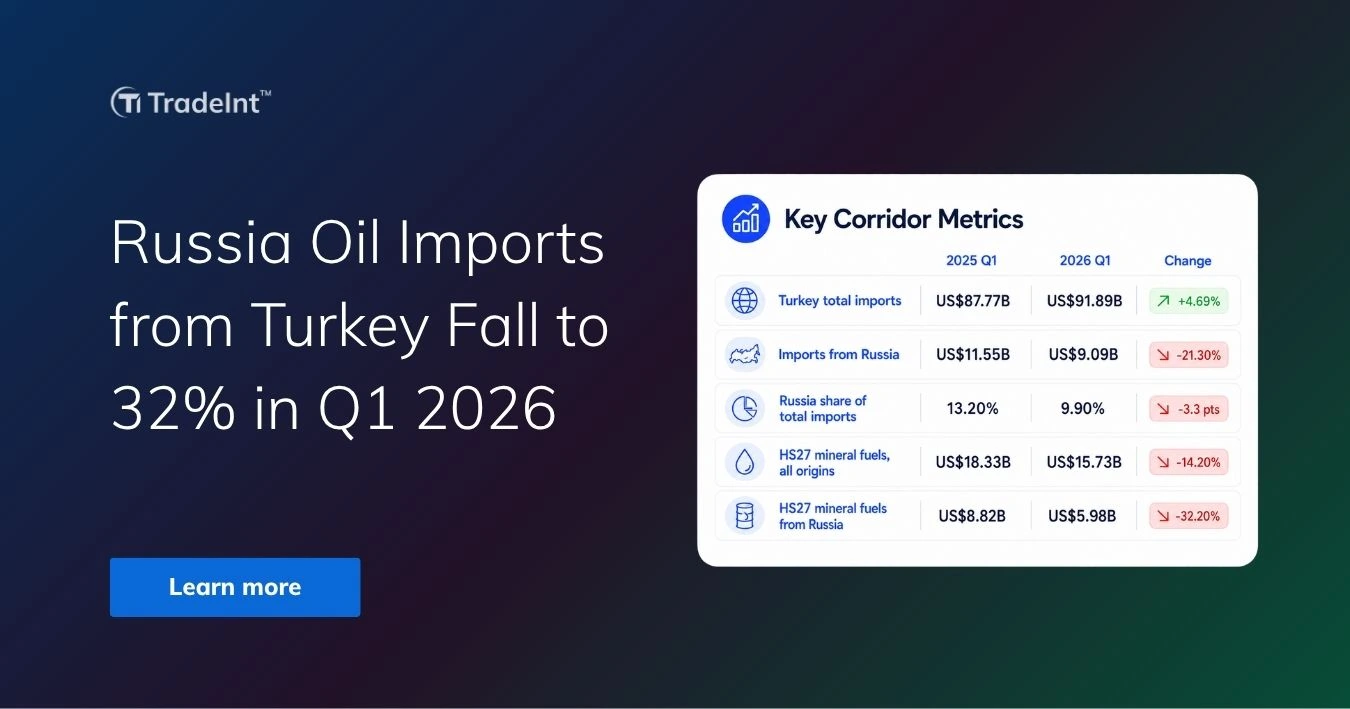
Two things happened to Turkey's energy ledger in the year to March 2026, and only one of them made the news. The reported story is declining. According to TradeInt's global trade database, Turkey's mineral-fuel imports from Russia fell from $8.82 billion in 2025 Q1 to $5.98 billion in 2026 Q1, a 32.2% drop in declared value. The unreported story is displacement of a different kind. Turkey's unspecified-origin import bucket, meaning customs declarations filed without a named source country, reached $7.32 billion in the same quarter, and $7.27 billion of it sits inside the energy chapter. Anonymous energy is now 46.3% of Turkey's mineral-fuel imports, larger than Russia's named 38.0%. Read together, the two lines say Turkey's celebrated "diversification" runs on two tracks at once: genuinely new supply corridors, and a migration of existing flows off the origin map.
Why Turkey's 4.69% import growth conceals a 21.3% fall in Russian trade
Nothing in Turkey's headline numbers signals a rupture. Total imports grew 4.69% year over year to $91.89 billion in 2026 Q1. The rupture appears one level down: imports from Russia fell 21.3%, from $11.55 billion to $9.09 billion, cutting Russia's share of total imports from 13.2% to 9.9%. That is the single largest absolute move among Turkey's roughly 209 import origins this quarter. Russia held the number-one supplier position as recently as 2024 Q1; China has since taken it and extended the lead, while the United States rose 18.2% and Switzerland 44.8%.
For an analyst benchmarking Turkey on aggregate figures, the lesson is that the total tells you nothing: a $2.46 billion corridor break was fully absorbed by other suppliers.
How much Russian crude and fuel does Turkey still import in 2026?
Still a great deal: the break is severe but not an exit. Drill into HS chapter 27, covering crude oil, refined products, gas, and coal, and Russia's decline is entirely an energy event: its non-energy sales, roughly $3.1 billion for the quarter, were essentially flat, while the energy line alone fell $2.84 billion. Even after a one-third fall, Russia's $5.98 billion remains the largest named origin in the chapter.
For a fuel trader or refiner, the operative point is that the whole chapter shrank 14.2%, so Russia lost ground in a contracting market, a harsher signal than losing share in a growing one.
Sourced from www.tradeint.com | Period: 2026 Q1 vs 2025 Q1 | HS code range: 27

TradeInt is a global trade data platform providing access to over 10 billion verified import and export records. Its coverage spans over 200 countries and more than 80 customs data sources.
This article provides an overview of Turkey’s oil imports from Russia. Use TradeInt to explore more detailed trade records and continue tracking this market as new data becomes available. Search Turkey oil import records →
Turkey Trade Data: Import and Export Country Profile Overview on TradeInt
Turkey imported US$91.89 billion in 2026 Q1 alone, up 4.69% year over year, across roughly 209 declared origins. Explore corridor-level values for every supplier and HS chapter.
Read more: Turkey Trade Data by Country
Who supplies Turkey's oil now? Kazakhstan rises while an unspecified origin overtakes Russia
The replacement flows split into two categories that deserve very different treatment in a sourcing model. The first is named and auditable: Kazakhstan, Turkey's fastest-growing top-20 supplier at +79.6% year over year. Its energy line was steady rather than spectacular, $318 million within HS27, up 7.5%, with most of the rise coming from a new precious-metal corridor. A buyer can underwrite Kazakhstan: the origin is declared, the trend is evident, and shipping reports corroborate Turkish refiners' bookings of Kazakh barrels.
The second category cannot be underwritten, and it is now the bigger one. The unspecified-origin bucket stood at $7.32 billion in 2026 Q1, 99.4% of it was energy. It has grown 57.3% in two years, and within the energy chapter, it now outweighs every named country, Russia included. Whoever supplies Turkey's oil, a growing share of the answer is recorded as no one in particular.
The commercial takeaway: a supplier-concentration analysis counting only named origins shows diversification, while the same analysis treating the anonymous bucket as a line item shows risk migrating from a known counterparty into an unknowable one.
Is Turkey's diversification from Russian crude real, or partly an accounting migration?
Both, and the data lets us say where each reading holds. The physical rerouting is real: the Centre for Research on Energy and Clean Air still ranked Turkey among the top three importers of Russian fossil fuels in May 2026, but tracked its Russian crude purchases falling steeply, and Reuters-reported shipping data covered by Turkish Minute showed TÜPRAŞ and the STAR refinery cutting Russian crude to the lowest level since the invasion of Ukraine while booking cargoes from Iraq, Kazakhstan, Brazil and Angola.
The accounting migration is equally visible, just less discussed. Azerbaijan's named energy line collapsed from $183.8 million to $3.0 million, a 98.4% fall, and Turkmenistan's imports dropped 67%, in the same window in which the anonymous bucket swelled. Read literally, two corridors died; read together, both look like probable reclassification artifacts, flows moving into the unspecified category rather than out of Turkey's ports.
TradeInt's records cannot confirm that mapping, so neither "collapse" should be traded on as a real supply event. Still, as sanctions pressure rises, the origin field itself becomes strategic. With the EU's ban on fuels refined from Russian crude in force since the end of January 2026, provenance is effectively part of the product, and a 46.3%-anonymous feedstock chapter is a due diligence problem, not a footnote.
✔ Lite ✔ Pro ✔ Premium ✔ EnterpriseTradeInt is a global trade data platform covering 200+ countries and 80+ customs sources. Learn about TradeInt →
Turkey Import Data: Top Suppliers and Product Categories, Ranked
China is now Turkey's leading supplier, while Russia's share fell from 13.2% to 9.9% in a year. See the full origin ranking behind Turkey's $91.89 billion quarterly import bill.
Read more: Turkey Import Data Insights by TradeInt
What US sanctions and falling Urals prices mean for reading value-only customs data
The causal chain behind the named decline is well documented externally: US sanctions on Lukoil and Rosneft thinned the intermediaries Turkish refiners depended on, and CE Energy News links the refinery pivot directly to the EU refined-fuels ban. TradeInt's role is narrower and firmer: establishing what happened to declared values, by origin, at customs.
One discipline follows: these figures are values, not volumes. No quantity data is available for this period, and Urals prices fell during it, so part of the 32.2% decline is due to cheaper Russian crude rather than fewer barrels. The honest reading is narrower than both bull and bear cases: the value break and the origin-reporting shift are certain; the barrel count is not ours to claim.
Conclusion
Turkey's 2026 Q1 ledger records the sanctions regime working through two channels at once. One is physical: refiners rerouting to Iraq, Kazakhstan, Brazil, and Angola, with Russia's declared energy value down by a third. The other is informational: $7.27 billion of energy imports now carrying no origin at all, a bucket larger than Russia's declared share. Anyone pricing Turkish supply risk should hold both lenses: dependence is falling, and visibility is falling with it. If your contracts assume you know where Turkey's energy comes from, that assumption now needs a quarterly audit. To benchmark supplier corridors, including the unspecified bucket for your product scope, talk to TradeInt's trade-data experts.
Frequently asked questions
Does Turkey still buy oil and gas from Russia in 2026?
Yes. TradeInt customs data shows $5.98 billion of Russian mineral-fuel imports in 2026 Q1, still the largest named origin at 38.0% of Turkey's declared energy-chapter imports. But the value is down 32.2% from $8.82 billion a year earlier, and Russia's share of Turkey's total imports has fallen from 13.2% to 9.9%.
Who is replacing Russia as Turkey's energy supplier?
By declared value, Kazakhstan is the clearest named gainer (+79.6% overall year over year), and Reuters-reported refinery data adds Iraq, Brazil, Angola, and the United States as physical crude sources. The largest single absorber, however, is Turkey's unspecified-origin bucket: $7.27 billion of energy, or 46.3% of the chapter, which names no country at all.
Is Turkey's shift away from Russian crude real or a reporting effect?
Both elements are present. Sanctions-driven rerouting is corroborated by external shipping and refinery data, so part of the decline is physical. But the simultaneous growth of unspecified-origin energy, alongside near-total drops in named Azerbaijan and Turkmenistan lines, indicates some flows were reclassified rather than replaced. Customs values also cannot separate falling Urals prices from falling volumes.