Malaysia Top 10 Export Countries in the World 2024
Learn more about Malaysia top 10 export by country and gain insights into the sector's future growth, key products, opportunities, and projections in 2025.

Malaysia's external trade reached $646.3 billion in 2025 (RM3.061 trillion in DOSM's release). Exports of $338.4 billion outpaced imports of $307.9 billion — the country's first crossing of RM3T and a 6.3% year-over-year increase. The milestone is more than a round-number headline: it confirms that Malaysia trade performance has moved beyond post-pandemic recovery and into a structurally larger trade economy. To put the scale in context, the $646.3B total puts Malaysia roughly on par with the GDP of Belgium, despite Malaysia having a population less than three times its size; a reminder that the economy's trade-to-GDP ratio remains one of the highest in ASEAN.
The 6.3% growth rate also outpaced global merchandise trade growth (estimated at 3.2% by WTO for 2025), suggesting Malaysia is gaining share in the regional trade map even as it sits geographically and economically between the two largest competing trade blocs.
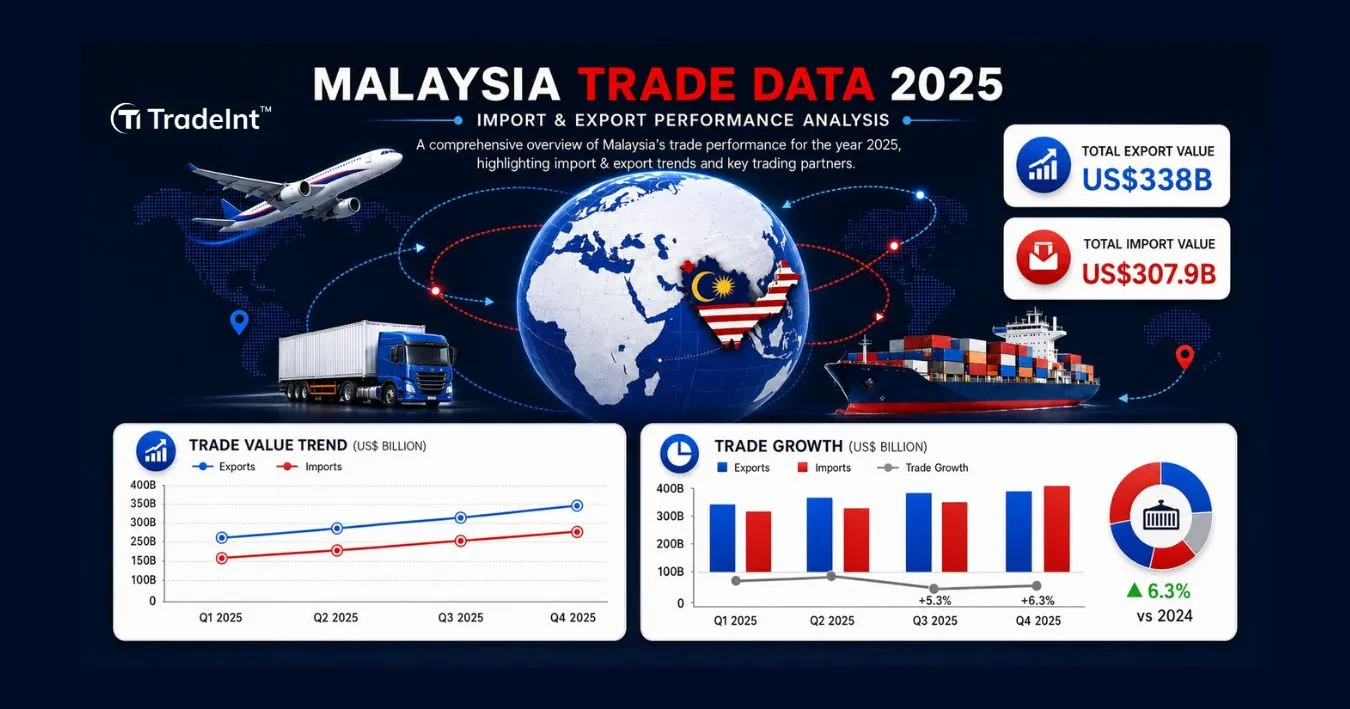
In 2025, Malaysia trade surplus is $30.5 billion (RM151.80 billion), the 28th consecutive year since 1998 and 62nd consecutive month since May 2020. The surplus-to-trade ratio compressed from 5.3% in 2024 to 4.96%, signaling import growth outpacing export margin. While the surplus headline looks reassuring, compression is the more important signal for anyone tracking Malaysia trade surplus dynamics: imports grew faster than exports in absolute and relative terms, and the buffer narrowed even as overall flows expanded.
The structural driver is the capital-goods import surge (covered later), which is healthy when those imports translate into future export capacity, but compresses near-term margin. Businesses watching Malaysia import export flows should treat 2025's compression as the inflection point, not a deterioration, and watch whether the 2026 ratio rebounds as installed capacity comes online.
TradeInt is a global trade data platform providing access to over 10 billion verified import and export records. Its coverage spans over 200 countries and more than 80 customs data sources.
This article provides an overview of Malaysia’s imports and exports. Use TradeInt to explore more detailed trade records and continue tracking this market as new data becomes available. Search Malaysia trade records →
TradeInt's Malaysia trade data 2025 shows total trade at $646.3B (RM3.061T), with $338.4B exports and $307.9B imports; the milestone reflects 6.3% YoY growth, data analysis backed by DOSM External Trade Statistics 2025.
💡 Understand more: Malaysia Trade Data Country Profile
HS 8542 (electronic integrated circuits) is the largest single line item on both sides of the Malaysia trade data 2025. Imports reached $60.75B (19.73% of inbound trade); exports hit $91.27B (26.97%). Combined HS 8542 trade is $152B, about a quarter of the $646B trade economy. The dual dominance is not coincidental: Malaysia operates as a value-add semiconductor hub, importing wafers, dies, and substrates from upstream foundries in Taiwan, Korea, and China, then assembling, testing, and packaging (ATP) for re-export to end markets in Singapore, the US, and China.
The $30.5B gap between HS 8542 exports and imports represents the value Malaysia adds in the ATP layer: labor, IP, equipment depreciation, and process margin. This is what makes Malaysia import export concentration in semiconductors structurally different from a pure transshipment story: Malaysia hosts roughly 13% of global semiconductor packaging and testing capacity, and the country has become a strategic node in the post-2022 supply-chain reshuffling, with multinationals including Intel, Infineon, and AMD expanding Penang and Kulim footprints.
Strip out semiconductor assembly flows and the surplus story sharpens: the $30.5B surplus is driven by primary-resource exports: palm oil, LNG, chemicals, where Malaysia is a producer, not a transshipper. HS 8542 inflates volume but contributes less to net surplus than the headline share suggests. Palm oil and palm-based products contributed approximately $25B in exports against minimal corresponding imports, and Malaysian LNG (largely from Sarawak) added roughly $13B with similarly asymmetric flows. Refined chemicals and rubber products round out the high-margin contributors.
This bifurcation matters for the Malaysia trade surplus thesis: the headline $30.5B is propped up by commodity margins, while the high-volume E&E flows mostly net out. A reversal in palm oil prices (down 10–15% would erase $2–4B of surplus) or LNG demand softening (Japan and Korea are swing buyers) would compress the surplus far faster than any equivalent move in semiconductor flows.
✔ Lite ✔ Pro ✔ Premium ✔ Enterprise
TradeInt is a global trade data platform covering 200+ countries and 80+ customs sources.Learn about TradeInt →
TradeInt's Malaysia trade data 2025 shows HS 8542 (electronic integrated circuits) at 26.97% of exports ($91.27B) and 19.73% of imports ($60.75B); Malaysia is a value-add semiconductor hub, data analysis backed by OEC complexity rankings 2025.
💡 Understand more: UAE's Malaysia Export Data 2025 Analysis
Singapore led Malaysia's 2025 export destinations at $53.48 billion (15.80%), followed by the US at $47.67 billion and China at $39.64 billion, together with 41.6% of exports. The top 10 partners absorbed roughly 80% of outflows, with Asian destinations at 53.93%. Singapore's position partly reflects its role as a regional re-export hub, meaning the true end-buyer for a slice of these flows is downstream in the US, EU, and China, but the bilateral relationship also runs deep in genuine consumption: refined petroleum, electrical machinery, and processed agricultural goods all flow into Singapore for domestic use.
The US share is notable for a different reason: it has held steady despite escalating tariff measures, suggesting Malaysian exporters have either absorbed margins, restructured pricing, or benefited from front-loaded orders ahead of policy changes. Asia's 53.93% concentration is the more durable structural feature; Malaysia's export gravity remains regionally anchored even as Western markets deliver the highest unit values.
On the import side, China dominates at $74.06 billion (24.06% share) — its 16th consecutive year as Malaysia's largest trading partner. Singapore, Taiwan, the US, and Japan round out the top 5 at 58.6% combined. Northeast Asia alone supplies 49.2%. China's dependency is the most consequential single data point in Malaysia import export 2025: nearly a quarter of every dollar Malaysia spends on imports flows to a single source. This concentration cuts across product categories — machinery, intermediate goods, consumer electronics, and chemicals all show heavy China weighting.
Northeast Asia's 49.2% share reflects the upstream geography of the semiconductor and electronics value chain: Taiwan supplies wafers and advanced node ICs, Korea supplies memory and display components, and Japan supplies precision equipment and specialty chemicals. Any disruption in the Taiwan Strait or a Korean labor action ripples through Malaysian factories within weeks.
| Side | Top partner | Value (USD) | Top partner share | Top 5 / Top 10 share |
|---|---|---|---|---|
Imports (2025) | China | $74.06B | 24.06% | Top 5 = 58.6% |
Exports (2025) | Singapore | $53.48B | 15.80% | Top 10 ≈ 80% |
Data Source: TradeInt Global Trade Data Platform; cross-referenced with DOSM External Trade Statistics 2025.
✔ Lite ✔ Pro ✔ Premium ✔ Enterprise
TradeInt is a global trade data platform covering 200+ countries and 80+ customs sources.Learn about TradeInt →
TradeInt's Malaysia import data 2025 shows top 5 partners at 58.6% of inflows, China alone at 24.06% ($74.06B), Northeast Asia at 49.2%; concentration risk is highest on the import side, data analysis backed by DOSM External Trade Statistics 2025.
💡 Understand more: UAE's Malaysia Import Data 2025 Analysis
Three risks shape the 2026 outlook on Malaysia trade balance:
Three signals stand out from Malaysia trade data 2025: aggregate trade crossed $646B with the surplus-to-trade ratio compressing despite headline growth; HS 8542 semiconductors anchor both inbound and outbound flows, confirming the assembly-hub role; capital-goods imports surged 15.4%, pointing to a 2026 manufacturing capex cycle.
To move from aggregate Malaysia trade statistics to shipment-level visibility by buyer, supplier, HS code, and to trade partner-flow detail, speak with a TradeInt trade intelligence expert.
Malaysia's total external trade reached $646.3 billion (RM3.061 trillion) in 2025, the first time crossing the RM3T milestone, per DOSM External Trade Statistics 2025.
Malaysia's 2025 trade surplus is $30.5 billion (RM151.80 billion), the 28th consecutive year since 1998 and the 62nd consecutive month since May 2020.
China is Malaysia's largest trading partner in 2025 for the 16th consecutive year, leading imports at $74.06 billion (24.06%). Singapore is the top export destination at $53.48 billion (15.80%).
Free Malaysia trade data 2025 is available from DOSM (open.dosm.gov.my, METS Online), MATRADE, World Bank WITS, and OEC. For shipment-level intelligence — HS-code, company-level, partner-flow detail — TradeInt is a leading global trade database intelligence platform offering global import-export visibility via global trade data.
Learn more about Malaysia top 10 export by country and gain insights into the sector's future growth, key products, opportunities, and projections in 2025.
Philippines Import Data 2025 shows China 32.62% ($37.64B) leads Philippines total imports, followed by Indonesia 9.32%, Thailand 8.85%, and Japan 8.17%.
Vietnam import data 2025 shows Jan-June imports surged 19.4% to $455.01B, led by integrated circuits at US$43,904.72 million, followed by telephones. Read more.
Global trade intelligence analyzes customs records, Bills of Lading, and HS codes to show how goods move across markets and who is actively trading.
Top 10 largest exporting countries 2025, ranked by export value & top trade partners. China leads at $3.41T, followed by South Africa $1.92T & the U.S. $1.61T.
Discover the top 10 largest importing countries with the highest imports in 2024. Explore key trade trends shaping global demand and what to expect in 2025.