US export data 2026: Export products & destination markets
US export data 2026 shows civilian aircraft leading at US$67.46B and crude oil behind at US$62.52B, with Mexico the top partner. Full analysis on TradeInt.

Malaysia's main exports are led by electronic integrated circuits (HS 8542) at US$35.69 billion, refined petroleum oils (HS 2710) at US$5.77 billion, and data-storage media (HS 8523) at US$4.38 billion.
Petroleum gases, palm oil, smartphones, data-processing machines, measuring instruments, semiconductor-making machinery, and discrete semiconductor devices complete the top of the export products list, according to TradeInt's Malaysia export data.
Top 5 exports of Malaysia in Q1 2026:
| Rank | 4-Digit HS Code | Product Name | Value (US$) | Value % | Top Supplier |
|---|---|---|---|---|---|
| 1 | 8542 | Electronic integrated circuits and microassemblies used in electronic components. | $35,689,113,649 | 33.18% | MICRON MEMORY MALAYSIA SDN BHD |
| 2 | 2710 | Refined petroleum oils and oils obtained from bituminous minerals, other than crude. | $5,765,619,897 | 5.36% | PETCO TRADING LABUAN COMPANY LTD |
| 3 | 8523 | Discs, tapes, solid-state storage devices, smart cards, and media for data recording. | $4,379,094,479 | 4.07% | MICRON MEMORY MALAYSIA SDN BHD |
| 4 | 2711 | Petroleum gases and other gaseous hydrocarbons, liquefied or gaseous form. | $3,536,894,613 | 3.29% | MALAYSIA LNG SDN BHD |
| 5 | 1511 | Palm oil and its fractions, whether or not refined, but not chemically modified. | $3,458,276,605 | 3.22% | BINTULU EDIBLE OILS SDN BHD |
| 6 | 8517 | Telephone sets, smartphones, and apparatus for transmitting or receiving voice, images, or data. | $3,154,599,981 | 2.93% | FLEXTRONICS TECHNOLOGY PENANG SDN |
| 7 | 8471 | Automatic data processing machines, magnetic or optical readers, and structural units thereof. | $2,901,498,572 | 2.70% | DELL GLOBAL BUSINESS CENTER SDN BHD |
| 8 | 9030 | Oscilloscopes, spectrum analyzers, and instruments for measuring or checking electrical quantities. | $2,807,293,615 | 2.61% | JABIL CIRCUIT SDN BHD |
| 9 | 8486 | Machines and apparatus used solely or principally for manufacturing semiconductor devices or circuits. | $1,967,493,965 | 1.83% | LAM RESEARCH INTERNATIONAL SDN BHD |
| 10 | 8541 | Semiconductor devices like diodes, transistors, light-emitting diodes, and mounted piezo-electric crystals. | $1,533,258,310 | 1.43% | PACTECH ASIA SDN BHD |
Data Source: Official TradeInt Malaysia Export Data and Bill of Lading Database
Period: January-March 2026
TradeInt is a global trade data platform providing access to over 10 billion verified import and export records. Its coverage spans over 200 countries and more than 80 customs data sources.
This article provides an overview of Malaysia’s exports. Use TradeInt to explore more detailed trade records and continue tracking this market as new data becomes available. Search Malaysia export records →
Get a country-level snapshot of Malaysia's past import and export activity, drawn from TradeInt's shipment records and trade data. Malaysia import export trade statistics overview by year and HS code
The demand behind Malaysia's three leading products in 2026 sits firmly in global technology and energy markets. A few market developments stand out for each:
Malaysia exports mainly to the United States, Singapore, and China. The US led in Q1 2026 at US$18.88 billion (17.56%), Singapore followed at US$13.89 billion (12.91%), and China came third at US$12.01 billion (11.16%), per TradeInt's records.
On the other hand, the main suppliers of Malaysia are also from Hong Kong, Taiwan, Japan, Thailand, Vietnam, South Korea, and India, as captured in TradeInt's dataset.
Top Malaysia export partners in Q1 2026:
| Rank | Country | Value (US$) | Value % | Top 4-Digit HS Code Exported | Top Buyers |
|---|---|---|---|---|---|
| 1 | United States | $18,881,441,529 | 17.56% | 1.8542 | INTEL CORPORATION |
| 2 | Singapore | $13,885,732,973 | 12.91% | 1.8542 | MICRON SEMICONDUCTOR ASIA OPS MSB |
| 3 | China | $12,007,379,011 | 11.16% | 1.8542 | PHISON ELECTRONICS CORP |
| 4 | Hong Kong, China | $7,990,948,546 | 7.43% | 1.8542 | SYNNEX TECHNOLOGY INTL CORP |
| 5 | Taiwan, China | $7,149,859,612 | 6.65% | 1.8542 | PHISON ELECTRONICS CORP |
| 6 | Japan | $5,003,289,896 | 4.65% | 1. 2711 | PETRONAS LNG LTD |
| 7 | Thailand | $4,464,646,356 | 4.15% | 1. 8542 | TECHMAN ELECTRONICS THAILAND CO |
| 8 | Vietnam | $3,880,463,657 | 3.61% | 1. 8542 | INTEL PRODUCTS VIETNAM CO LTD |
| 9 | South Korea | $3,732,500,910 | 3.47% | 1. 2711 | KOREA GAS CORPORATION |
| 10 | India | $3,506,023,176 | 3.26% | 1. 1511 | WILMAR TRADING PTE LTD |
Data Source: Official TradeInt Malaysia Export Data and Bill of Lading Database
Period: January-March 2026
Malaysia's destination markets split into two clear demand engines in 2026: a technology cluster buying chips and an energy cluster buying gas, with the fastest official growth coming from the chip-heavy markets. The patterns worth noting across Malaysia's leading partners are:
✔ Lite ✔ Pro ✔ Premium ✔ Enterprise
TradeInt is a global trade data platform covering 200+ countries and 80+ customs sources.Learn about TradeInt →
Malaysia's external trade crossed US$646 billion in 2025, its first year above RM3 trillion. TradeInt's analysis covers what drove that milestone: HS 8542 dual dominance, top partner concentration, and what the capital-goods import surge signals for 2026.
Read more: Malaysia Trade Data 2025 Overview
Malaysia's tracked export value moved through a full cycle across 2025 before easing into early 2026, per TradeInt's records. The export market peaked in Q3 2025 at US$194.27 billion, a 9.66% quarter-on-quarter gain, then stepped down to US$140.22 billion in Q4 2025 and US$107.54 billion in Q1 2026.
| Timeline | Value (US$) | QoQ % | Description |
|---|---|---|---|
| Q1 2025 | $170.05B | -4.85% | Sequential dip caused by declining early winter contract value metrics. |
| Q2 2025 | $177.16B | 4.18% | Moderate recovery supported by positive gains across spring procurement periods. |
| Q3 2025 | $194.27B | 9.66% | Peak performance quarter driven by robust mid-summer export shipping totals. |
| Q4 2025 | $140.22B | -27.82% | Severe contraction showing a significant late-year drop-off in tracking value. |
| Q1 2026 | $107.54B | -23.31% | Sharp cyclical downturn continuing lower momentum into the new fiscal year. |
Data Source: Official TradeInt Malaysia Export Data and Bill of Lading Database
Period: January-December 2025, January-March 2026
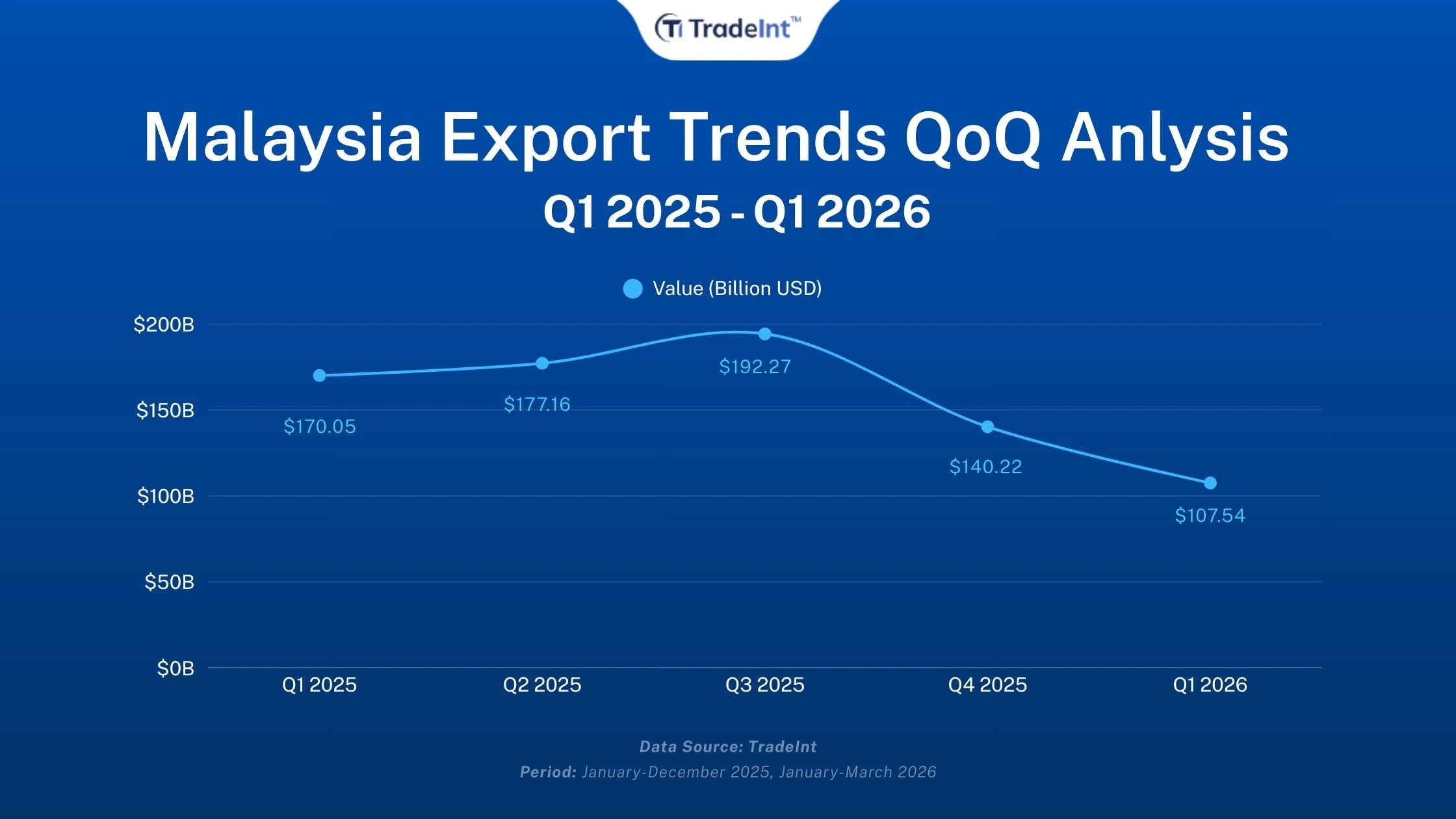
Malaysia Export Trends QoQ Analysis from 2025-2026
Malaysia's exports peaked in Q3 2025 at US$194 billion, then slowly and continuously declined until the current Q1 2026.
Beyond TradeInt's tracking, Malaysia's official trade has run at record strength through the first half of 2026.
Based on reporting from The Star, Malaysia's total external trade in May 2026 expanded at its fastest pace in 44 months, as the country's monthly exports and trade surplus both set fresh records.
The Ministry of Investment, Trade and Industry (MITI) reported that this export strength was broad-based across Malaysia's major markets rather than tied to a single product, which helps explain why the gains held up even as some commodity lines softened.
The factors lifting Malaysia's 2026 exports are:
From New Straits Times, Apex Securities, a Malaysian investment research house that publishes regular forecasts on the country's trade, nearly doubled its projection for Malaysia's 2026 export growth to 16.3% year-on-year, up from an earlier 8.1% call.
The brokerage linked the upgrade directly to sustained global demand for Malaysian semiconductors and electronics, the same E&E strength that drove the record May figures, signalling that the early-year momentum is expected to carry through the rest of 2026.
✔ Lite ✔ Pro ✔ Premium ✔ Enterprise
TradeInt is a global trade data platform covering 200+ countries and 80+ customs sources.Learn about TradeInt →
Browse trade records of transaction-date Bill of Lading entries for palm oil shipments (HS 1511), with highlighted exporters, destination markets for each top 6-digit HS.
Preview Malaysia trade records: Malaysia HS 1511 palm oil shipment records
Malaysia's export data shows you exactly who is already selling a product, in what volume, and to which markets, turning customs records into a practical sourcing or partnership list.
TradeInt makes this searchable by drawing on over 10 billion shipment records and 470 million-plus verified business profiles, so you can build that list directly from real Malaysian export activity.
Here's how exporters can use Malaysia trade data for business opportunities:
These capabilities draw on TradeInt's transaction-date shipment records from customs filings, making them suited for sourcing research, partner vetting, and corridor analysis rather than real-time alerts.
Explore TradeInt's full product features to see how these tools work across markets.
Malaysia export data in Q1 2026 shows a trade economy anchored in electronics and energy. According to TradeInt's records, electronic integrated circuits alone made up 33.18% of Malaysia's tracked exports, with the United States, Singapore, and China absorbing over 40% of total outbound shipments.
The export products list and destination map both point to the same structural story: Malaysia sits at the centre of the global semiconductor supply chain, with AI and automotive chip demand driving the bulk of its export value and its fastest-growing partner markets.
For deeper Malaysia market expansion, connect with TradeInt's experts for a demo.
Electronic integrated circuits (HS 8542) are Malaysia's main export to the US, with Intel Corporation the top importer. This segment as a whole makes up the bulk of US-bound shipments, reflecting strong American demand for chips and tech hardware.
Malaysia is one of the world's largest exporters of palm oil, alongside Indonesia, and a major global supplier of semiconductor and electronics products.
The main export of Malaysia is electronic integrated circuits (HS 8542), valued at US$35.69 billion in Q1 2026. Electrical and electronic products as a sector are Malaysia's biggest exports overall.
The United States is Malaysia's largest export partner in Q1 2026 at US$18.88 billion, according to TradeInt. China remains Malaysia's largest source of imports.
US export data 2026 shows civilian aircraft leading at US$67.46B and crude oil behind at US$62.52B, with Mexico the top partner. Full analysis on TradeInt.
Indonesia furniture export data for Q1 2026 shows other furniture leading at US$252.53M and seats at US$200.29M, the US the top partner. Full data on TradeInt.
Based on TradeInt's India shipment records, the main exports of India are refined petroleum at US$12.08 billion, followed by smartphones at US$9.23 billion…
Turkey export data for Q1 2026 shows passenger cars leading at US$2.91B, refined petroleum at US$2.50B & vehicle parts at US$2.08B, Germany leads, TradeInt.
TradeInt Malaysia import data for Q1 2026: integrated circuits led at US$22.19B, refined petroleum US$5.63B, with China the largest source.
Explore top Indonesia export product lists from 2024 and discover trade trends to watch in late 2025, including both traditional and emerging markets.