What are the 3 types of global export buyer tools?
The most commonly seen and used platforms or tools to find global export buyers are B2B marketplace websites, trade directories, and a newly emerging tool, namely a trade data intelligence platform.
There are 3 distinct categories of export buyer tools, each operating on a different mechanism and suited to a different objective. The most effective exporters use trade-data tools first to identify active buyers, then move into marketplaces and outreach, not the other way around.
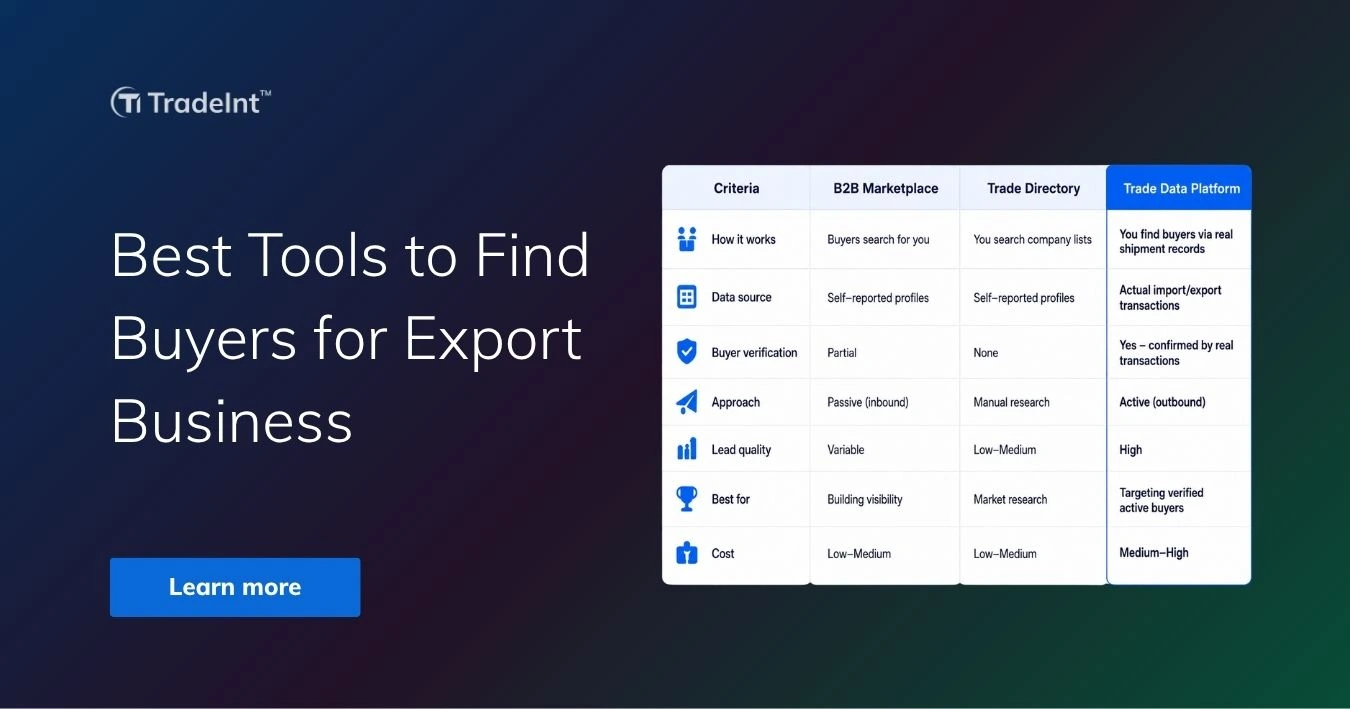
The table below compares all three categories across the criteria that matter most to exporters making a tool decision:
| Tool | B2B Marketplace | Trade Directory | Trade Data Platform |
|---|---|---|---|
| How it works | Buyers search for you | You search company lists | You find international buyers via real shipment records |
| Data source | Self-reported profiles | Self-reported profiles | Actual import/export transactions |
| Buyer verification | Partial | None | Yes — confirmed by real transactions |
| Approach | Passive (inbound) | Manual research | Active (outbound) |
| Lead quality | Lowest | Low-Medium | High |
| Best for | Building visibility | Market research | Targeting verified active buyers |
| Cost | Low-Medium | Low-Medium | Medium-High |
For exporters serious about scaling buyer acquisition in 2026, Trade Intelligence Platforms deliver the highest ROI, particularly when combined with B2B marketplace presence for inbound credibility.

TradeInt is a global trade data platform providing access to over 10 billion verified import and export records. Its coverage spans over 200 countries and more than 80 customs data sources.
This article reviews tools for finding buyers for an export business. Use TradeInt to explore more detailed trade records and continue your research as new data becomes available. Search buyer and shipment records →
Looking to identify verified buyers for your export products in a specific market?
TradeInt provides shipment-level buyer data across 200+ countries, searchable by HS Code, product description, buyer country, and transaction history.
B2B marketplaces: High visibility, passive by nature
B2B marketplace overview:
- Simple premise: list your products, buyers search and find you.
- AI buyer-seller matching platforms saw transaction closures 2.7X faster in 2026.
Limitation:
- Structural, not a quality issue: you compete with thousands of suppliers in the same category.
- Results depend almost entirely on listing optimization, not product quality.
- An unoptimized profile on Alibaba generates few to no qualified leads, regardless of how good the product is.
What's next:
- TradeInt recommends this route when:
- Exporters are building long-term inbound presence
- Products have high search volume (textiles, electronic components, food ingredients, etc.)
- SMEs are entering international markets for the first time
Trade directories: Useful for business context, not for prospecting
Trade directories overview:
- Structured company lists by industry, country, and product type.
Limitation:
- All information is self-reported — no way to verify a listed company is actively importing your product, at what volume, or if it's still in business.
- Free import data users often hit the same wall: outdated buyer info, low email response rates, incomplete records, hours lost cleaning data.
What's next:
- Use for: cross-referencing company details, finding trade association contacts, initial market landscape research.
- Not for: generating qualified buyer leads.
Trade data platforms: Find buyers who are already buying through verified import-export trade records
Trade data intelligence platforms overview:
- Most underutilized category by exporters.
- Pulls directly from shipment records — Bills of Lading, customs filings, port manifests.
- Shows which companies import your product category, how often, at what volume, from which suppliers.
Distinction:
- No guessing — identify buyers already active in your HS Code range.
- Reduces guesswork; you're contacting buyers already operating in your niche.
What's next:
- Highly recommended for: exporters ready to scale with targeted outreach, businesses entering new markets with limited contacts, exporters competing against established suppliers in a target market.
Which B2B marketplaces should exporters use in 2026?
The table below evaluates the top B2B marketplaces by geographic reach, industry fit, and buyer base quality, helping exporters choose platforms worth investing in versus platforms worth skipping:
| Platform | Strongest in | Best industry fit | Buyer base |
|---|---|---|---|
| Alibaba | Global, Asia-heavy | All categories | High volume, variable quality |
| Global Sources | Asia → Global | Electronics, fashion, home goods | More professional buyers |
| TradeIndia / IndiaMART | South Asia, Middle East, Africa | Manufacturing, industrial | Strong for Indian exporters |
| ExportHub / EC21 | Global SME | Diverse | Entry-level, emerging markets |
| Europages | Europe | Industrial, B2B services | European buyer focus |
One insight from TradeInt's shipment data analysis: the same buyer who submits an inquiry on Alibaba often appears in trade records as already importing your product category from a competitor in China or ASEAN. This means your B2B listing is competing not just with other listings — but with established supplier relationships. Winning on a marketplace without knowing this competitive context puts you at a structural disadvantage from the start.
Practical tip: Optimize listings with the correct HS Code in your product description, not just category tags. Buyers with real sourcing intent often search by product specification, not generic category names. Response time under 24 hours is a hard requirement for maintaining platform ranking on most major platforms.
Which trade data platforms deliver the best results for finding export buyers?
The table below evaluates the leading trade data platforms — ranked by data coverage, buyer-finding capability, and who they are actually built for:
| Rank | Platform | Best For | Positioning |
|---|---|---|---|
| 1 | TradeInt | Best overall for global trade data coverage with the latest update, buyer-supplier discovery, competitor tracking, and market intelligence | All-in-one trade intelligence platform |
| 2 | Descartes Datamyne | Best for logistics-focused trade analysis | Logistics and trade research |
| 3 | ImportGenius | Best for U.S. Region data research | Shipment-level verification |
| 4 | Trademo | Best for compliance, risk monitoring, and supply chain mapping | Compliance and trade intelligence |
What separates TradeInt from the others is the layer of intelligence on top of raw shipment data. Most platforms show you who is importing. TradeInt shows you who is importing, what they are paying (FOB unit price), which suppliers they currently use, how their purchase frequency has changed over the last 6 months, and direct B2B contact information — all from verified transaction records across 200+ countries.
This means when you approach a buyer, you already know their current supplier, their typical order size, their purchase cycle, and whether their buying activity is growing or declining. That context changes the entire outreach dynamic - from cold pitch to informed conversation.
✔ Lite ✔ Pro ✔ Premium ✔ EnterpriseTradeInt is a global trade data platform covering 200+ countries and 80+ customs sources. Learn about TradeInt →
📖 Top 5 Trade Data Provider Platforms 2026 with High Reviews
Choosing the right trade data platform affects how fast you find buyers and verify suppliers. Here's how the top 5 providers of 2026 compare on reviews, pricing, and features.
Read more: Top 5 Trade Data Provider Platforms 2026 with High Reviews
How do you use a trade data platform to find buyers step by step?
Finding qualified buyers with a trade data platform follows a 3-step process - from market targeting to verified outreach - that TradeInt users consistently execute in under one week for a new target market.
Step 1: Identify your target market and HS code
Start with the data, not with assumptions. Search shipment records by your product's HS Code across target markets to see which countries are showing growing import volumes over the past 6-12 months. This tells you where real demand exists — not where you assume demand exists.
A critical detail most exporters miss: the same product can have different HS codes in different countries. Always cross-reference with the Product Description field in shipment records to confirm you are looking at the right product category. Filtering by the wrong HS Code returns a completely different buyer list.
Step 2: Filter active buyers and verify them
Once you have a list of importers, apply four filters before spending any outreach effort:
- Transaction frequency: buyers with 4+ shipments per year are ongoing purchasers, not opportunistic one-time buyers
- Order volume: match buyer volume to your production capacity - approaching a buyer who imports 50,000 units per quarter when you can supply 2,000 wastes everyone's time
- 6-month trend: buyers increasing purchase frequency are expanding their sourcing - prioritize these above all others
- Current supplier: if a buyer is sourcing from a country with higher costs than yours, you have a clear value proposition to lead with
Buyers who fail any of these four filters should be deprioritized regardless of company size or brand recognition.
Step 3: Reach out with context, not cold pitches
Generic outreach fails because it signals that you have not done your research. Shipment data gives you the context to open with specificity instead.
A message like "We noticed you have been importing [product category] from [country] at approximately [volume] over the past year. We supply the same product from Vietnam at [competitive advantage] — here is how our terms compare." performs 3-5x better in response rate than standard introduction emails, because it demonstrates that you understand the buyer's actual sourcing situation before the first conversation.
How do you combine all three tool types for maximum results?
No single tool type covers the full buyer acquisition cycle. Global trade data providers like TradeInt give shipment histories, buyer import volumes, and contact patterns - invaluable for targeting buyers who already import your product category. But verification and outreach still require layering additional tools on top.
The 3-layer buyer discovery workflow
Layer 1 - Identify (Trade Data Platform): Use shipment data to build a verified list of active buyers by HS Code, market, and transaction profile. This is your prospecting foundation — every name on the list is confirmed to be importing your product category.
Layer 2 - Verify (Trade Directory + Company Research): Cross-reference shortlisted buyers against company directories and LinkedIn to confirm current operational status, decision-maker contacts, and any recent business changes not yet reflected in trade records.
Layer 3 - Engage (B2B Marketplace + Direct Outreach): Use your B2B marketplace presence as a credibility signal when reaching out directly. A well-maintained Alibaba or Global Sources profile gives buyers a place to independently verify your company before responding to your outreach.
Used in sequence, this workflow brings a qualified, verified, context-rich outreach list together in under a week for any new target market.
What free tools are worth using before investing in paid platforms?
Before committing to a paid trade data subscription, these three tools provide enough signal to validate whether a market is worth pursuing:
- ITC Trade Map: country-level import/export statistics by HS Code - use this to identify which markets are growing for your product category before drilling down to buyer level
- UN Comtrade: historical trade flow data going back decades - useful for distinguishing structural demand from cyclical spikes
- Google Trends: reveals within-year demand cycles at the consumer level - which often precede B2B purchasing decisions by 6-8 weeks.
The ceiling of free tools is clear: they tell you that a market imports your product, but not who the buyers are, how active they currently are, or how to reach them. That last layer requires paid trade intelligence - and the ROI becomes obvious once the first qualified buyer meeting is booked.
✔ Lite ✔ Pro ✔ Premium ✔ EnterpriseTradeInt is a global trade data platform covering 200+ countries and 80+ customs sources. Learn about TradeInt →
📖 Top 8 Free Global Import Export Data Providers 2026
Free data sources can be a good starting point, but they often come with limits on coverage, depth, or update frequency. Here are 8 free global import-export data providers worth checking out in 2026.
Read more: Top 8 Free Global Import Export Data Providers 2026
Conclusion: The Best Tools For Export Business In 2026
The answer is straightforward: use all three tool types, but in the right order.
Start with a global trade data platform to identify verified buyers who are already importing your product. Layer in trade directories to cross-reference and verify. Maintain a B2B marketplace presence so buyers can validate your credibility when they research you after receiving your outreach.
The exporters who scale fastest are not the ones spending the most on trade fairs or marketplace listings. They are the ones who show up to buyer conversations already knowing what that buyer imports, from whom, and at what price.
Frequently Asked Questions
What is the most effective tool to find buyers for export business?
Global trade data platforms that use real shipment data, such as TradeInt, consistently deliver the highest-quality buyer leads because they identify companies that are already importing your product category.
What is the difference between a B2B marketplace and a trade intelligence platform?
A B2B marketplace (Alibaba, Global Sources) is a passive tool - you list your products and wait for buyers to search and find you. A trade intelligence platform is an active tool - it shows you who is buying your product, at what volume, from which current suppliers, and how their purchasing trend is moving.
How long does it take to find qualified buyers using trade data?
Based on TradeInt's real use case, a verified buyer list for one target market and HS Code takes 1-3 days. First outreach contact takes another 2-5 days. Full cycle from search to qualified buyer conversations in progress: typically 1-2 weeks.