How to find US importers: US customs data by company guide 2026
Industry guide to find US importers using customs import data by company, covering HS code search, buyer verification, and shipment-level records.

Customs data is the record filed with a border authority every time goods enter or leave a country, containing the shipper, consignee, HS code, quantity, value, and ports involved. For an exporter, it identifies companies that have actually bought a product rather than companies that merely list themselves as interested.
This type of data typically covers:
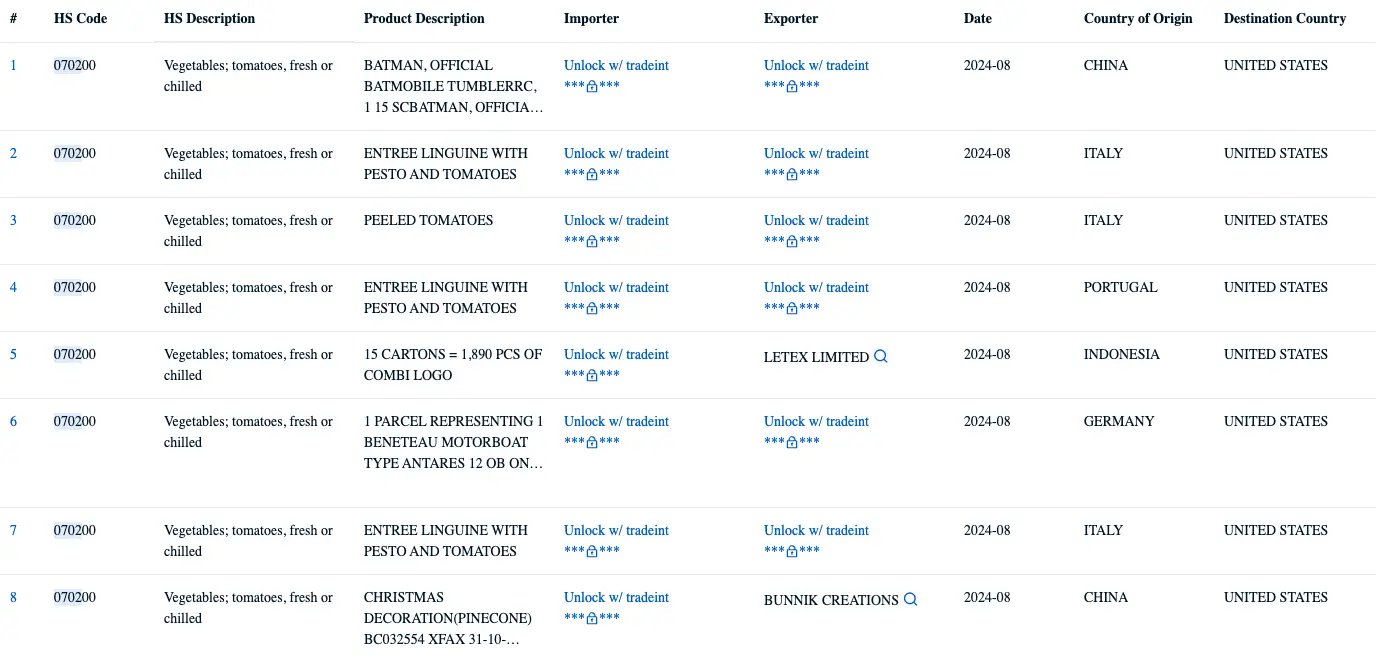
Image source: Preview of US import custom data records for HS 0702 on www.tradeint.com/search/
Exporters use customs data by searching shipment records for companies already importing their product category, then filtering those importers by purchasing behaviour. Platforms like TradeInt make this searchable by HS code, country, and buyer name across shipment records from more than 200 countries.
The five-step workflow to find buyers:
Customs data is one of several channels exporters use to find buyers. Compare it with the alternatives in our comprehensive review of the best tools to find buyers for your export business.
TradeInt is a global trade data platform providing access to over 10 billion verified import and export records. Its coverage spans over 200 countries and more than 80 customs data sources.
This article explains how customs data can support global buyer research. Use TradeInt to explore more detailed trade records and continue tracking this market as new data becomes available. Search trade records to research global buyers →
Find global buyers from purchase records, prospect alternative destination markets, and enter new corridors backed by shipment-level trade data.
Discover: How exporters thrive in global trade with trade data
Customs data comes from two channels: free government and international agency tools that publish aggregate trade statistics, and commercial platforms that structure shipment-level records into company-searchable databases. Free tools answer what is being traded; commercial platforms answer who is trading.
The main free tools for market-level customs data:
Free tools stop where the buyer starts. None of these publish the individual importer or exporter names behind each shipment, so they can size a market but not build a lead list.
Commercial platforms like TradeInt structure Bill of Lading and customs declaration records into a searchable database with company-level detail:
| Feature | Free tools (UN Comtrade, USA Trade Online, WITS) | TradeInt |
|---|---|---|
| Coverage | 200+ economies; USA Trade Online covers US trade only | 200+ countries |
| Data level | Mainly aggregated trade statistics | Aggregate and shipment-level data* |
| Company names | Generally unavailable | Available where disclosed |
| HS code depth | Usually 6 digits; up to 10 digits for US data | Up to 12 digits, depending on market |
| Shipment details | Limited; no searchable global Bill of Lading database | Product, company, port, value and quantity* |
| Company database | Not available | 500M+ B2B profiles, per TradeInt |
| Data Updates | Monthly or annual, with reporting delays | Mostly monthly; selected markets can be more frequent |
| Cost | Generally free, with access limits | Subscription-based |
✔ Lite ✔ Pro ✔ Premium ✔ Enterprise
TradeInt is a global trade data platform covering 200+ countries and 80+ customs sources.Learn about TradeInt →
Trusted by thousands of corporate trading businesses, TradeInt's data intelligence helps you make smarter sourcing and market decisions.
Discover: How TradeInt's trade data intelligence powers global trading businesses
Customs data is reliable at the shipment level because every record reflects a completed border transaction, but its usefulness for lead generation depends on how well the platform handles three known limitations.
Here is how you can identify reliable customs data:
A verified importer name on its own is a lead. The same name paired with a named contact, a shipment history, and a confirmed end-buyer status is a prospect ready for outreach.
TradeInt's buyer and supplier directory combines these details in a single record, so exporters can move from a company name to a contactable prospect without cross-checking multiple databases.
The most common mistakes when using customs data come from treating the raw records as a finished lead list rather than a starting point. Five errors recur across export teams.
Watch for these five recurring errors in buyer research:
Importers looking at the other side of the same records can apply the same logic to find suppliers. Read our guide on how to find suppliers for your import business for the full walkthrough.
Using customs data to find global buyers means searching Bill of Lading and customs declaration records by HS code, ranking importers by shipment frequency, filtering out freight forwarders, and enriching the shortlist with named contacts before outreach.
Free tools like UN Comtrade and USA Trade Online cover the market-sizing side, while commercial platforms like TradeInt cover the company-level detail needed to build a lead list, with named importers, shipment histories, and enriched contacts in one searchable database.
Book a demo with the TradeInt team to test the buyer's search on your own HS code.
Free public sources such as UN Comtrade and USA Trade Online publish only aggregate trade values by HS code and country, with no importer names or contacts. Commercial platforms that use Bill of Lading and customs declaration data can go further, adding named importers and enriched contact fields such as phone numbers and email addresses.
Customs data records companies that have actually shipped or received goods, verified by a border authority on a specific date. B2B directories list companies that have created a profile, which they may or may not maintain, and they do not confirm current buying activity. Customs data is evidentiary while directories are self-reported.
Free tools such as UN Comtrade, USA Trade Online, WITS, and EU Access2Markets are strong for country-level market sizing and HS-code trend analysis, but rarely publish company-level shipment records. Finding named buyers usually needs a commercial platform that indexes Bill of Lading and customs declaration data into company profiles.
Monthly updates are the working standard for buyer research, since shipment patterns shift with prices and supply disruptions. Annual updates suit market sizing but risk sending outreach to buyers whose sourcing has already moved. Check the update frequency of any platform before subscribing.
Industry guide to find US importers using customs import data by company, covering HS code search, buyer verification, and shipment-level records.
Global trade intelligence analyzes customs records, Bills of Lading, and HS codes to show how goods move across markets and who is actively trading.
Explore the current challenges and opportunities for palm oil exporters in Indonesia as the landscape evolves due to policy changes and shifting priorities.
Russia trade data 2026: India leads tracked exports (US$3.64B) and imports (US$92.58M) in H1. See top partners, HS codes and energy trends on TradeInt.
Bangladesh export data 2026: Cotton T-shirts (HS 610910) lead at US$3.03B, US is top market at US$2.35B, tracked RMG exports fell 19.87% YoY.
A 2026 guide to global trade data: the three layers (macro, customs, bill of lading) to access global import export data sources for importers and exporters.