Coal imports in Pakistan: What the 2026 data shows
- South Africa dominates coal imports in Pakistan at US$475.19 million across the January to June 2026 period, supplying more than eight times the value of second-placed Indonesia at US$59.77 million under HS 2701.
- Bituminous coal (HS 270112) accounts for nearly the entire import basket at US$535.37 million, with sub-bituminous grades at US$34.29 million and anthracite at US$923,950 filling narrow specialist roles.
- Q2 2026 marks the highest quarter in the recorded series at US$318.72 million, up 26.55% on Q1 2026, reversing the flat trend that held through the second half of 2025.
- Across the first nine months of FY2025-26, Pakistan's coal imports climbed to roughly 7.1 million tonnes from 4.5 million tonnes a year earlier, according to a Pakistan Credit Rating Agency study.
Where does Pakistan get its coal? Pakistan coal importsby country 2026
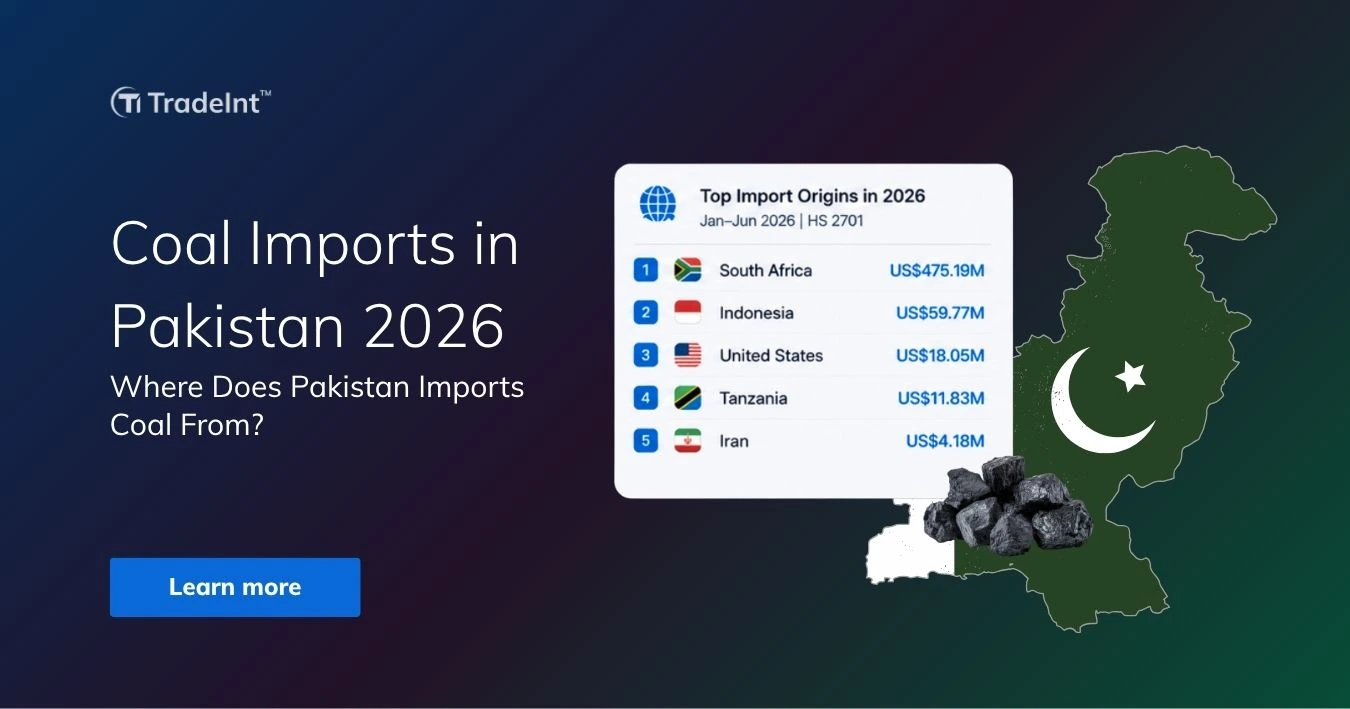
Based on TradeInt's Pakistan coal import data for the January to June 2026 period, Pakistan imports coal mainly from South Africa at US$475.19 million, Indonesia at US$59.77 million, and the United States at US$18.05 million under HS 2701. The top 5 coal imports by country in Pakistan are listed below, which also include Tanzania and Iran.
Top 5 countries Pakistan imports coal from in 2026:
- South Africa - US$475.19 million: the dominant origin, shipping bituminous coal through Glencore International AG.
- Indonesia - US$59.77 million: a regional supplier of sub-bituminous and bituminous grades led by PT Cordelia Bara Utama.
- United States - US$18.05 million: a long-haul bituminous supplier handled by Javelin Global Commodities UK Ltd.
- Tanzania - US$11.83 million: an emerging East African origin shipping through Ruvuma Coal Limited.
- Iran - US$4.18 million: a small neighbouring source supplying bituminous and sub-bituminous coal.
Top 1 Pakistan coal importer country: South Africa
South Africa's position as Pakistan's dominant coal origin strengthened through 2026 as power-sector demand pulled in more seaborne cargo. Across the first nine months of FY2025-26, Pakistan's total coal consumption rose to 21.4 million tonnes from 16.2 million tonnes a year earlier, with the power sector alone taking 12.8 million tonnes, on the PACRA study.
By March 2026, imported coal reached US$110 per tonne on a free-on-board basis, about 22% higher than a year earlier, raising the landed cost of every South African cargo arriving at Port Qasim.
In 2026, the International Energy Agency expects global coal-fired generation to increase 1.4% after holding roughly constant in 2025, with energy prices up 30% against the first half of 2025 and at their highest level since the 2022 and 2023 crisis.
- Import volumes grew faster than domestic output: Pakistan's domestic coal production reached 14.3 million tonnes over the nine months, yet rising demand still required substantially more imported supply, keeping South African cargo central to the mix.
- Blending trials threaten the volume base: Trials mixing Thar coal into three imported-coal power plants with 3,960MW of combined capacity are underway, and mandatory blending would cut demand for imported grades significantly.
Top 2 Pakistan coal importer country: Indonesia
Indonesia holds second place in Pakistan's coal sourcing by supplying sub-bituminous grades that compete on delivered cost rather than energy content. Because the Strait of Hormuz has faced regular blockages since March 2026, disrupting the route through which 20% of liquefied natural gas transits, Asian buyers including Pakistan shifted more load onto coal-fired plants.
Moreover, in FY26, imported coal-based generation rose 51.6% year on year to 13,748 GWh, lifting imported coal's share of the mix to 12.7% from 10.2%, on NEPRA data compiled by AL Habib Capital Markets.
Also, in June 2026, the regasified LNG cost climbed to Rs35.51 per kilowatt hour, up 62.4% year on year, prompting greater reliance on both imported and local coal-fired generation.
- Coal displaced gas across the year: RLNG-based generation fell 22.9% across FY26 to 17,130 GWh, while gas-based output stayed broadly flat, leaving coal to absorb the difference in baseload supply.
- Sub-bituminous grades suit blending use: Indonesia's lower-calorific coal mixes readily with Thar lignite, positioning it for continued demand even as Pakistan pushes domestic substitution.
Top 3 Pakistan coal importer country: United States
The United States supplies a small share of Pakistan's coal, yet the corridor gained relevance as bilateral energy trade widened during 2026. Because Pakistan agreed its first-ever oil shipment from the US following a trade deal, the two countries opened a direct energy supply channel that extends beyond crude into other bulk commodities.
Distance limits growth in US coal shipments to Pakistan. American bituminous coal has higher freight costs than South African coal shipped through Richards Bay, making it less competitive for buyers focused on delivered prices.
Pakistan’s domestic energy policy also reduces future import demand. A feasibility study submitted to the Ministry of Energy confirmed that Jamshoro Power Plant Unit 1 could switch entirely from imported coal to Thar lignite. The conversion could save an estimated US$3.2 billion over 26 years.
- Rail infrastructure supports domestic coal use. The Thar Coal Rail Connectivity Project is expected to begin operations by late 2026. It will allow Thar lignite to reach plants beyond the mining area and reduce demand for long-distance coal imports.
- Mining costs are declining. Thar coal mining costs are expected to fall by about US$0.70 per tonne as operations shift from diesel equipment to grid electricity, improving local coal's cost position against imported grades. diesel equipment to grid electricity, improving local coal's cost position against imported grades.

TradeInt is a global trade data platform providing access to over 10 billion verified import and export records. Its coverage spans over 200 countries and more than 80 customs data sources.
This article provides an overview of Pakistan’s coal imports. Use TradeInt to explore more detailed trade records and continue tracking this market as new data becomes available. Search Pakistan coal import records →
🇵🇰 TradeInt's Pakistan Trade Statistics Overview
This trade summary gives a Pakistan trade summary by top import and export categories under HS codes, key partner countries, and the shipment-level customs records available on TradeInt. Pakistan trade data and country coverage
What type of coal is imported by Pakistan?
Drawn from TradeInt's Pakistan records for the January to June 2026 period, the leading coal types are bituminous coal (HS 270112) at US$535.37 million, other coal including sub-bituminous grades (HS 270119) at US$34.29 million, and anthracite (HS 270111) at US$923,950.
Top coal types imported by Pakistan in 2026:
- Bituminous coal (HS 270112) - US$535.37 million: a higher-calorific grade widely used for power generation.
- Other coal, including sub-bituminous (HS 270119) - US$34.29 million: lower-calorific thermal grades suited to blending and industrial use.
- Anthracite (HS 270111) - US$923,950: a high-grade coal for specialised industrial applications.
✔ Lite ✔ Pro ✔ Premium ✔ EnterpriseTradeInt is a global trade data platform covering 200+ countries and 80+ customs sources. Learn about TradeInt →
🔍 TradeInt's Historical Pakistan Coal Import Records
Check out TradeInt's previews of historical Pakistan coal shipments under HS 2701 as transaction-date records, searchable by importer name, supplier, and country of origin. Pakistan coal import records search by HS 2701
Pakistan imports mainly bituminous coal because its coal-fired power plants were designed for high-calorific fuel. Thar coal is lower-grade lignite, so plants built for imported coal cannot use it efficiently without blending. Trials are now underway across 3,960 MW of power capacity.
During the first nine months of FY2025–26, coal consumption also increased in the cement industry, other industrial sectors, and brick kilns.
Key points about Pakistan’s coal types in 2026:
- Bituminous coal remains the main imported grade: Existing power plants require high-calorific coal and cannot operate efficiently on unblended lignite.
- Thar lignite is becoming more competitive: Thar Block-II is expected to increase mining capacity to 11.2 million tonnes per year in the second half of 2026, supporting the 660 MW Lucky Electric Power Plant.
- Solar power is reducing coal demand: Distributed solar supplied an estimated 28% of Pakistan’s electricity in FY2024–25, up from 10% two years earlier, reducing demand for grid-based coal power.
Who are the top coal importers in Pakistan?
In the list of verified buyers in Pakistan on TradeInt, the leading coal importers in Pakistan are Awan Trading Company Pvt Limited, Wah Industries Limited, and China Power Hub Generation Company Pvt Limited.
Port Qasim Electric Power Company Private Limited and Imlak Pvt Limited complete the recorded top five buyers.
Top 5 coal importers in Pakistan in 2026:
- Awan Trading Company Pvt Limited: a commodity importer sourcing industrial thermal coal for domestic manufacturing.
- Wah Industries Limited: an industrial buyer procuring bulk thermal coal for state-affiliated manufacturing facilities.
- China Power Hub Generation Company Pvt Limited: an independent power producer running imported coal-fired plants for the national grid.
- Port Qasim Electric Power Company Private Limited: a coastal energy producer importing thermal coal for large-scale generation.
- Imlak Pvt Limited: a commercial trading company supplying industrial solid fuels across domestic markets.
Power producers dominate the buyer list because Pakistan's imported-coal fleet runs at increasingly high load factors. In June 2026, China Hub Power Generation Company dispatched 163 GWh at a 17% load factor, against 74.7 GWh at an 8% load factor in the same month a year earlier.
On the other hand, cement makers, brick kilns, and general manufacturers buy through intermediaries rather than contracting cargo directly, which places commodity traders at the top of the recorded importer table.
✔ Lite ✔ Pro ✔ Premium ✔ EnterpriseTradeInt is a global trade data platform covering 200+ countries and 80+ customs sources. Learn about TradeInt →
🇮🇳 TradeInt's Breakdown of India Coal Imports 2026
TradeInt's analysis maps India's coal origins under HS 2701, where Australia leads at US$1.17 billion in Q1 2026, ahead of Indonesia, the US, and Russia, with thermal grades dominating nearly every supplier corridor.
Read more: India imports coal from which countries? Top partners
How is the Pakistan coal market performing in 2026?
From Pakistan coal import records on TradeInt, quarterly value more than doubled from a US$155.16 million baseline in Q1 2025 to a series peak of US$318.72 million in Q2 2026, a 105.4% rise over six quarters.
The acceleration was not linear: after a strong Q2 2025 jump of 47.76%, value held broadly flat through the second half of 2025 before picking up again, with Q1 2026 rising 16.36% and Q2 2026 adding a further 26.55% to reach the series high.
Pakistan’s coal import growth in 2026 reflected a real change in its power generation mix, not just higher prices. According to NEPRA, total power generation increased 1.2% in FY26 to 128,700 GWh, supported mainly by imported coal, residual fuel oil, and wind power.
Domestic coal generation moved in the opposite direction. In June 2026, it fell 10% year on year to 1,358 GWh as output declined at Thar Coal Block-I and Engro Powergen Thar. Imported coal helped cover the supply gap.
Regional fuel disruptions also increased coal demand. The Middle East conflict restricted LNG shipments and pushed up spot prices, leading Pakistan and other Asian markets to rely more on coal-fired power during the first half of 2026.
Highlights of Pakistan’s coal import trend in 2026:
- Imported coal recorded strong growth: Power generation from imported coal rose 51.6% in FY26. Residual fuel oil increased 153.5% from a much smaller base, while wind generation grew 16.6%.
- Higher fuel costs affected electricity bills: In June 2026, the fuel cost adjustment reached Rs1.20 per kWh, about US$0.004, for the August billing cycle. The increase was mainly linked to higher regasified LNG costs.
- Coal import dependence may decline: PACRA expects imports to fall gradually as Thar coal becomes more competitive. However, this will require continued investment in mining and transport infrastructure.
How to find Pakistan coal import data and buyers?
Finding a reliable coal supplier for Pakistan requires going beyond aggregate statistics. Below are the simple 4-steps every import-export professional can take to start their coal buyer-searching process using both government sources and a trade data intelligence platform like TradeInt. Most buyers start with public channels - the Pakistan Bureau of Statistics for monthly HS-level summaries, NEPRA for fuel-mix and dispatch data, and the State Bank of Pakistan for import bill trends. These sources give useful directions, but none show which supplier loaded which grade, at which port, or on what schedule.
- Official statistics by HS code: The Pakistan Bureau of Statistics publishes commodity-level import data under HS 2701, separating bituminous, sub-bituminous, and anthracite grades. This gives buyers a quarterly view of how the market is moving before approaching specific suppliers.
- Power-sector generation reports: NEPRA's monthly dispatch data shows how much imported versus domestic coal each plant is burning. A rising imported-coal share signals growing supplier demand before it shows up in trade statistics, helping buyers time their approach.
- Port and terminal activity: Port Qasim handles the majority of Pakistan's coal arrivals. Tracking berth bookings and terminal throughput confirms whether a supplier is genuinely active in the Pakistani market or simply listing it as a destination.
- Shipment-level customs records: The only channel that shows a supplier's real delivery history - which importer they served, which port they discharged at, and how regularly - is transaction-level trade data. TradeInt's Bill of Lading database covers 10B+ shipment records and 500M+ company profiles, searchable by HS code, supplier name, and port of loading, letting buyers verify any supplier's track record against actual cargo movements before negotiating.
Request a free TradeInt platform demo to access verified Pakistan import data & buyers on TradeInt.
Conclusion
Coal imports in Pakistan in 2026 is dominated by South Africa, Indonesia, and the United States as the top three origins, with bituminous coal making up nearly the entire product basket. Q2 2026 reached a series peak as imported coal generation grew 51.6% across FY26, driven by rising power demand and tight LNG supply, though Thar lignite expansion and plant blending trials could reduce import volumes from 2027 onward.
Discover more about global trade data intelligence on TradeInt.
Frequently asked questions
What type of coal does Pakistan import?
Pakistan imports mainly bituminous coal (HS 270112), which accounted for US$535.37 million across the January to June 2026 period, far ahead of sub-bituminous grades and anthracite. This concentration reflects plant design, since Pakistan's imported-coal power fleet was engineered for high-calorific feedstock rather than the lower-grade lignite mined domestically at Thar.
How is coal used in Pakistan?
The power sector is Pakistan's largest coal consumer, taking 12.8 million tonnes of the 21.4 million tonnes used across the first nine months of FY2025-26, with cement, general industry, and brick kilns making up the balance. In FY26, imported coal generated 13,748 GWh of electricity, or 12.7% of the national mix, up from 10.2% a year earlier.
Which is the best quality coal in Pakistan?
Imported bituminous coal carries the highest calorific value in Pakistan's market, which is why it makes up nearly the entire import basket by value. Domestically, the Thar coalfield holds lignite, a lower-grade coal that requires blending before it can substitute for imported grades in existing plants, with trials currently running at three imported-coal power producers totalling 3,960MW.