Rice remains one of the world’s most important food staples, and its global trade tells us a lot about shifting supply, demand, and food security.
In 2025, the rankings of the top rice exporting countries reveal not only which nations dominate the market, but also the challenges and opportunities shaping the industry, from India’s export policies to Vietnam’s rapid rise and the competition among Thailand, Pakistan, and the U.S.
This article breaks down the latest data and trends, giving you a clear picture of where the global rice market is heading.
💡 In a trade as dynamic as rice, numbers alone don’t tell the full story. TradeInt helps exporters dig deeper with Big Trade Data analytics & visualisations, turning YoY or MoM shifts into meaningful insights.
🔍 From generating detailed reports to guiding stakeholder discussions, TradeInt acts as a trusted partner for navigating global trade with clarity.
Global rice export market in 2024: Record-breaking performance
The global rice export market in 2024 delivered one of its strongest performances in recent history.
World’s Top Exports reported that rice exports reached US$39.1 billion, up 12% from 2023 and an impressive 52.5% surge compared to 2020, when shipments were valued at just $25.6 billion. Behind this record-breaking growth was a combination of bumper harvests in leading producers and strong international demand, proving once again how central rice remains in the global food system.

TradeInt is a global trade data platform providing access to over 10 billion verified import and export records. Its coverage spans over 200 countries and more than 80 customs data sources.
This article provides a snapshot of global rice exports. Use TradeInt to explore more detailed trade records and continue tracking this market as new data becomes available. Search global rice export records →
What are the top 5 countries that produce and export rice?
The table shows the top rice exporting countries in FY24/25, with India leading at US$14.17 billion, followed by Vietnam (US$5.64 billion), Pakistan (US$3.96 billion), Uurguay (US$839 million), and Brazil (US$584 million). These five make up the top 5 rice exporting countries, showing Asia’s strong dominance in the global rice trade.
The top 5 major countries that produce and export rice globally:
India – US$6.40 billion: Driven by large-scale production and strong demand for both basmati and non-basmati varieties, India leads global rice exports. However, water scarcity and frequent government export restrictions pose ongoing challenges.
Vietnam – US$5.63 billion: Specializing in fragrant, high-quality rice, Vietnam leverages proximity to key Asian markets like China and the Philippines. Yet, salinity intrusion and Mekong Delta climate issues push it to diversify toward Europe and the Middle East.
Pakistan – US$3.95 billion: Basmati rice remains Pakistan’s flagship export, with strong demand in the Middle East and Europe. Water shortages and rising costs pressure output, making modernization and branding essential for growth.
Uruguay – US$839 million: Known for its high-quality long-grain rice, Uruguay’s mechanized systems ensure strong yields, though limited scale and dependency on few markets restrict its competitiveness.
Brazil – US$584 million: Backed by modern agriculture and strong domestic consumption, Brazil leads Latin America’s rice exports but faces high logistics costs and competition from Asian suppliers.
#1 Top Rice Export Country: India - US$6.4B
Is India the largest rice exporting country in the world?
Yes — India remains the largest rice exporter globally in 2025, far ahead of competitors such as Vietnam, Pakistan, and Thailand. Backed by its vast cultivation capacity, competitive pricing, and strong demand for both basmati and non-basmati varieties, India continues to dominate the world rice trade.
According to TradeInt’s data for H1 2025, India’s rice exports reached USD 1.76 billion across its top five markets alone, reflecting the country’s resilient trade performance despite climatic and policy challenges.
5 Major Countries of Destinations India Exports Rice to, H1 2025:
Saudi Arabia – US$448.19 million:
Major importer of India’s premium basmati rice, supported by long-standing trade partnerships and cultural demand for aromatic rice varieties.
Iran – US$406.51 million:
Consistent buyer of Indian basmati rice; trade flow influenced by regional logistics and currency settlement mechanisms.
Benin – US$360.41 million:
Key entry point for Indian non-basmati rice exports to West Africa, often re-exported to neighbouring markets.
Bangladesh – US$283.39 million:
Strong demand driven by food security needs and seasonal shortfalls in local production.
Iraq – US$262.75 million:
Stable buyer of Indian rice, with imports supported by state procurement and public food programs.
Want more insights on the Indian trade market besides rice? One of the largest Indian imports is palm oil.
🔍 You may read more: Indian palm oil imports in 2025
India firmly established itself as the top country export rice in 2024, strengthening its position among the top 10 rice exporting countries in the world despite global supply challenges.
The Financial Express paper indicated that agricultural and processed food exports rose 13% year-on-year to $25.14 billion in 2024–25, with rice leading the surge.
Rice exports alone jumped 20% within one year. This growth was fueled by bumper harvests, higher stock levels, and the government’s decision to ease and eventually remove export restrictions on both basmati and non-basmati varieties.
In 2024–25, India shipped an estimated 20 million tonnes of rice, keeping its position ahead of other top rice exporting countries such as Thailand, Vietnam, Pakistan, and the U.S. Even with the temporary export ban on non-basmati white rice (July 2023–Sept 2024), India still managed to export 17.8 million metric tonnes, almost equal to the previous year’s 17.86 million tonnes.
India’s temporary ban on non-basmati white rice in July 2023 triggered a sharp spike in global prices, reaching a 15-year high according to the FAO, underscoring its dominant role in world rice trade. Once restrictions were lifted, exports rebounded swiftly, reaffirming India’s position as the top rice exporter in the world, as noted by the USDA Foreign Agricultural Service.
On one hand, geopolitical tensions in the Middle East, such as the Iran–Israel conflict and Red Sea disruptions, caused higher shipping costs and created uncertainty for basmati shipments. India’s dependence on Gulf countries, which account for about 70% of its basmati demand, also left exporters vulnerable to regional instability. On the other hand, the outlook remains positive. Iranian purchases are expected to rise by nearly 30% this fiscal year, while shortages in other Gulf nations may drive stronger demand and higher prices.

#2 Top Rice Export Country: Vietnam - US$5.3B
Is Vietnam one of the major rice exporting countries in the world?
Yes, Vietnam stands as the second world’s leading rice exporter, consistently ranking among the top three globally alongside India and Thailand. In the first half of 2025, Vietnam’s rice exports reached over USD 580 million across its top five destinations, according to TradeInt’s global rice trade data.
In the first half of 2025, Vietnam’s rice exports remained robust, led by the Philippines (US$396.88 million) — the country’s top buyer and a key partner in food security. Singapore (US$130.87 million) followed as a vital re-export hub across ASEAN, while Ghana (US$17.21 million), UAE (US$17.83 million), and Hong Kong (US$16.82 million) represented Vietnam’s expanding reach into Middle Eastern and African markets.
5 Major Countries of Destinations Vietnam Exports Rice to, H1 2025:
Philippines – US$396.88 million: p<>Vietnam’s largest rice buyer, driven by food security needs and reliance on imports to stabilize domestic supply.
Singapore – US$130.87 million: Acts as a key re-export and consumption hub for premium Vietnamese rice in Southeast Asia.
UAE – US$17.83 million: Expanding Middle Eastern market for Vietnamese rice, favored for its long-grain and fragrant varieties.
Hong Kong – US$16.82 million: Stable demand for high-grade rice, supported by Vietnamese exporters’ strong logistics and quality standards.
Ghana – US$17.21 million: Growing African market with increasing preference for Vietnam’s affordable long-grain rice.
While Vietnam is the second-highest exporter of rice in 2025, it is also, in fact, the 2nd largest coffee exporter globally and has remained in this position for several years.
🔍 Discover more about Vietnam coffee exports and what the other largest coffee exporters in the world are in 2025.
Vietnam emerged as the second-largest rice exporting country in 2025, surpassing Thailand and strengthening its position among the top 5 rice exporting countries in the world. In 2024, Vietnam achieved a record of $5.75 billion, Vietnam Net reported, in rice exports of 9.18 million tonnes shipped, benefiting from high prices.
Within its key markets, the Philippines continued to dominate as the single largest buyer, though declining value underscored the challenges of weaker prices. At the same time, African and South Asian destinations emerged as bright spots of growth:
Philippines: Largest buyer, taking 42.6% of total export turnover, though the value dropped 13.5% in the first half of 2025.
Ghana: Shipments rose 53.5%, signaling Vietnam’s success in building demand in West Africa.
Côte d’Ivoire: Imports nearly doubled, up 96.6%, confirming the region’s growing importance.
Bangladesh: Recorded the most dramatic surge, with a 188-fold increase in value, showing Vietnam’s ability to capture sudden shifts in global demand.
The Vietnam Law Magazine also indicated that average export prices dropped to $514 per tonne, down 18.4% year-on-year, and further slipped to around $404 per tonne for 5% broken rice in early 2025. These prices are now lower than those of India, Thailand, and Pakistan, squeezing Vietnam’s profit margins even as it cements its role as the world’s second-largest supplier.
While Vietnam’s climb to second place underscores its resilience, oversupply in the global market and India’s easing of export restrictions are intensifying price competition.
At home, strong seasonal harvests in the Mekong Delta have helped stabilize supply, but they have also contributed to falling domestic prices. To sustain momentum, the government introduced Decree 01 in early 2025 to tighten export regulations, safeguard food security, and strengthen brand recognition abroad. Trade promotion efforts are now targeting new regions such as the Middle East and Northern Europe, alongside traditional markets in Asia.
#Top 3 Rice Export Country: Pakistan- US$3.95B
Pakistan remained one of the top 5 rice exporting countries in H1 2025, ranking 3rd among the top 10 rice exporting countries in the world after India and Vietnam.
For the first time ever, the country’s rice exports crossed the US$4 billion mark, continuing to strengthen its position in global markets with both Basmati and non-Basmati varieties.
In H1 2025, Pakistan’s rice exports to its top five destinations totaled over US$484 million, according to TradeInt’s global trade database for Pakistan’s rice exports. Despite facing production challenges linked to water scarcity and energy costs, the country’s rice industry benefits from a strong export network, regional demand, and its reputation for high-quality long-grain rice.
Is Pakistan self-sufficient in rice?
Yes, Pakistan is self-sufficient in rice production and is also a significant exporter of rice, with the top 5 export countries of destinations being:
- Malaysia – US$109.10 million: Key Southeast Asian partner importing both Basmati and non-Basmati rice; trade supported by long-term private sector contracts.
- Afghanistan – US$108.18 million: Major cross-border market for Pakistani rice, ensuring stable demand despite occasional logistical constraints.
- UAE – US$100.28 million: A critical Gulf re-export hub for Pakistani rice to the broader Middle East and Africa.
- Madagascar – US$96.73 million: Expanding African market reflecting Pakistan’s growing outreach beyond traditional regions.
- Saudi Arabia – US$78.17 million: Continues to be a key market for premium Pakistani Basmati rice, favored for its quality and aroma.

Bar chart showing pakistan rice exports by market value from 2024 vs 2025
As the figure showed, while overall exports declined by 11.7% in value, the milestone $4 billion figure highlighted Pakistan’s capacity to expand despite short-term fluctuations.
According to the Pakistan Bureau of Statistics, during the first eleven months of FY2024–25, the country exported 5.544 million metric tons of rice valued at $3.203 billion, compared to 5.593 million metric tons worth US$3.628 billion in the same period of the previous year.
- Basmati rice remains Pakistan’s strength: Globally valued for its fragrance and long grains, basmati exports grew slightly by 1.03%, reaching 761,702 metric tons worth $781.9 million, compared with $773.9 million in the previous year. This shows steady growth in demand for Pakistan’s premium variety.
- Non-basmati rice faced a decline: Exports dropped to 4.783 million tons, with value falling to $2.44 billion from $2.85 billion last year. This downward trend highlights challenges in the bulk rice segment and shows that basmati is becoming increasingly central to sustaining Pakistan’s export performance.
This progress is tied closely to the role of the Special Investment Facilitation Council (SIFC), which has been central in attracting investment, introducing better seed varieties, and encouraging modern farming methods. Exporters and industry leaders remain optimistic, with goals to reach $5 billion in rice exports in the near future. Achieving this target will require continued research into higher-yield seeds, better farming practices, and environmentally sustainable methods, while also supporting farmers with modern equipment and training.
Pakistan’s rise as one of the top rice exporting countries shows how innovation and investment are shaping its future. With strong international demand for its basmati rice and a clear roadmap for growth, Pakistan is well-positioned to remain a leading player in the global rice trade and further secure its place among the top rice exporting countries in the coming years.
#Top 4 Rice Export Country: Uruguay- US$0.839B
According to TradeInt’s rice export data, Uruguay exported US$839 million worth of rice in FY24/25, positioning itself among the world’s top five rice exporters. Its exports are driven by mechanized farming systems that produce high-quality long-grain rice, mainly catering to Latin American and select European markets:
- Brazil – USD $64.33 million: Largest destination, highlighting Uruguay’s strong regional trade integration within Latin America.
- Mexico – USD $59.72 million: A key North American partner benefiting from consistent supply and quality standards.
- Peru – USD $42.34 million: Strengthens South-South trade links, driven by regional food demand and agricultural collaboration.
- Costa Rica – USD $40.70 million: Stable demand reflecting Uruguay’s growing role as a reliable supplier in Central America.
- Belgium – USD $34.93 million: A major European entry point for Uruguayan long-grain rice, supporting diversification beyond Latin America.
Uruguay’s rice export performance underscores its niche competitiveness, with leading companies such as S.A. Molinos Arroceros Nacionales Saman and Damboriarena Escosteguy S.R.L. driving output through efficient production and sustainable practices.
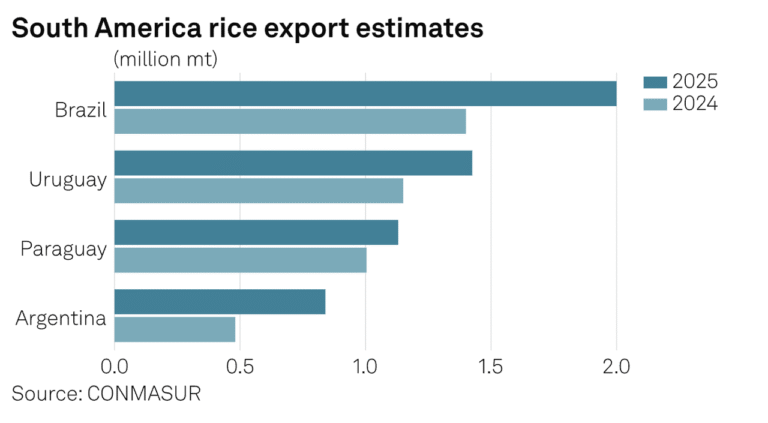
Bar chart showing south america rice exports by market value from 2024 vs 2025
As of 2025, Uruguay has become the 4th largest rice exporter globally, standing shoulder to shoulder with trade giants like India, Thailand, and Vietnam.
According to Conmasur, Uruguay’s rice exports are projected to hit over 1.4 million metric tons, a 24% surge from 2024, while production is expected to reach around 1.7 million metric tons, proof that efficiency and precision can rival size and scale.
Every grain that leaves its fields carries the stamp of a tightly integrated industry where farmers, millers, and exporters work as one. Companies like Casarone, one of the country’s key exporters, manage everything from cultivation to shipment, ensuring Uruguay’s rice meets the highest global standards. Its fields, spread across more than 180,000 hectares, achieve yields above 9,000 kg per hectare, reflecting an agricultural system that values both innovation and sustainability.
The return of India, the top country to export rice, has reshaped pricing, flooding markets and pulling rates downward. Brazil’s weaker currency adds another layer of pressure, squeezing margins for Uruguay’s exporters. And with 95% of its rice destined for foreign markets, Uruguay feels every ripple in global demand.
President Yamandú Orsi’s new administration is pushing trade missions into Central America and Mexico, opening doors to fresh buyers. As global demand shifts, Uruguay’s rice — prized for its purity and reliability — keeps the country firmly within the top 10 rice exporting countries in the world, proving that excellence, not size, defines true competitiveness.
#Top 5 Rice Export Country: Brazil- US$0.584B
According to TradeInt’s Brazil rice export data, Brazil exported US$584 million worth of rice in FY24/25, maintaining its 5th position among the world’s top five rice exporters. Its performance is supported by large-scale modern agriculture and strong domestic production capacity, allowing Brazil to meet demand in both nearby Latin American and African markets.
- Senegal – USD $33.02 million: The largest destination, reflecting Brazil’s growing foothold in West Africa’s rice market.
- Peru – USD $32.42 million: A stable Latin American trade partner driven by regional food security and proximity advantages.
- Mexico – USD $22.19 million: Expanding trade supported by Brazil’s competitive pricing and logistics connectivity.
- Gambia – USD $20.19 million: Growing exports highlight Brazil’s diversification into emerging African markets.
- Nicaragua – USD $18.96 million: Consistent demand in Central America reinforces Brazil’s influence in regional food trade.
Leading exporters such as Arrozeira da Quinta Alimentos LTDA, Craft Multimodal LTDA, and Rio Grande Importação Exportação e Comércio play a key role in maintaining Brazil’s export competitiveness through efficient logistics and strong trade networks.
Did you know, besides being the top exporters, Brazil also imports a lot of agricultural products, even including rice?
🔍 Read this article to discover: What Brazil imports the most from the world in 2025
As the largest rice producer in South America, Brazil is expected to harvest around 12 million metric tons in the 2025–26 season, benefiting from favorable weather and an expansion in planted areas. Yet, the first half of 2025 showed a 12.7% drop in exports, totaling 389,200 tons and US$123.1 million in revenue, according to Abiarroz (the Brazilian Rice Industry Association). The main destinations were Senegal, Gambia, and Peru, though shipments to Europe — particularly Portugal and the Netherlands — are also climbing.
June 2025 brought a notable rebound, with 71,800 tons exported, more than double the volume from a year earlier. Brazil’s exporters, led by Abiarroz’s trade initiatives, are finding new momentum through competitive pricing and trade diversification, especially as India, the top country to export rice globally, re-entered the market and reshaped global price dynamics.
By expanding shipments to Mexico, the country is tapping into one of Latin America’s fastest-growing import markets. Together, Brazil and Argentina are expected to capture about 35% of Mexico’s rice imports by the end of 2025, a sign of South America’s rising profile among the top 10 rice exporting countries in the world.
To stay competitive, Brazil has also eliminated import tariffs on certain rice categories, improving access for re-export and strengthening its regional trade position.
Regional Leadership and Export Concentration
Asia cemented its dominance as the world’s rice powerhouse, supplying about 90% of exports, USDA stated, with shipments worth $31.2 billion. The top five exporters, India, Thailand, Pakistan, Vietnam, and the United States, collectively captured 73.8% of global value, showing heavy reliance on a small group of suppliers.
India stood out with a record forecast of 145 million tons in 2024/25, driven by favorable weather and expanded planting. Thailand and Vietnam maintained their reputation as steady suppliers, while Pakistan pushed forward despite infrastructure and energy hurdles.
Outside Asia, exporters contributed modestly: Europe (7.1%), North America (6.4%), and Latin America (5.5%), while Oceania (0.63%) and Africa (0.55%) remained marginal players. This distribution underscores the concentration risk many importing regions face, being highly dependent on Asia’s output.
Production Gains and Setbacks
A report by USDA on November 2024 claimed that global rice production rose 3.4 million tons to 533.8 million tons (milled basis) in 2024/25, largely due to India’s record harvest. Additional increases came from Guinea and Nepal, while declines in Bangladesh, Burma, and Laos reflected the pressures of weather shocks and resource challenges. Total supplies reached a record 713.1 million tons, up 10.6 million tons year-on-year, temporarily reinforcing market stability.
Looking ahead, 2025/26 is projected to push production further to 541.5 million tons, USDA forecasts, with larger harvests in Nigeria and the United States offsetting declines in Côte d’Ivoire, South Korea, and Uzbekistan. India and China will continue to dominate the global supply picture, together producing more than half of the world’s rice.

Rice trading prices among the top rice exporting countries from August 2021 to August 2025. Source: USDA
Consumption, Demand, and Challenges
In 2024, rice consumption rose steadily as rising incomes and population growth across Africa and Latin America fueled stronger demand, while Asia continued to anchor global intake.
Despite record supplies, the market already showed signs of tightening, with ending stocks shrinking in several key exporters such as Thailand, Vietnam, and Burma. This reflected not only strong outbound shipments but also weaker harvests in some regions, creating pockets of vulnerability beneath the record totals.
India’s bumper crop helped offset some of this pressure, but the reliance on a handful of top producers left the system exposed to risks ranging from climate volatility to sudden export bans.
The strong momentum of 2024 paints a picture of both promise and risk. Exporters have opportunities to expand into Africa and the Middle East, regions where demand is growing rapidly, while trade data shows room for more competitive pricing strategies to capture market share.
Conclusion
The rice trade of 2025 reveals that beyond the headline rankings, the real impact comes from changing prices, trade routes, and policies that are redefining the top rice exporting countries.
India may still dominate, but Vietnam is moving to higher volumes at lower margins, Thailand is defending market share with quality, and Pakistan is leveraging basmati at its competitive edge. Together, these dynamics show that the top rice exporting countries are competing in strategy, innovation, and adaptability.
For exporters, this article’s value lies in connecting the dots: understanding not only where rice is flowing, but also why trade routes, margins, and demand patterns are changing. Those who read the signals early will find opportunities hidden in volatility; those who don’t risk being left behind.
👉 Request a demo with TradeInt today to see how its near-real-time trade intelligence helps you spot shifting routes, anticipate competitor moves, and turn market disruptions into strategic advantages before your rivals do.