Table of Contents
What are Market Entry Strategies?
Market entry strategies are defined as planned approaches for businesses to enter new markets with their products or services, targeting growth through tailored market selection, entry modes, pricing, and distribution. Using trade data such as import-export records detailing volumes, values, and supplier-buyer dynamics, strategies become data-driven, identifying demand, competitors, and regulations. Supply chain optimization via verified trade data ensures efficient logistics, risk mitigation, and alignment with global trade trends for successful market entry.
Global market expansion offers businesses a powerful opportunity to drive growth, tap into new customer bases, and diversify revenue streams. However, success hinges on navigating complex factors such as regulatory frameworks, competitive landscapes, and local consumer behaviors.
This guide explores how businesses can leverage trade data to strategically enter new markets, ensuring decisions are data-driven and aligned with global trade dynamics.

Understanding Trade Data for Market Entry Strategies
Trade data encompasses detailed records of global transactions, including bills of lading, customs declarations, and shipping manifests. It reveals product demand, trade volumes, pricing trends, and supplier-buyer relationships, offering a clear view of market dynamics. For market entry strategies, trade data transforms uncertainty into opportunity by identifying viable markets, partners, and risks.
Unlike traditional research, trade data provides granular, verifiable insights. For example, HS code-specific data can highlight demand for specific products, while company profiles reveal active traders. TradeInt enhances this with AI-driven analytics, enabling businesses to filter by country, product, or company for precise, actionable intelligence.
Key trade data components include:
- Shipment Records: Details on volumes, values, origins, and destinations.
- Company Insights: Profiles of competitors, suppliers, and buyers.
- Market Trends: Patterns in trade lanes, tariffs, and demand shifts.
These elements empower businesses to develop market entry strategies that reduce risks and align with market realities.
What are the 5 Key Considerations before Leveraging Trade Data?
Successful market entry strategies begin with aligning internal capabilities and external conditions. Trade data informs several critical areas:
- Market Demand: Analyze import trends to confirm demand. High import growth signals opportunity, while stagnation may indicate saturation.
- Regulatory Environment: Cross-reference tariff and compliance data with local laws to anticipate barriers.
- Competitive Landscape: Use exporter-importer lists to identify key players and market gaps.
- Economic and Cultural Context: Combine trade data with macroeconomic and cultural insights for a holistic approach.
- Operational Readiness: Ensure teams can interpret data; user-friendly platforms like TradeInt simplify analysis for all levels.
These considerations ensure market entry strategies are grounded in data-driven realities, minimizing missteps.
What are the 7 Steps Guide to Market Entry Using Trade Data?
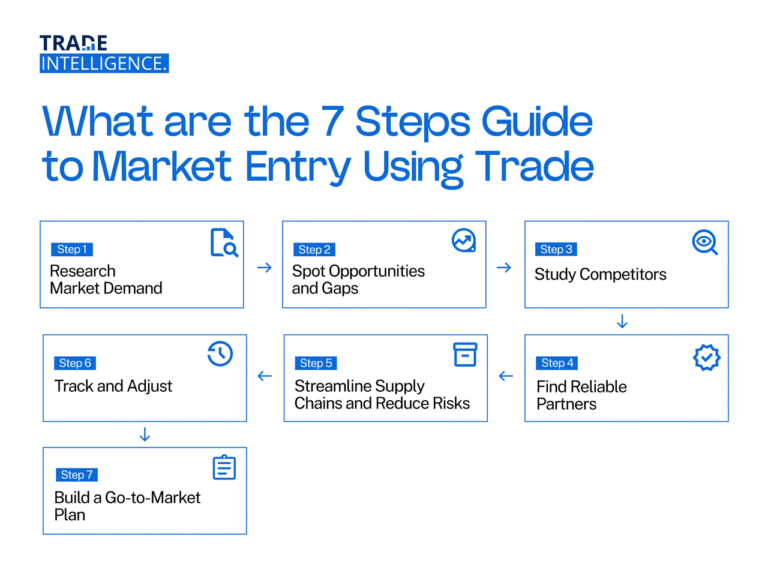
A structured approach leverages trade data to build effective market entry strategies. Below is a comprehensive roadmap:
- Research Market Demand: Use trade data to explore import and export trends in target markets. Focus on product-specific data to uncover demand patterns and growth opportunities, ensuring your entry aligns with market needs.
- Spot Opportunities and Gaps: Analyze trade volumes over time to identify emerging markets or underserved niches. For example, rising imports in a sector like renewable energy could indicate potential for expansion.
- Study Competitors: Examine competitors’ trade activities, such as sourcing and pricing, to understand their market positioning. This helps you differentiate your offerings, whether through better pricing or unique features.
- Find Reliable Partners: Identify trusted suppliers and buyers through trade data. Reviewing transaction histories ensures you connect with credible partners to support your market entry.
- Streamline Supply Chains and Reduce Risks: Study trade routes and historical data to optimize logistics and anticipate disruptions, like tariff changes or market instability, for smoother operations.
- Build a Go-to-Market Plan: Tailor your products, pricing, and marketing based on trade data insights to meet local preferences. Create targeted distribution strategies to establish a strong market presence.
- Track and Adjust: After launch, monitor key metrics like market share or sales growth using trade data. Regularly review performance to adapt your strategy and stay competitive.
How can trade data help overcome barriers to market entry?
- Regulatory Hurdles: Data on tariffs and trade compliance informs legal strategy.
- Cultural Misalignment: Import trends reveal consumer preferences, guiding product localization.
- Competitive Intensity: Detailed competitor data supports strategic positioning, such as targeting underserved niches.
- Operational Risks: Historical trade patterns predict volatility, enabling proactive contingency plans.
By addressing these barriers, trade data enhances entry resilience and success.
How do you evaluate a market entry strategies?
Measuring the success of market entry strategies is crucial for ensuring efforts and long-term growth. Trade data enables tracking of key performance indicators (KPIs) such as:
- Market Share Growth: Monitor changes in import volumes for your product category to gauge penetration.
- Revenue Impact: Compare sales data against trade data benchmarks to assess financial performance.
- Partner Engagement: Evaluate trade volumes with new suppliers or buyers to measure partnership strength.
- ROI Analysis: Calculate returns on marketing, logistics, and compliance investments using trade data cost metrics.
Advanced analytics platforms provide real-time dashboards with visualizations like market share trends or revenue forecasts, simplifying KPI tracking. Regular monitoring allows businesses to iterate strategies—adjusting pricing, shifting partners, or refining marketing—based on fresh data. For sustained success, integrate trade data into quarterly reviews to ensure alignment with evolving market conditions. This iterative approach ensures market entry strategies remain agile and effective over time, adapting to shifts in demand, competition, or regulations.
Strategic Insights for Emerging vs. Developed Markets
- Emerging Markets (e.g., Turkey, Malaysia): These regions offer high growth potential driven by rising consumer demand and digital adoption. Trade data highlights surging imports, such as consumer electronics in Indonesia, signaling entry opportunities. However, risks like regulatory shifts or infrastructure gaps require careful analysis of historical data. Advanced trend analytics identify fast-growing sectors, while risk assessment tools support scenario planning to mitigate uncertainties. Forming local partnerships, identified through supplier-buyer directories in trade databases, is critical for navigating volatile conditions and building trust with local stakeholders.
- Developed Markets (e.g., US, Germany): Stable but highly competitive, these markets demand precision and differentiation. Trade data uncovers niche opportunities, such as unmet demand for sustainable products in Europe, enabling targeted entry. High entry costs and strict regulations necessitate detailed compliance data, accessible through tariff schedules and company transaction records. Differentiation strategies, such as optimizing pricing or targeting underserved segments, are informed by granular trade insights. Robust analytics ensure alignment with stringent regulatory requirements and elevated consumer expectations, fostering long-term success.
By customizing market entry strategies to market maturity, businesses maximize impact. Comprehensive trade data platforms, with global coverage of import-export records, ensure relevance across both emerging and developed markets, enabling informed and adaptable strategies.
What are the common Market Entry Pitfalls to avoid?
Trade data helps businesses avoid frequent errors in market entry strategies:
- Overlooking Granularity: Broad data misses local nuances; uses HS code-specific insights for accuracy.
- Relying on Outdated Data: Stale data misguides strategy; TradeInt’s monthly updates ensure freshness.
- Neglecting Localization: Import trends must inform cultural adaptations, not just product offerings.
- Underestimating Risks: Cross-verify trade data with multiple sources to anticipate disruptions.
Proactive use of trade data strengthens market entry strategies and prevents costly missteps.
TradeInt: Your Solution for Data-Driven Market Entry

For businesses aiming to enter new markets using trade data, TradeInt Global offers a comprehensive solution to streamline and enhance market entry strategies. With access to over 400 million company profiles, trends across 200+ countries, and AI-driven analytics, TradeInt Global empowers businesses to:
- Identify High-Potential Markets: Use HS code searches and trend analytics to pinpoint demand and growth opportunities.
- Navigate Complex Regulations: Leverage tariff and compliance insights to ensure seamless market entry.
- Outmaneuver Competitors: Access detailed competitor profiles to craft differentiated strategies.
- Build Strategic Partnerships: Connect with verified suppliers and buyers through TradeInt’s matching tools.
- Monitor and Adapt: Utilize real trade data dashboards to track KPIs and adjust strategies dynamically.
TradeInt Global’s multilingual interface and monthly data updates make it an accessible, reliable partner for SMEs and enterprises alike. Whether entering emerging and developed markets, TradeInt Global provides the intelligence needed to transform trade data into successful market entry outcomes.