Top 10 Largest Importing Countries 2025: Trend & Free Data

Top 10 largest importing countries in 2025  featuring USA China Germany Japan South Korea France Canada Hong Kong and South Africa with TradeInt global trade visualization

Table of Contents

Top 10 largest importing countries 2025: Which country is the largest importer in 2025?

According to TradeInt’s global import–export database, the United States was the world’s largest importing country in 2025, with total imports reaching approximately US$2.54 trillion, driven by strong consumer demand and deep integration within North American supply chains. TradeInt’s latest data shows that U.S. imports were primarily sourced from Mexico, Canada, and China, with key inflows concentrated in vehicles and auto parts (HS 8703, HS 8704), machinery and electronics, and energy products (HS 2709) supporting manufacturing, transportation, and domestic consumption. By comparison, China followed closely with US$2.43 trillion in imports, while South Africa (US$1.73 trillion), Germany (US$1.14 trillion), and Hong Kong (US$684 billion) formed the next tier, highlighting the United States’ continued position as the largest global demand hub in 2025.

Which country imports the most in 2025?


  • United States— US$2.54 trillion: High import demand for vehicles, electronics, machinery, and energy products supports domestic consumption and industrial output.

  • China— US$2.43 trillion: Manufacturing-led imports focus on semiconductors, industrial components, and raw materials for export-oriented production.

  • South Africa— US$1.73 trillion: Imports are driven by fuels, machinery, and agricultural inputs supporting mining, infrastructure, and domestic consumption.

  • Germany — US$1.14 trillion:Import demand centers on vehicles, pharmaceuticals, and industrial components, sustaining advanced manufacturing and intra-EU supply chains.

  • Hong Kong— US$684 billion: Operates as a major re-export hub, with imports concentrated in electronics and high-value goods flowing between China and global markets.

  • Canada— US$592 billion: Strong cross-border trade with the United States drives imports of vehicles, machinery, and energy-related inputs.

  • Netherlands — US$565 billion:Functions as Europe’s logistics gateway, with imports driven by re-export activity, energy products, and industrial machinery.
Top 10 Largest Importing Countries in 2025
Rank Country Import Value (USD) Top 3 Export Countries Top 3 Import HS Code Economic Key Drivers
1 United States $2.54T 1. Mexico
2. Canada
3. China
1. 8471
2. 8703
3. 2709
High consumer demand, strong automotive and electronics imports, and deeply integrated North American supply chains drive sustained import volumes.
2 China $2.43T 1. Taiwan
2. South Korea
3. Japan
1. 8542
2. 2709
3. 2601
Manufacturing-led import demand for semiconductors, components, and raw materials supports export processing and technology upgrading.
3 South Africa $1.73T 1. China
2. India
3. United States
1. 2710
2. 9801
3. 8703
Heavy reliance on imported fuels, machinery, vehicles, and agricultural inputs supports mining, infrastructure, and domestic consumption.
4 Germany $1.14T 1. Netherlands
2. China
3. Poland
1. 8703
2. 8708
3. 3004
Automotive, machinery, and pharmaceutical imports support advanced manufacturing and intra-EU supply chain integration.
5 Hong Kong $684B 1. China
2. Taiwan
3. Singapore
1. 8542
2. 7108
3. 8517
Functions as a re-export hub driven by electronics, semiconductors, and high-value goods between China and global markets.
6 Canada $592B 1. United States
2. China
3. Mexico
1. 8703
2. 8704
3. 8708
Cross-border integration with the U.S. fuels imports of vehicles, machinery, and industrial inputs.
7 Netherlands $565B 1. China
2. Germany
3. United States
1. 2709
2. 8471
3. 8517
Acts as Europe’s logistics gateway, driven by re-export activity, energy products, and electronics through major ports.
8 South Korea $521B 1. China
2. United States
3. Japan
1. 2709
2. 8542
3. 2711
Import demand centers on semiconductors, energy resources, and industrial inputs supporting advanced manufacturing.
9 France $506B 1. Germany
2. Belgium
3. Netherlands
1. 8703
2. 2709
3. 2711
Automotive, energy, and industrial imports support diversified demand within strong intra-EU trade flows.
10 Japan $485B 1. China
2. United States
3. Taiwan
1. 8517
2. 8542
3. 8471
High dependence on imported energy, semiconductors, and components sustains advanced manufacturing and technology-intensive industries.
Data Source: TradeInt
TradeInt Logo
✔ Lite   ✔ Pro   ✔ Premium   ✔ Enterprise

Import data is only powerful when you can act on it — that’s where TradeInt stands apart

As a global trade intelligence platform, we enable importers like you to:

  • Trace real import transactions down to the shipment and Bill of Lading level
  • Discover verified suppliers already exporting to top importing countries
  • Track demand shifts and sourcing changes in near real time
  • Benchmark competitor import activity and supplier relationships
  • Turn raw trade data into actionable sourcing decisions
Unlock TradeInt’s global import data

Top 1 Largest Importing Country: United States | USD$2.54 trillion

How much has the United States imported in 2025?

According to TradeInt’s global import–export database, the United States imported about US$2.54 trillion worth of goods in 2025, maintaining its position as the world’s largest import market. U.S. imports were primarily sourced from Mexico (US$386.73B), Canada (US$283.86B), and China (US$235.21B), led by telecom and electronic equipment (HS 8471) from Mexico and China and crude petroleum (HS 2709) from Canada, supporting manufacturing, technology, and energy demand, while Vietnam (US$137.27B) and Taiwan (US$132.83B) followed as key suppliers of electronics and industrial components, highlighting the breadth of U.S. global supply-chain reliance in 2025.

Which countries did the United States import most from in 2025?

  • Mexico— US$386.7 billion: The U.S.’s largest import partner, driven by tightly integrated supply chains in electronics, automotive components, and manufacturing inputs.

  • Canada — US$283.9 billion:A critical energy and industrial supplier, with imports centered on crude oil, refined fuels, and cross-border manufacturing goods.

  • China— US$235.2 billion: A major source of electronics, machinery, and consumer goods supporting U.S. retail and technology demand.

  • Vietnam— US$137.3 billion: An increasingly important manufacturing hub, supplying electronics, electrical equipment, and assembled consumer products.

  • Taiwan— US$132.8 billion: Strategically significant for advanced electronics and semiconductor-related imports supporting U.S. technology and industrial sectors.
United States Top Imports by Country, 2025
Rank Country Import Value (USD) Share (%) Top HS Code Top 3 Import Companies Top 3 Export Company
1 Mexico $386,725,091,998 15.24% 8471 1. INVENTEC DISTRIBUTION NORTHAMERICA CO
2. NUMBER ONE EXPEDITE INC
3. QOLSYS CO JUSDA SUPPLY CHAIN MANAGEMENT
1. WIWYNN MEXICO SA DE CV
2. INGRASYS TECHNOLOGY MEXICO SA DE CV
3. PCE TECHNOLOGY DE JUAREZ SA DE CV
2 Canada $283,856,952,230 11.18% 2709 1. MARATHON PETROLEUM COMPANY LP
2. SUNCOR ENERGY USA MARKETING INC
3. PBF ENERGY LIMITED
1. SUNCOR ENERGY MARKETING INC
2. MARATHON PETROLEUM CANADA TRADING
3. CHEVRON CANADA TRADING LIMITED
3 China $235,211,172,579 9.27% 8471 1. BLOCKSTREAM SERVICES CANADA ULC
2. WESTROCK CP LLC
3. UPS OCEAN FREIGHT SERVICES INC
1. BEIJING FENGFU ZHILIAN TECHNOLOGY CO
2. OIA GLOBAL LOGISTICS THAILAND LTD
3. HOXIN PRECISION THAILAND CO LTD
4 Vietnam $137,268,065,762 5.41% 8471 1. DHL GLOBAL FORWARDING
2. SHIPCO TRANSPORT INC
3. AMAZON COM SERVICES LLC DGL
1. CÔNG TY TNHH FUKANG TECHNOLOGY
2. CÔNG TY TNHH ĐIỆN TỬ BYD VIỆT NAM
3. CÔNG TY TNHH COMPAL VIỆT NAM
5 Taiwan $132,829,255,138 5.23% 8471 1. WESTROCK CP LLC
2. VIEWSONIC CORPORATION
3. DELTA ELECTRONICS AMERICAS LTD
1. OIA GLOBAL LOGISTICS THAILAND LTD
2. AMTRAN VIETNAM TECHNOLOGY CO LTD
3. DELTA ELECTRONICS INC TAINAN
Data Source: TradeInt

💡Want to see the latest insights into what the U.S. is importing?

Explore United States Trade Data on TradeInt to track actual import shipments, top suppliers, HS codes, and buyer activity across the world’s largest importing market.

Key Market Trade Trends in 2025

The United States reached US$2.60 trillion in imports through September 2025, marking a 7.33% increase and crossing the $2.5 trillion threshold for the first time. The country maintained its position as the largest importing country globally, though import patterns shifted significantly amid policy changes.

According to Forbes, growth drivers powering expansion included:

  • Precious metals positioning:Articles with precious metals surged 1,003.42% ($68.31 billion increase), and gold imports rose 158.55% as economic uncertainty drove investor demand

  • Healthcare innovation:Insulin, hormones, and steroids exceeded 100% growth, driven by GLP-1 drugs like Wegovy and Ozempic reaching mass market adoption

  • Technology infrastructure:Computers and natural gas/LNG maintained strong import demand, supporting domestic consumption

Standout declines demonstrated policy-driven disruption:

  • Automotive sector:Passenger vehicles dropped significantly as tariffs affected major suppliers—Japan down 7.72%, South Korea down 18.53%, Germany down 13.97%

  • Energy independence:Oil and gasoline imports fell as domestic production increased and global prices softened

  • Luxury goods:Diamond imports declined due to tariff impacts on Indian suppliers and lab-grown diamond competition

Source diversification accelerated notably, with China imports falling 16.9% while EU imports jumped 14.3% and Mexico gained substantial shares. Early-year frontloading drove January-July real goods imports 10% above 2024 levels.

Market Opportunities & Future Outlook in 2026

Contraction signals dominate the largest importer country’s near-term trajectory. October port volumes reached 2.07 million TEU, down 7.9% year-over-year, with accelerating declines projected through Q1 2026.

Volume forecasts indicate sustained pressure:|

  • Q1 2026 weakness:January (-10.3%), February (-8.5%), March (-16.8%), April (-10.9%) all showing double-digit year-over-year declines

  • Policy uncertainty impact:Container shipping rates are declining on both coasts as demand weakens for goods from Asia and Europe

  • Inventory management shift:Retailers are fully stocked after early-year frontloading, reducing replenishment needs despite holiday sales topping $1 trillion

Top 2 Largest Importing Country: China | USD$2.43 trillion

How much does China import in 2025?

China imported approximately US$2.43 trillion worth of goods in 2025, ranking as the second-largest importing country worldwide, according to global trade data from TradeInt. China’s import demand is largely tied to manufacturing supply chains, particularly for semiconductors, electronic components, and industrial inputs. Imports are concentrated among East Asian partners and key resource suppliers, supporting domestic production, export processing, and ongoing technology upgrading.

What countries does China import the most from in 2025?

  1. Taiwan— US$251.3 billion: China’s top import source, mainly supplying semiconductors and advanced electronic components critical to manufacturing and technology sectors.
  2. South Korea— US$234.2 billion: A major supplier of chips, electronic parts, and industrial materials used in high-value manufacturing.
  3. Japan— US$148.6 billion: Provides precision machinery, electronic components, and specialized industrial equipment.
  4. United States — US$129.0 billion: Supplies technology-related products, industrial inputs, and selected high-value goods despite broader trade diversification.
  5. Australia— US$117.8 billion: A key source of raw materials and resources supporting China’s industrial and processing industries.
China Imports 2025
Rank Country Import Value (USD) Share (%) Top HS Code Top 3 Importers Top 3 Export Company
1 Taiwan $251,276,717,542 10.35% 8542 1. INTEL CORPORATION
2. CLOUD NETWORK TECHNOLOGY SINGAPORE PTE LTD
3. PROFIT NEW LIMITED
1. CÔNG TY TNHH INTEL PRODUCTS VIỆT NAM
2. CÔNG TY TNHH PRECISION TECHNOLOGY COMPONENT FULIAN
3. CÔNG TY TNHH FUHONG PRECISION COMPONENT BẮC GIANG
2 South Korea $234,182,561,651 9.65% 8542 1. INTEL CORPORATION
2. PROFIT NEW LIMITED
3. BANG TAI INTERNATIONAL LOGISTICS CO
1. CÔNG TY TNHH INTEL PRODUCTS VIỆT NAM
2. SMART MODULAR TECHNOLOGIES SDN BHD
3. CÔNG TY TNHH PRECISION TECHNOLOGY COMPONENT FULIAN
3 Japan $148,601,425,715 6.12% 8542 1. CÔNG TY TNHH PRECISION TECHNOLOGY COMPONENT FULIAN
2. SUMITRONICS HONGKONG LIMITED
3. HOSIDEN CORPORATION CO NEW LUCK COMPANY LTD
1. CÔNG TY TRÁCH NHIỆM HỮU HẠN UNIGEN VIỆT NAM HÀ NỘI
2. CÔNG TY TNHH KHOA HỌC KỸ THUẬT GOERTEK VINA
3. SANDISK STORAGE MALAYSIA SDN BHD
4 United States $129,037,161,949 5.31% 8542 1. HOSIDEN CORPORATION CO ZHUHAI MITSUMI ELECTRIC CO LTD
2. GOERTEK HONGKONG CO LIMITED
3. CLOUD NETWORK TECHNOLOGY SINGAPORE PTE LTD
1. CÔNG TY TNHH HOSIDEN VIỆT NAM BẮC GIANG
2. CÔNG TY TNHH KHOA HỌC KỸ THUẬT GOERTEK VINA
3. CÔNG TY TNHH INTEL PRODUCTS VIỆT NAM
5 Australia $117,784,270,671 4.85% 2601 🔒 Discover China’s Importing Companies 🔒 Discover Global Country Exporting Companies
Data Source: TradeInt

💡China’s import activity is best understood at the shipment and HS-code level.
Search China Trade by HS Code on TradeInt to review import volumes by product, compare commodity market shares, and analyse long-term import trends using interactive visual tools.

Key Market Trade Trends in 2025

According to China Briefing, China’s imports reached 18.48 trillion yuan (~US$2 trillion) in 2025, up 0.5% year-on-year, cementing its position as the world’s second-largest import market for 17 consecutive years among the top importing countries.

china import growth rate 2025

Growth drivers powering expansion included:

  • Technology infrastructure:Integrated circuits remained the largest category at US$228 billion, with electronic components and automatic data processing equipment (US$56 billion) expanding at an accelerated pace

  • Industrial upgrading:Petrochemicals, textiles, and machinery recorded double-digit growth as domestic production advanced

  • Consumer resilience:Food and beverages up 8.8%, cultural products up 10.8%, cosmetics reached US$10 billion, supported by premium demand

Commodity price volatility masked volume strength:

  • Energy and raw materials:Crude oil (US$171 billion), natural gas (US$32 billion), and coal (US$19 billion) showed volume increases despite average prices falling >10% YoY

  • Agricultural staples:Soybeans (US$27 billion) and cereals (US$32 billion) maintained substantial inflows

Market Opportunities & Future Outlook in 2026

Another China Briefing paper reported that China implemented provisional tariff reductions on 935 product categories effective January 2026, targeting high-tech components, healthcare products, and green transition materials:


  • Semiconductor manufacturing:Reduced tariffs on constant temperature control devices and specialized equipment supporting domestic capacity expansion

  • Healthcare advancement:Artificial blood vessels (4% to 2%), diagnostic kits for infectious diseases (3% to 0%), medical device components (8% to 4%)

  • Clean energy scaling:Battery materials, including recycled black powder (6.5% to 3%), unroasted pyrite (1% to 0%), supporting a 3,600 GW renewable capacity target by 2035

Top 3 Largest Importing Country: South Africa | USD$1.73 trillion

How much does South Africa import in 2025?

According to TradeInt’s global import–export database, South Africa imported approximately US$1.73 trillion worth of goods in 2025, reflecting strong demand across energy, manufacturing, and consumer sectors. TradeInt’s latest data shows that imports were led by China (US$383.88B), dominated by telecommunications and electronics equipment (HS 8517), followed by India (US$126.24B), largely driven by coal and solid fuels (HS 2702), and the United States (US$121.08B), with key inflows in electronic integrated circuits and advanced components (HS 8542) supporting industrial and technology needs. Beyond the top three, Germany (US$120.25B) and Thailand (US$57.13B) also ranked among South Africa’s major suppliers, highlighting the country’s diversified sourcing strategy across Europe and Asia in 2025.

Which countries does South Africa import the most from in 2025?

  • China— US$383.9 billion: South Africa’s largest supplier, mainly providing electronics, machinery, and manufactured goods used across retail, mining, and infrastructure sectors.

  • India— US$126.2 billion: Supplies refined fuels, chemicals, and industrial inputs supporting energy use and manufacturing activity.

  • United States— US$121.1 billion: Key sources of technological products, industrial equipment, and specialized machinery.

  • Germany— US$120.2 billion: Imports focus on vehicles, automotive components, and high-quality industrial machinery.

  • Thailand — US$57.1 billion:Supplies electronics, machinery parts, and consumer goods supporting domestic demand and distribution.
South Africa Imports 2025
Rank Country Import Value (USD) Share (%) Top HS Code Top 3 Importers Top 3 Export Company
1 China $383,881,931,373 22.14% 8517 1. THE CORE COMPUTER BUSINESS NBLOCK G WINGFIELD PARK NGEERTSMA
2. BUDGET CELLULAR
3. AFRILEK AUTOMATION PTY LTD
1. PC CENTRE PTY LTD
2. ECONET TELECOM LESOTHO PTY LTD
3. ECOPROJECTS CC NBOX
2 India $126,238,292,832 7.28% 2702 🔒 Discover South Africa’s Importing Companies 🔒 Discover Global Country Exporting Companies
3 United States $121,083,086,161 6.98% 8542
4 Germany $120,247,791,281 6.93% 8703
5 Thailand $57,126,842,362 3.29% 8471
Data Source: TradeInt
💡Read TradeInt’s in-depth analysis on the Top 5 Countries From Which South Africa Imports Products in 2025 to see which countries dominate supply, how import values compare, and what this means for sourcing and trade strategy.

Key Market Trade Trends in 2025

South Africa’s imports reached R150.3 billion in November 2025, up 2.9% year-on-year, though the year-to-date trade surplus of R178.8 billion trailed 2024’s R182.5 billion as the country maintained its position among the largest importing countries in Africa.

Import composition reflected resource and manufacturing dependencies:

  • Petroleum products:Crude and refined petroleum oils dominated inflows as South Africa remained a net fuel importer despite domestic refining capacity

  • Automotive supply chains:Original equipment components and passenger motor vehicles sustained substantial volumes supporting local assembly operations

  • Agricultural staples:Wheat imports projected at 1.74 million tonnes (down 5% from the previous season) as improved domestic harvest of 1.98 million tonnes still covered only half of the 3.8 million tonnes annual consumption needs

Imports decreased 14.9% between October and November, driven by lower petroleum product purchases, reflecting global oil price fluctuations and rand strength against the dollar (R17.22 to R16.85 per USD).
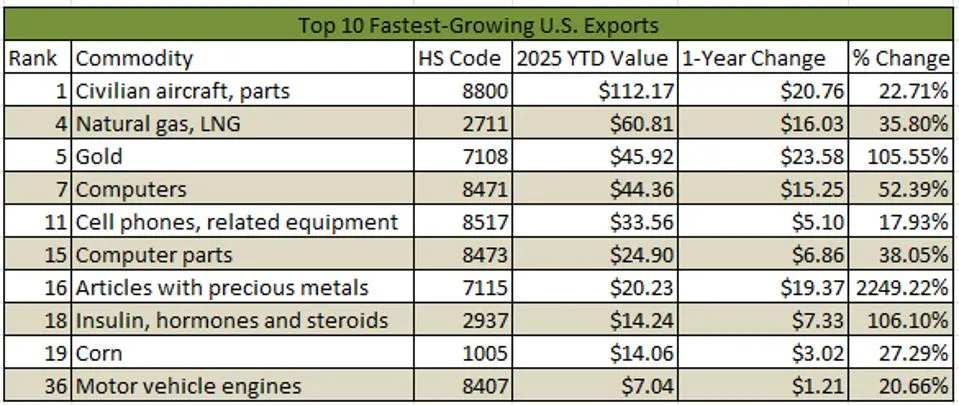
Top 10 fastest growing US Export categories
Top 10 fastest-growing U.S. Export categories

Market Opportunities & Future Outlook in 2026

Fuel price relief opened 2026 with diesel down R1.50 per litre from January 7, driven by declining Brent crude (USD 63.55 to USD 61.47) and currency appreciation. The adjustment underscores South Africa’s structural exposure to international petroleum markets as domestic refining capacity continues declining.


Wheat import reduction to 1.74 million tonnes reflects a 12,000-hectare expansion in planted area (517,300 hectares total), though volumes remain well below 2021’s 2.28 million tonne production peak. Import bill eased from $537.8 million in 2024 as Northern Cape, Free State, and Eastern Cape provinces posted improved yields.

Trade balance outlook for 2026 hinges on global commodity price movements and rand stability, with petroleum products and automotive components remaining primary import drivers for this largest importer country in the region.

Top 4 Largest Importing Country: Germany | USD$1.14 trillion

How much does Germany import in 2025?

According to TradeInt’s global import–export database, Germany imported approximately US$1.14 trillion worth of goods in 2025, reflecting its role as Europe’s largest manufacturing and consumption hub. TradeInt’s latest data shows that German imports were led by the Netherlands (US$158.74B), dominated by mineral fuels and energy products (HS 2710), followed by China (US$85.61B), primarily supplying telecommunications equipment (HS 8507), and Poland (US$80.21B), driven by vehicle parts and automotive components (HS 8708) supporting Germany’s industrial base. Beyond the top three, Belgium (US$65.88B) and France (US$63.69B) also ranked among Germany’s key suppliers, underscoring the country’s deep integration within both global and intra-EU supply chains in 2025.

Top Germany imports by country in 2025

  1. Netherlands— US$158.7 billion: Germany’s top import partner, acting as a key logistics and energy gateway for oil, gas, and bulk goods entering Europe.

  2. China — US$85.6 billion:Supplies machinery, electronics, and manufactured components used in German industrial and consumer markets.

  3. Poland — US$80.2 billion:An important regional manufacturing partner, providing automotive parts and industrial inputs through integrated EU supply chains.

  4. Belgium— US$65.9 billion: Imports focus on energy products, chemicals, and transit goods moving through major European ports.

  5. France— US$63.7 billion: A close intra-EU partner supplying vehicles, industrial products, and specialized manufactured goods.

💡Germany’s position as a major importing country is built on thousands of active buyers.

Identify top importing companies, review their product focus, and understand how import demand
is distributed across Germany’s industrial and manufacturing sectors using TradeInt’s collected data on Top Germany Importers.

Germany Imports 2025
Rank Country Import Value (USD) Share (%) Top HS Code Top 3 Importers Top 3 Export Company
1 Netherlands $158,743,755,343 13.91% 2710 1. ADOLF WURTH GMBH
2. N/A
3. N/A
1. ADOLF WURTH GMBH
2. N/A
3. N/A
2 China $85,611,813,908 7.50% 8507 1. CÔNG TY TNHH GREEN PLANET DISTRIBUTION CENTRE
2. CÔNG TY TNHH DATALOGIC VIỆT NAM
3. CÔNG TY TNHH HH POWER TECHNOLOGY
1. TTI PARTNERS SPC ACTING FOR THE ACCOUNT OF MPV SP ALFRED KARCHER SE CO
2. TTI PARTNERS SPC ACTING FOR THE ACCOUNT OF MPV SP AL KA SE CO KG
3. TTI PARTNERS SPC ACTING FOR THE ACCOUNT OF MPV SP ALFRED KARCHER SE
3 Poland $80,210,836,778 7.03% 8708 🔒 Discover Germany’s Importing Companies 🔒 Discover Global Country Exporting Companies
4 Belgium $65,883,037,189 5.77% 8703
5 France $63,692,917,928 5.58% 3004
Data Source: TradeInt

Key Market Trade Trends in 2025

Germany’s imports reached €1.03 trillion through September 2025, up 4.8% from 2024, as one of the top importing countries bought more goods from abroad than it sold, according to the Nation Federal Ministry for Economic Affairs and Energy. The trade surplus dropped to €15.3 billion in September (down from €18.0 billion a year earlier), marking the lowest level since October 2024 for this largest importer country in Europe.

Import growth powered by:

  • Higher energy and commodity costs:Import prices rose 0.2% in June as Germany paid more for energy and raw materials needed for manufacturing

  • Strong domestic buying:Imports jumped 3.1% in September despite weak global demand, showing German consumers and businesses continued purchasing foreign goods

  • Manufacturing needs:Factories require steady flows of production inputs to maintain operations

Market Opportunities & Future Outlook in 2026

Global trade faces headwinds. The CPB World Trade Monitor showed worldwide goods trade fell 0.9% in May, while European port activity stagnated at 136.5 points through June, signaling uncertainty among the top 10 largest importing countries in 2025.

The IMF expects global trade to grow 2.6% in 2025, then slow to 1.9% in 2026 due to trade tensions and new barriers.

For Germany, among the largest importing countries, imports will likely stay strong as energy transition projects and factory upgrades require continued purchases of technology and industrial components from abroad, reinforcing its position as a major driver of global import demand.

Top 5 Largest Importing Country: Hongkong | US$684 billion

How much does Hong Kong import in 2025?

According to TradeInt’s global import–export database, Hong Kong imported approximately US$684 billion worth of goods in 2025, underscoring its role as a global re-export and electronics trading hub. TradeInt’s latest data shows that imports were led by China (US$186.32B), dominated by electronic integrated circuits (HS 8542), followed by Taiwan (US$71.65B), also centered on semiconductors and advanced chips (HS 8542), and Singapore (US$47.29B), driven by high-value electronics and precision components (HS 8542) supporting regional redistribution. Beyond the top three, Japan (US$36.56B) and Vietnam (US$33.11B) ranked among Hong Kong’s key suppliers, reflecting strong electronics-led supply chain integration across East and Southeast Asia in 2025.

Where does Hong Kong import from in 2025?

  • China— US$186.3 billion: Hong Kong’s largest source of imports, mainly electronics and electronic components supporting re-export activity.

  • Taiwan — US$71.6 billion:A key supplier of semiconductors and advanced electronic parts used in regional manufacturing and redistribution.

  • Singapore— US$47.3 billion: Supplies high-value electronics and acts as a logistics and technology trading partner.

  • Japan— US$36.6 billion: Provides precision electronics, machinery, and specialized industrial components.

  • Vietnam— US$33.1 billion: An emerging source of electronics and assembled products feeding Hong Kong’s re-export supply chains.
Hong Kong Imports 2025
Rank Country Import Value (USD) Share (%) Top HS Code Top 3 Importers Top 3 Export Company
1 China $186,315,953,363 27.22% 8542 1. CLOUD NETWORK TECHNOLOGY SINGAPORE PTE LTD
2. PROFIT NEW LIMITED
3. INTEL CORPORATION
1. CÔNG TY TNHH PRECISION TECHNOLOGY COMPONENT FULIAN
2. CÔNG TY TNHH CÔNG NGHỆ CHÍNH XÁC FUYU
3. SMART MODULAR TECHNOLOGIES SDN BHD
2 Taiwan $71,646,643,842 10.47% 8542 1. CLOUD NETWORK TECHNOLOGY SINGAPORE PTE LTD
2. PROFIT NEW LIMITED
3. INTEL CORPORATION
1. CÔNG TY TNHH PRECISION TECHNOLOGY COMPONENT FULIAN
2. CÔNG TY TNHH CÔNG NGHỆ CHÍNH XÁC FUYU
3. SMART MODULAR TECHNOLOGIES SDN BHD
3 Singapore $47,290,322,225 6.91% 8542 1. SHENZHEN FUTAIHONG PRECISION INDUSTRIAL CO LTD
2. CLOUD NETWORK TECHNOLOGY SINGAPORE PTE LTD
3. JABIL INTERNATIONAL TREASURY PTE LTD
1. CÔNG TY TNHH FUSHAN TECHNOLOGY VIỆT NAM
2. CÔNG TY TNHH CÔNG NGHỆ CHÍNH XÁC FUYU
3. CÔNG TY TNHH JABIL VIỆT NAM
4 Japan $36,556,351,394 5.34% 7108 🔒 Discover Hong Kong’s Importing Companies 🔒 Discover Global Country Exporting Companies
5 Vietnam $33,106,998,694 4.84% 8517
Data Source: TradeInt
TradeInt Logo
✔ Lite   ✔ Pro   ✔ Premium   ✔ Enterprise

TradeInt plays as your importing solution

We give importers a clear view into who competitors buy from, how often shipments move, and which products dominate re-export flows:

  • Track competitor and partner import movements
  • Identify high-volume suppliers and repeat buyers
  • Measure market share and sourcing concentration
  • Evaluate import performance by product and route
See how TradeInt supports smarter importer decisions with real trade data

Key Market Trade Trends in 2025

Hong Kong’s imports surged 18.1% year-on-year to $517.4 billion in November 2025, with January-November imports up 14.1% as one of the top importing countries maintained its position as Asia’s premier re-export hub. Import volumes climbed 15.7% in October while prices rose 2.3%, demonstrating strong purchasing power.

Data reported from Census and Statistics Department, The Government of the Hong Kong Special Administrative Region, showed that import acceleration driven by technology and re-export demand:

  • Electronics and electrical machinery dominance:Electrical machinery imports jumped $34.1 billion (+16.9%) in November, telecommunications and sound equipment surged $16.8 billion (+34.3%), reinforcing electronics’ 70%+ share of total import value

  • Regional supply chain shifts:Vietnam import volumes exploded 175.6% in October (70.1% in May), reflecting manufacturing diversification and component sourcing away from traditional suppliers

  • Mainland China integration:Import volumes from Mainland China rose 18.2% in October (17.1% in May), maintaining Hong Kong’s role as gateway for Chinese goods redistribution

  • Price stability supporting volume growth:Import prices increased just 2.3% year-on-year, allowing volume expansion to drive overall value gains

Terms of trade improved 0.2% in October 2025, indicating favorable pricing conditions for this largest importer country in the region.

Market Opportunities & Future Outlook in 2026

AI-related electronics expected to drive 8-9% export growth, directly boosting component import demand as Hong Kong’s re-export model requires corresponding upstream purchases. Trade shows including Hong Kong Toys & Games Fair and Baby Products Fair (January 2026) highlight sector recovery momentum.

Technology and consumer sectors powering import expansion:

  • AI and smart systems boom:Rising demand for AI-enabled electronics, telecommunications equipment, and electrical components requiring specialized high-tech imports supporting manufacturing and re-export operations

  • Toys and games rebound:Sector recovery in retail and e-commerce channels driving renewed import demand for consumer products after previous slowdown

  • Regional sourcing diversification:Vietnam and Taiwan cementing positions as key suppliers (Taiwan export volumes +43-48%, Vietnam +52.6%) as businesses rebalance supply chains

Seasonally adjusted data shows import values up 2.8% in three months ending November 2025 versus prior three months, indicating sustained momentum. The largest importing countries in Asia face continued re-export dependency, with 70%+ of imported goods destined for further processing and redistribution, reinforcing Hong Kong’s strategic position in global trade flows despite geopolitical uncertainties affecting traditional partners.

Top 6 Largest Importing Country: Canada | US$592 billion

What country does Canada import from the most in 2025?

Canada imports the most from the United States, with import value reaching US$592 billion in 2025. This reflects Canada’s strong dependence on cross-border supply chains, especially in vehicles, machinery, and consumer goods. Other key suppliers—including China, Mexico, Germany, and Japan—support Canada’s electronics demand, automotive production, and industrial manufacturing needs.

Who are Canada’s top 5 import partners in 2025?

  • United States — US$305.7 billion:Canada’s largest import partner, driven by integrated North American supply chains for vehicles, machinery, food, and consumer products.

  • China — US$76.1 billion:Supplies electronics, electrical equipment, and consumer goods supporting retail and manufacturing demand.

  • Mexico — US$43.3 billion:A key automotive and manufacturing partner, exporting vehicles and auto parts to Canada.

  • Germany — US$20.9 billion: Imports focus on vehicles, automotive components, and industrial machinery.

  • Japan — US$17.5 billion:Supplies automobiles, vehicle parts, and advanced manufacturing equipment.
Canada Imports 2025
Rank Country Import Value (USD) Share (%) Top HS Code Top 3 Importers Top 3 Export Company
1 United States $305,715,163,649 46.30% 8704 1. CEVA LOGISTICS
2. N/A
3. N/A
1. GOLDEN STATE VINTNERS
2. NIVO LLC
3. N/A
2 China $76,122,644,407 11.53% 8517 1. SANDVINE CORPORATION
2. SAMSUNG ELECTRONICS AMERICA INC
3. CROSS TELEPHONE COMPANY
1. SEKOM ILETISIM SISTEMLERI SANAYI VE TICARET ANONIM SIRKETI
2. CÔNG TY TNHH SAMSUNG ELECTRONICS VIỆT NAM THÁI NGUYÊN
3. FLEXTRONICS TECHNOLOGY PENANG SDN
3 Mexico $43,263,076,307 6.55% 8703 1. NISSAN NORTH AMERICA INC
2. VOLKSWAGEN GROUP OF AMERICA
3. MERCEDES BENZ AG
1. COOPERATION MANUFACTURING PLANT AGUASCALIENTES S A P I DE CV
2. VOLKSWAGEN DE MEXICO SA DE CV
3. HONDA DE MEXICO SA DE CV
4 Germany $20,915,513,243 3.17% 8703 1. ALLCARGO EXPRESS INC
2. INTER PAR LOGISTICS INC
3. KEVIN DEDYS
1. ALLIANCE SERVICES INTERNATIONAL
2. BAYERISCHE MOTOREN WERKE
3. INTERNATIONAL VEHICLE SHIPPING SERV
5 Japan $17,545,171,907 2.66% 8703 1. SARAH ELIZABETH ERLICHMAN
2. JOSHUA BREBNER TABAH
3. IAN MCGRATH
1. CHRISTOPHER JAMES THORNLEY
2. CFAO MOBILITY KENYA LIMITED
3. JANINE COCKER
Data Source: TradeInt
💡For a wider perspective on how Canada compares with other major markets, check out Top 10 Largest Importing Countries in 2024–2025 on TradeInt to see the full ranking, import values, and how global import volumes are evolving across key economies.

Key Market Trade Trends in 2025

Data from the Government of Canada reported that goods imports declined for three consecutive months through May 2025, down 1.6% as one of the top importing countries faced weakening domestic demand. September showed continued pressure with imports from non-U.S. sources falling 7.3%, though the trade deficit narrowed to $8.5 billion (lowest since October 2024).

Import composition reflected industrial slowdown:


  • Metal and mineral products:Declined 16.8% in May, driven by unwrought gold, silver, and platinum group metals plunging 43.2% after April’s record high

  • Automotive sector weakness:Motor vehicles and parts fell 5.3%, with passenger cars and light trucks down 9.7% to their lowest level in over 2 years

  • Consumer goods resilience:Rose 4.3% from video game consoles and pharmaceutical products, partially offsetting industrial declines

Goods imports from the U.S. fell 1.2% in May (third straight monthly drop). Import prices declined 1.0% while volumes fell 0.6%, reflecting subdued purchasing power among the largest importing countries.

Market Opportunities & Future Outlook in 2026

The Bank of Canada projects continued import weakness through late 2025, with real GDP growth of 1.2% in 2025 and 1.1% in 2026. Q3’s 2.6% GDP growth was driven mainly by declining imports, particularly industrial machinery, a trend signaling weak investment that could limit competitiveness.

Subdued domestic demand and U.S. tariff impacts on key sectors (vehicles, steel, aluminum, copper, furniture, softwood lumber) will suppress imports through year-end. Recovery anticipated in 2026-2027 as businesses adapt to trade barriers and economic conditions improve.

However, the drop in industrial machinery imports aligns with investment weakness that may hinder Canada’s ability to modernize production capacity, presenting challenges for this largest importer country in maintaining competitive positioning among top importing countries globally.

Top 7 Largest Importing Country: Netherlands | US$565 billion

What is the import value of the Netherlands in 2025?

According to TradeInt’s global trade data, the Netherlands imported approximately US$565 billion in 2025. This high import value reflects the country’s role as Europe’s main logistics and re-export hub, with imports focused on electronics, energy products, machinery, and transit goods moving through major ports such as Rotterdam to other EU markets.

Who are the main import partners of the Netherlands in 2025?

  • China — US$80.3 billion:The largest source of imports, mainly electronics, IT equipment, and manufactured goods entering Europe via Dutch ports.

  • Germany — US$79.1 billion:Strong intra-EU trade partner supplying vehicles, machinery, and industrial components.

  • United States — US$51.0 billion:Imports driven by energy products, chemicals, and high-value industrial goods.

  • Belgium — US$41.9 billion:Close logistics partner, with imports tied to energy, chemicals, and port-to-port transit trade.

  • Ireland — US$20.1 billion:Supplies pharmaceuticals and high-value manufactured products serving European distribution networks.
Netherlands Imports 2025
Rank Country Import Value (USD) Share (%) Top HS Code Top 3 Import Companies Top 3 Export Company
1 China $80,333,242,329 14.23% 8471 1. NETAPP BV C O TECHDATA
2. ASUS BV
3. DELL PRODUCTS
1. ORACLE TECHNOLOGY SYSTEMS KENYA LIMITED
2. FREIGHT IN TIME LIMITED
3. ELEVETUS TECHNOLOGIES LIMITED
2 Germany $79,142,825,512 14.02% 8703 🔒 Discover Netherlands’s Importing Companies 🔒 Discover Global Country Exporting Companies
3 United States $51,016,738,210 9.03% 2709
4 Belgium $41,896,836,637 7.42% 2710
5 Ireland $20,069,296,479 3.55% 3002
Data Source: TradeInt

Key Market Trade Trends in 2025

Netherlands’ goods imports reached 2.0% growth in the first half of 2025, with total value rising year-on-year as one of the top importing countries maintained its position as Europe’s logistics gateway. Monthly performance showed volatility: strong gains in Q1 (January +6.1%, February +3.5%, March +4.4%) followed by April-May contractions before June’s recovery (+1.7%).

Import composition reflected price-driven expansion:

  • Agricultural commodities surge:Food product imports jumped 19% year-on-year, with agricultural goods reaching €95.1 billion (up 11.3%)—driven by higher cocoa prices and 9% volume growth in natural oils and fruit

  • Technology and consumer electronics:Chinese imports rose 5.3%, led by electrical appliances, laptops, and tablets, particularly strong in January-February

  • Energy sector contraction:Mineral fuel imports fell 11% in value as global petroleum prices declined

Market Opportunities & Future Outlook in 2026

Import growth projected at 2.8-3.0% for 2026, driven by rising household consumption (supported by real wage increases) and government spending, particularly defense procurement. The trade surplus continues narrowing to approximately 10% of GDP as imports outpace export growth.

Strategic sourcing shifts emerging:

  • Supply chain resilience focus:European strategic autonomy push driving demand for essential raw materials, critical semiconductor components for AI and data centers, and semi-finished goods from EU-based suppliers

  • Renewable energy transition:Denatured ethanol imports for gasoline blending face RED III compliance changes, potentially shifting demand toward undeniable alternatives and raising prices

  • Manufacturing recovery:Semiconductor component imports expected to increase, supporting tech sector expansion

The largest importer country in the Benelux region faces geopolitical volatility risks from U.S. tariff policies and a stronger euro, making imported goods relatively cheaper, reinforcing import momentum through 2027.

Top 8 Largest Importing Country: South Korea | USD$521 billion

How much does South Korea import in 2025?

South Korea imported around US$521 billion in 2025, mainly driven by semiconductor production, energy needs, and advanced manufacturing, with a strong focus on electronic components, raw materials, and industrial inputs, as South Korea’s trade data presented by TradeInt.

Who does South Korea import from in 2025?

  • China — US$115.3 billion:South Korea’s largest supplier, mainly providing semiconductors, electronic components, and manufacturing inputs.

  • United States — US$60.2 billion:Key source of energy products, chemicals, and high-value industrial materials.

  • Japan — US$40.3 billion:Supplies precision components, semiconductor materials, and advanced industrial equipment.

  • Taiwan — US$26.6 billion:Important partner for semiconductor-related imports supporting chip production.

  • Australia — US$26.1 billion:Supplies raw materials and energy resources critical for industrial and manufacturing operations.
France Imports 2025
Rank Country Import Value (USD) Share (%) Top HS Code Top 3 Importers Top 3 Export Company
1 Germany 77,555,437,284.47 15.34% 8703 1. AVAKYAN ARTYOM
2. SERL EMIRZIAN
3. SEPTJIAN WARTAN
1. GOR BADALYAN PRIVATE ENTERPRISE
2. HAKOBJANYAN MUSHEGH ARARAT
3. VARDAN SEPTJIAN
2 Belgium 47,529,680,623 9.40% 2711 1. SAMSUNG ELECTRONICS CO LTD
2. HANYANG DIGITECH CO LTD
3. DONGYANG E P INC
1. SAMSUNG ELECTRONICS CO LTD
2. HANYANG DIGITECH CO LTD
3. DONGYANG E P INC
3 Netherlands 44,450,306,844.27 8.79% 8703 🔒 Discover France's Importing Companies 🔒 Discover Global Country Exporting Companies
4 Italy 41,785,899,231.15 8.26% 3004
5 Spain 38,461,394,659.12 7.61% 8703
Data Source: TradeInt

Import composition reflected diverging sector performance:

  • Technology infrastructure expansion:Non-energy imports drove late-year growth, particularly semiconductor manufacturing equipment supporting domestic chip production capacity

  • Energy sector contraction:Energy imports declined throughout 2025 as global oil prices fell, reducing overall import values despite volume stability

  • Commodity surge in late 2025:Gold imports jumped 553% in November, ships rose 174%, and copper ore increased 87%, reflecting industrial restocking and price arbitrage opportunities

  • Consumer shift toward value:Lower-priced goods like wine showed import gains, signaling cost-conscious purchasing patterns

Import prices moderated sharply, rising just 0.3% year-on-year in December 2025 (down from 1.9% in November), indicating easing cost pressures.

Market Opportunities & Future Outlook in 2026

Economic growth is projected at 1.8-2.0% for 2026, driven by recovering domestic demand and a robust semiconductor cycle. The Bank of Korea anticipates sustained import levels as AI investment and chip manufacturing expansion boost demand for specialized equipment.

Growth drivers for the largest importing countries:

  • AI and advanced manufacturing:Increased investment in artificial intelligence infrastructure driving imports of high-specification equipment and components

  • Semiconductor cycle strength:Strong chip production outlook supporting continued demand for manufacturing inputs and raw materials

  • Trade policy stability:S. agreement capping duties at 15% maintain predictable cost structure for American industrial inputs

Korea Import Expo 2026 (June 23-25, COEX Seoul) and SEMICON Korea 2026 (February) highlight government’s focus on facilitating import partnerships. However, global economic uncertainty and potential trade tensions present downside risks to the projected moderate recovery trajectory for this top importing country.

Top 9 Largest Importing Country: France | USD$506 billion

How much does France import in 2025?

France imported approximately US$506 billion in 2025, shaped by automotive manufacturing, energy needs, and industrial production, with most imports coming from European partners. Strong intra-EU trade links play a key role in supplying vehicles, machinery, and industrial goods to the French market.

Top 5 France-importing countries of origin in 2025:

  1. Germany — US$77.6 billion:France’s largest supplier, mainly providing vehicles, automotive parts, and industrial machinery.

  2. Belgium — US$47.5 billion:A key energy and industrial partner, supplying fuels, chemicals, and intermediate goods.

  3. Netherlands — US$44.5 billion:Acts as a logistics and energy gateway, with imports routed through major European ports.

  4. Italy — US$41.8 billion:Supplies machinery, industrial products, and consumer goods through close regional trade ties.

  5. Spain — US$38.5 billion:Provides vehicles, agricultural products, and manufactured goods supporting domestic consumption.
France Imports 2025
Rank Country Import Value (USD) Share (%) Top HS Code Top 3 Importers Top 3 Export Company
1 Germany 77,555,437,284.47 15.34% 8703 1. AVAKYAN ARTYOM
2. SERL EMIRZIAN
3. SEPTJIAN WARTAN
1. GOR BADALYAN PRIVATE ENTERPRISE
2. HAKOBJANYAN MUSHEGH ARARAT
3. VARDAN SEPTJIAN
2 Belgium 47,529,680,623 9.40% 2711 1. SAMSUNG ELECTRONICS CO LTD
2. HANYANG DIGITECH CO LTD
3. DONGYANG E P INC
1. SAMSUNG ELECTRONICS CO LTD
2. HANYANG DIGITECH CO LTD
3. DONGYANG E P INC
3 Netherlands 44,450,306,844.27 8.79% 8703 🔒 Discover France's Importing Companies 🔒 Discover Global Country Exporting Companies
4 Italy 41,785,899,231.15 8.26% 3004
5 Spain 38,461,394,659.12 7.61% 8703
Data Source: TradeInt

💡How are goods actually entering France’s market?
Review the France Trade Summary on TradeInt to examine import flows by product and HS code, identify importing companies, and understand sourcing patterns across France’s key trade partners.

Key Market Trade Trends in 2025

France experienced significant import price deflation through April 2025, with industrial product import prices falling 2.0% month-on-month (after -1.3% in March) as one of the top importing countries faced declining commodity costs. Year-on-year import prices dropped 1.3% (reversing from +0.9% growth in March).

Import composition reflected energy-led price declines:

  • Petroleum products collapse:Refined petroleum import prices plunged 8.1% in April (following -8.3% in March), driven by falling world oil prices and euro appreciation against the dollar

  • Energy and raw materials:Crude petroleum and natural gas (liquefied and gaseous) prices fell sharply, reducing mining and quarrying product costs

  • Food commodities surge:Import prices accelerated +0.6% (from +0.2%), driven by cocoa, chocolate, and sugar confectionery prices jumping 2.2% amid global supply tightness

  • Manufactured goods deflation:General manufactured products continued declining (-0.6%), with electronic equipment and machinery down 0.3%, while transport equipment remained stable

Market Opportunities & Future Outlook in 2026

GDP growth forecast at 0.9-1% signals stable but modest demand for the largest importer country in Western Europe. Regulatory tightening from January 1, 2026, will reshape compliance requirements and operational costs.

Regulatory shifts impacting import operations:

  • VAT Regime 42 elimination:Non-EU companies must register for French VAT and file returns, significantly increasing compliance burdens for U.S. and UK suppliers

  • Agricultural restrictions:New decrees prohibit food imports treated with certain pesticides, directly affecting U.S. exports and forcing supply chain reconfigurations

  • Environmental standards:Stricter enforcement across categories raises operational complexity

Sector outlook for the top importing countries:

  • Pharmaceuticals:Leading category maintains strong import momentum supporting healthcare demand

  • Machinery and equipment:Industrial activity drives continued elevated demand for tools, parts, and manufacturing inputs

  • Agri-food:New pesticide restrictions limit sourcing options while global commodity volatility affects cocoa, grain, and specialty products

Top 10 Largest Importing Country: Japan | USD$485 billion

Who is Japan’s largest import partner in 2025?

China is Japan’s largest import partner in 2025, with imports valued at US$110.3 billion. The list, with verified data from TradeInt, followed by the United States (US$42.4 billion) and Taiwan (US$20.5 billion). These import flows highlight Japan’s reliance on electronics, energy products, and industrial components to support domestic manufacturing and technology-driven industries.

What countries does Japan import the most from in 2025?

  • China — US$110.3 billion:Japan’s top supplier, mainly providing electronics, components, and manufactured goods for consumer and industrial use.

  • United States — US$42.4 billion:A key source of energy products, chemicals, and industrial materials supporting power generation and manufacturing.

  • Taiwan — US$20.5 billion:Supplies semiconductors and electronic components critical to Japan’s technology and electronics sectors.

  • Vietnam — US$18.6 billion:An important manufacturing base for electronics and assembled products within regional supply chains.

  • Thailand — US$16.1 billion:Provides machinery parts, electronics, and processed goods supporting industrial production.
Japan Imports 2025
Rank Country Import Value (USD) Share (%) Top HS Code Top 3 Importers Top 3 Export Company
1 China 110,277,152,528.37 31.79% 8517 1. SAMSUNG ELECTRONICS JAPAN
2. CLOUD NETWORK TECHNOLOGY SINGAPORE PTE LTD
3. SOJITZ TECH INNOVATION CO LTD
1. SAMSUNG ELECTRONICS VIETNAM THAI NGUYEN
2. FUYU PRECISION TECHNOLOGY
3. FLEXTRONICS TECHNOLOGY PENANG
2 United States 42,385,912,272.57 12.22% 8411 1. JERA CO INC
2. N/A
3. N/A
1. GCF US HOLDINGS LLC
2. EASTMAN CHEMICAL LTD
3. YUSEN LOGISTICS AMERICAS INC
3 Taiwan 20,474,235,437.76 5.90% 8542 1. RHYTHM CO LTD
2. RICOH COMPANY LTD
3. PEGATRON CORPORATION
1. RHYTHM VIETNAM CO LTD
2. MEIKO ELECTRONICS VIETNAM CO LTD
3. PEGATRON VIETNAM CO LTD
4 Vietnam 18,612,202,946.42 5.37% 8517 1. COMPAL ELECTRONICS INC
2. SAMSUNG ELECTRONICS CO LTD
3. LUXSHARE PRECISION LIMITED
1. COMPAL VIETNAM CO LTD
2. SAMSUNG ELECTRONICS VIETNAM
3. SAMSUNG ELECTRONICS THAI NGUYEN
5 Thailand 16,123,593,326.72 4.65% 1602 🔒 Discover Japan's Importing Companies 🔒 Discover Global Country Exporting Companies
Data Source: TradeInt
💡Ready to stay ahead of Japan’s import market?
Subscribe today to TradeInt to access the latest 2026 Japan import data , with HS-code level insights, real shipment records, and up-to-date sourcing trends that help importers and analysts track market changes as they happen.

Key Market Trade Trends in 2025

Japan’s imports rose 5.3% to JPY 10,305.8 billion in December 2025 (jumping from 1.3% in November)—the highest growth in eleven months—as strong domestic demand from government stimulus outpaced export growth. The trade surplus declined to JPY 105.7 billion (down from JPY 120.3 billion a year earlier) as the largest importer country in Asia experienced faster import expansion.

Import composition showed diverging sector performance:

  • Energy sector contraction:Mineral fuel imports (petroleum, coal, LNG) fell significantly in value during April-September despite volume stability, driven by lower global commodity prices

  • Automotive decline:Vehicle imports decreased 17.7% year-on-year, with diesel fuel imports also falling 29.3%, reflecting reduced transportation demand

  • Technology and machinery strength:Electronics and machinery shipments increased, supported by AI boom driving demand for advanced components and production equipment

  • Front-loading effects:Import acceleration in late 2025 partly reflected businesses’ stockpiling ahead of anticipated tariff increases

Market Opportunities & Future Outlook in 2026

Moderate economic growth with positive real wage increases supports consumption-driven import demand for this top importing country. The large stimulus package under the Takaichi administration directly fuels corporate investment and consumer spending needs.

Government stimulus and technology driving import acceleration:

  • AI and smart manufacturing:Rising demand for IoT devices, advanced materials, and smart systems components requiring specialized high-tech imports

  • Regulatory compliance push:Stricter safety and emissions standards are encouraging imports of eco-friendly products, particularly automotive and industrial equipment

  • Inflation transition:Shift from cost-push to demand-pull inflation may trigger Bank of Japan rate hikes, affecting import costs.

Conclusion

In 2025, global import demand is clearly concentrated among the top 10 largest importing countries, led by the United States (US$2.54 trillion), China (US$2.43 trillion), and South Africa (US$1.73 trillion). These largest importing countries drive global sourcing across energy, manufacturing, electronics, and industrial supply chains.

Understanding who imports the most, what they import, and from where is critical for exporters, importers, and analysts.

With TradeInt’s global trade data, you can track real import flows, identify active buyers, and uncover market opportunities. Book a demo with TradeInt to turn personalized trade data into your next actionable decisions.

Share the Post:

Latest Global Trade Insights

TradeInt vs Trademo 2026 comparison  side by side dashboard interfaces showing shipment search trade analytics product and market insights

TradeInt vs Trademo: A Comprehensive Comparison

Table of Contents About TradeInt TradeInt (Trade Intelligence Global) is an AI/ML-enriched global trade intelligence platform built around bills of lading, shipping manifests, and customs-sourced trade records. The platform positions itself

Read More
Trade Intelligence Global Pte Ltd   TradeInt   Vietnam Trade Data coverage up to 200 countries and 80 exclusive customs Vietnam Import Export

BOOK A 15-MIN GLOBAL TRADE STRATEGIC

Get Free Sample

Trade Intelligence Global Pte Ltd   TradeInt   Vietnam Trade Data coverage up to 200 countries and 80 exclusive customs Vietnam Import Export

ACTIVATE FREE ACCOUNT ACCESS &

REDEEM UP TO $899!

Trade Intelligence Global Pte Ltd   TradeInt   Vietnam Trade Data coverage up to 200 countries and 80 exclusive customs Vietnam Import Export

ACTIVATE YOUR FREE

ACCOUNT ACCESS

Trade Intelligence Global Pte Ltd   TradeInt   Vietnam Trade Data coverage up to 200 countries and 80 exclusive customs Vietnam Import Export

REQUEST YOUR GLOBAL INDUSTRIAL

Competitor's Data

Trade Intelligence Global Pte Ltd   TradeInt   Vietnam Trade Data coverage up to 200 countries and 80 exclusive customs Vietnam Import Export

REDEEM YOUR SPECIAL OFFER UP TO

$899!

Trade Intelligence Global

Online Payment Terms & Conditions

Payment made via online payment gateways is secured and covered by service transaction policies (e.g. PayPal’s buyer and seller protection policies).


TradeInt is classified under the intangible, virtual item or service, which is not eligible for refunds due to its nature (e.g. digital data display and downloads).


1. All TradeInt products that involve payment are of one-time transaction products that comply with the “intangible or virtual goods or services” as defined by reputable and trusted platform, such as PayPal. Payments are to be made one-time in full through payment gateways at the price set by TradeInt. No refunds shall be made once payment is done.


2. After payment is made and confirmed, access will be granted to subscriber within 24 hours. A confirmation e-mail will be sent to the subscriber which constitutes as the delivery of the subscription as well as the commencement of the subscription.


3. TradeInt will use webpage display, online communication, and other methods of communication to provide customers with the complete information to understand the product as much as possible. It is the customer’s duty to fully understand and decide the suitability of the product, and ensure that TradeInt meets their needs. If the customer has any questions and faces any major issues, the customer should communicate with TradeInt sales and customer service before the payment. TradeInt is obliged to assist the customer in responding to the problem and will proactively help to resolve related issues.

Trade Intelligence Global

Terms & Conditions

1. General:
Subscribers are granted access to and utilization of the Services exclusively for internal business operations, in accordance with the terms of the Agreement. This encompasses enabling Users to:
(a) View, copy, print, and/or download the Content within the guidelines outlined by the terms of Service/Agreement.
(b) Generate derivative works from the Content or through its utilization, and share such derivative works with Users. All Services obtained by Subscribers are provided by TradeInt or its licensors and are subject to the terms of Service/Agreement, including this Policy.
2. Changes:
Throughout the Term, TradeInt reserves the right to amend or terminate the Services, which may involve adding, removing, or modifying features or functionality, as necessary to reflect changes in applicable law, regulations, technology, or data availability. Subscriber will be informed of any significant changes affecting their access to or use of the Services or discontinuation of any Services.
3. Rights:
TradeInt hereby extends to Subscriber a revocable, non-exclusive, and non-transferable limited right to utilize the Services solely for their internal business operations during the Term, including enabling Users to:
(a) View, copy, print, and/or download the Content within the guidelines outlined by the terms of Service/Agreement.
(b) Generate derivative works from the Content or through its utilization, and share such derivative works with Users. TradeInt and its licensors retain all ownership and intellectual property rights to the Services, including any derivative works created by Subscriber, or anything developed or provided by TradeInt under the Agreement. Subscriber is not granted any intellectual property rights in the Services.
4. Limitations and Restrictions on Use:
By accessing or utilizing TradeInt’s services, you agree to adhere to the following limitations and restrictions on use. These restrictions apply to subscribers, their designated users, and any third parties accessing or utilizing TradeInt’s services.
(a) Program and Service Markings: You are prohibited from altering or removing any program or service markings, trademarks, or proprietary notices belonging to TradeInt, its affiliates, or licensors.
(b) Prohibited Activities: Users are prohibited from engaging in any automated data collection activities, including but not limited to web scraping, data mining, or the use of robots, spiders, or other automated tools, without explicit permission from the website or service provider.
(c) Intellectual Property Rights: Users acknowledge and agree that all content, including text, images, videos, and other materials, available on the website or service, is protected by copyright, trademark, and other intellectual property laws. Users may not extract, copy, or distribute this content without proper authorization.
(d) Access Restrictions: Access to certain areas of the website or service may be restricted or blocked for automated tools or excessive data requests. Users agree not to circumvent these restrictions or attempt to gain unauthorized access to restricted areas.
(e) Rate Limiting: To prevent server overload and ensure fair access for all users, the website or service may impose rate limits on data requests. Users agree to abide by these rate limits and not to exceed them through automated means.
(f) Non-Commercial Use: Licensing, selling, or otherwise making available the services to third parties for commercial exploitation is prohibited. Unless otherwise specified, automated data collection activities are strictly prohibited for any purposes. Users agree not to use automated tools to gather data without explicit permission.
(g) Indemnification: Users agree to indemnify and hold harmless the website or service provider from any damages, losses, or liabilities arising out of their unauthorized use of automated tools or violation of these terms and conditions.
(h) Modification and Reverse Engineering: You may not modify, disassemble, decompile, reverse engineer, reproduce, republish, copy, or create derivative works of any part of the infrastructure.
(i) Framing and Mirroring: “Framing” or “mirroring” of any services provided through the Internet is not permitted.
(j) Benchmarking and Testing: Benchmarking, vulnerability scanning, penetration testing, or any other form of testing of the services without explicit authorization is prohibited.
(k) Interference with Proper Operation: You may not use any device, software, or routine that could damage or interfere with the proper operation of the services.
(l) Service Operation: Inhibiting the operation of the services, engaging in denial of service attacks, or conducting search queries deemed abusive by TradeInt is prohibited.
(m) Competitive Products and Services: Developing, supporting, or assisting in the development of products or services that directly compete with TradeInt’s services is not allowed.
(n) Unlawful Use: Accessing or using the services for unlawful purposes or in a manner intended to harass or cause damage to any person or property is not permitted. Violation of these terms may result in legal action and termination of access to TradeInt services. Users are expected to adhere to these provisions to ensure lawful and respectful use of the services.
(o) Termination of Access: The website or service provider reserves the right to terminate or suspend access to users engaging in unauthorized data collection activities or violating these terms and conditions.
(p) Modification of Terms: These limitations and restrictions on data crawl and robot software usage may be modified or updated by the website or service provider at any time. Users are responsible for regularly reviewing the terms and conditions for any changes.
5. No Refund Policy:
All subscriptions and services are issued on a license basis and are non-refundable. By subscribing to or utilizing TradeInt’s services, you acknowledge and agree that no refunds will be issued for any reason, including but not limited to, unused services, partial usage, or dissatisfaction with the services.
6. Disclaimers:
TradeInt does not guarantee the availability, provision, quality, accuracy, integrity, or reliability of the services, and they are provided “as is”. TradeInt does not warrant that the services will be error-free or uninterrupted, or that they will meet subscriber’s expectations. Except as prohibited by law, TradeInt, its affiliates, and licensors disclaim all warranties.
7. Limitation of Liability:
TradeInt, its affiliates, and licensors shall not be liable for indirect, incidental, consequential, special, or exemplary damages, or any loss of revenue, profits, data, goodwill, or reputation. TradeInt’s aggregate liability under the Agreement shall not exceed the total amounts paid by the subscriber for the services during the preceding twelve (12) months.
8. Indemnification:
Subscriber agrees to defend and indemnify TradeInt against any claims arising out of or in connection with breaches of the Agreement or violations of applicable law by Subscriber or any User, materials furnished by Subscriber or any User, or disputes between Subscriber or any User.
9. Confidentiality:
Both parties agree to maintain the confidentiality of any disclosed Confidential Information and to use it solely in connection with the Agreement. Confidential Information shall not include certain information as outlined in the Agreement. The Receiver agrees to protect the Confidential Information and restrict its disclosure to authorized representatives.
10. Force Majeure:
Neither party shall be liable for failure or delay in performance due to conditions beyond its control, such as acts of God, governmental restrictions, or natural disasters. If a Force Majeure Event continues for more than thirty (30) days, either party may cancel unperformed Services.
11. Dispute Resolution:
Disputes shall be resolved through good faith negotiations between the parties, with escalation to senior officers if necessary.
12. Miscellaneous:
The Agreement may not be assigned without prior consent. The parties are independent contractors, and no partnership or agency relationship is created. Failure to enforce any provision of the Agreement shall not constitute a waiver. Each party agrees to comply with applicable laws. The Agreement constitutes the entire agreement between the parties and supersedes all prior agreements.
13. Definitions:
Various terms used in the Agreement are defined for clarity, including “Affiliate,” “Confidential Information,” “Credentials,” “Infrastructure,” “Materials,” “Representative,” “Services,” “Trademarks,” and “User.”
14. Governing Law:
Any disputes arising from the interpretation or enforcement of these terms and conditions shall be governed by the laws of the jurisdiction where the website or service provider is based.
Trade Intelligence Global

Privacy Policy

Trade Intelligence Global operates this website https://www.tradeint.com (“our Website”). We are committed to respecting and protecting your personal data collected through or in connection with our Website.


1. Introduction
We take our responsibilities under the Singapore Personal Data Protection Act 2012 seriously. We also recognize the importance of the personal data you have entrusted to us and believe that it is our responsibility to properly manage, protect and process your personal data.
This Privacy Policy is designed to assist you in understanding how we collect, use, disclose and/or process the personal data you have provided to us, as well as to assist you in making an informed decision before providing us with any of your personal data.
If you, at any time, have any queries on this policy or any other queries in relation to how we may manage, protect and/or process your personal data, please do not hesitate to contact our Data Protection Officer (the “DPO”) at the contact details below.
This Privacy Policy (together with our Website Terms of Use) sets out the basis on which we use and process any personal data we collect from you as a user of our Website. By accessing our Website, you hereby agree to be bound by the terms of this Privacy Policy.
In addition, our Website may, from time to time, contain links to and from the websites of our partner networks, advertisers, affiliates or other third parties. If you follow a link to any of these websites, please note that these websites have their own privacy policies. As these websites are not owned or operated by us, we do not accept any responsibility or liability for the contents of these websites and their privacy policies and you access and provide your personal data to these third-party websites at your own risk. Please check these policies before you submit any personal data to any such websites.
 
2. Personal data we collect
We may collect and process personal data about you such as:
(a) Personal data that you may provide when submitting or making available personal data to, our Website. This includes but is not limited to any personal data provided when you contact us through our contact page such as your name, email address and contact details.
(b) If you contact us for any reason, we may keep a record of that correspondence.
(c) Personal data that may be captured via any error logging and reporting tool that captures error report data and, at your option and with your consent, sends this data to us in order for us to be informed of any software errors or problems that may occur during your use of our Website or the services provided on it.
(d) Details of your visits to our Website, the activities you engage in when accessing our Website and the resources that you access on or via our Website.
 
3. Cookies
We use cookies on our Website. A cookie is a text file that a website transfers to your computer’s hard disk so that the website can remember who you are. Cookies only record those areas of a website that have been visited by your computer and for how long.
You have the ability to accept or decline cookies by modifying the setting in your browser. If you would like to do this, please see the help menu of your browser. However, you may not be able to use all the interactive features of our Website if cookies are disabled.
 
4. How we use your personal data
We may use your personal data that we possess for the following purposes:
(a) to process, administer and/or manage your Member account with us and contact you as may from time to time be necessary in connection with your use of our Website and/or the Services made available on it;
(b) to contact you through the contact information provided by you in order to provide you with information that you request from us;
(c) to manage and administer your use of our Website and contact you as may from time to time be necessary in connection with your use of our Website;
(d) To collect information relating to your online interactions with us (including, for example, your IP address and the pages you view) so that we can offer you a more consistent and personalized experience in your relationship with us and better serve your needs by customizing the content that we share with you;
(e) to store, host and/or back up (whether for disaster recovery or otherwise) your personal data, whether within or outside Singapore;
(f) for record-keeping purposes;
(g) to conduct research, analysis and development activities (including but not limited to data analytics, surveys and/or profiling) to improve our Website, services and facilities in order to enhance the services we provide to you, where you have consented to be contacted for such purposes;
(h) to perform credit risk, know-your-customer, anti-money laundering / countering the financing of terrorism, financial and other relevant risk assessments and checks on you;
(i) to responding to legal process, pursuing legal rights and remedies, defending litigation and managing any complaints or claims;
(j) to respond to requests for information from public and governmental / regulatory authorities, statutory boards, related companies and for audit, compliance, investigation and inspection purposes;(k) to comply with any applicable law, regulation, legal process or government request;
(l) to enforce or apply our Terms of Use and [insert name of Platform Agreement]; or
(m) to protect the rights, property or safety of any person (including for the purposes of fraud detection and prevention).
 
5. Disclosure of your information
Your personal data may be used, disclosed, maintained, accessed, processed and/or transferred to the following third parties, whether sited in Singapore or outside of Singapore (including the People’s Republic of China), for one or more of the purposes set out above:
(a) our headquarters, subsidiaries and group companies;
(b) third party service providers which require the processing of your data, for example, third party service providers which have been engaged by us to: (i) to provide and maintain any IT equipment used to store and access your personal information; (ii) to host and maintain our Website; or 
(iii) otherwise in connection with the provision of certain services provided to you on or via our Website;
(c) our auditors and legal advisors;
(d) public and governmental/regulatory authorities, statutory boards, industry associations; and /or
(e) courts and other alternative dispute forums.
In certain circumstances we may provide third parties (whether or not located in Singapore) with aggregate information about our Website’s users. This may include information about your computer, including where available your IP address, operating system and browser type, for system administration and to report aggregate information to our advertisers. This is anonymized statistical data about our users’ browsing actions and patterns, and does not identify any individual. If we are under a duty to disclose or share your personal data in order to comply with any legal obligation, or in order to enforce or apply our Website Terms of Use; or to protect the rights, property, or safety of any person (including for example for the purposes of fraud detection and prevention). Please rest assured that we never sell or rent your personal data.
 
6. Transfer of your personal data outside of Singapore
The personal data that we collect from you may be transferred to, used, processed and stored outside of Singapore for one or more of the purposes set out above. By submitting your personal data and/or using our Website, you agree and consent to such transfer, storing or processing.
We have entered into contractual undertakings to ensure that the personal data which we collect from you and transfer to our service providers (whether or not located in Singapore) is adequately protected.
We will take reasonable steps to maintain appropriate physical, technical and administrative security to help prevent loss, misuse, unauthorized access, disclosure or modification of your personal information.
 
7. Updating your information
Where you submit your personal data on our Website, you should try to ensure such personal data is accurate, and let us know if such personal data changes so that we are not holding any inaccurate personal data about you.
 
8. Your rights
You may withdraw your consent for us to collect, use, disclose and/or process your personal data for some or all of the purposes listed in this Privacy Policy.
You may request to access and/or correct the personal data currently in our possession by writing to the Data Protection Officer using the contact details provided below. Please note that we may charge you a reasonable fee for the handling and processing of your requests to access your personal data.
 
9. Changes to this Privacy Policy
We reserve the right to amend the terms of this Privacy Policy at our absolute discretion. Any amended privacy policy will be posted on our Website. You are expected to check this page from time to time to take notice of any changes we have made as they are binding on you. Your continued use of our Website and/or the services made available on or via our Website following any amendment of this Privacy Policy will signify your assent to and acceptance of its revised terms.
 
10. Further information about protection of personal data and the Singapore Personal Data Protection Act 2012
If you want to contact us with specific queries or concerns in relation to this Privacy Policy, or if you have any questions or complaints as to how your personal data is collected, used, disclosed and/or processed by us, please contact our Data Protection Officer at [email protected].
