Brazil Import Data 2025: Top Partners, Products Analysis
Brazil import data 2025: Top trade partner: China (26.29%, $70B). Top categories: machinery ($41.1B) and fuels ($30.1B). Key HS code: 2710 crude oil ($13.7B).

Brazil’s import data in 2025 shows total imports of more than US$280 billion, concentrated in a few key partners and essential goods. China was Brazil’s largest supplier at about US$70.9 billion, followed by the United States (around US$38–40 billion) and Germany (about US$14.8 billion). Most imports were energy products, industrial machinery, pharmaceuticals, vehicles and parts, and chemical inputs. This article uses verified 2025 data to show who Brazil buys from, what it buys most, and where import dependence is highest.
According to import–export intelligence from TradeInt, Brazil’s biggest import product from January to November 2025 is petroleum and refined oils (HS 2710), with imports valued at US$13.25 billion, followed by crude petroleum oil (HS 2709) at US$9.35 billion. Other major import categories during this period include turbojet engines (HS 8411), parts and accessories of motor vehicles (HS 8708), and passenger motor vehicles (HS 8703). Over the same 11-month period, Brazil’s total exports exceeded US$266 billion, reflecting a trade structure where high-value energy and industrial inputs support domestic production and downstream export activities.
Discover Brazil’s top imported goods and key trading partners in the first half of 2025.
🔍 Check the full analysis of Brazil’s Leading Imports in H1 2025
Brazil’s top imports 2025 by value and category (Jan–Nov 2025):
| Rank | HS Code | Category | Import Value (US$) | Share % | Quantity |
|---|---|---|---|---|---|
| 1 | 2710 | Petroleum and oils | $13,250,554,659 | 5.15 | 727,662,049 |
| 2 | 2709 | Petroleum crude oil and crude oil | $9,346,270,972 | 3.63 | 22,829,478 |
| 3 | 8411 | Turbojet engines | $9,221,660,618 | 3.58 | 524,070 |
| 4 | 8708 | Parts and accessories of motor vehicles | $7,552,874,607 | 2.94 | 1,060,034,152 |
| 5 | 8703 | Motor vehicles mainly used to carry people | $6,524,305,658 | 2.54 | 365,092 |
Data Source: TradeInt
TradeInt is a global trade data platform providing access to over 10 billion verified import and export records. Its coverage spans over 200 countries and more than 80 customs data sources.
This article provides an overview of Brazil’s imports. Use TradeInt to explore more detailed trade records and continue tracking this market as new data becomes available. Search Brazil import records →
Our AI-powered system uses visualization to simplify complex data into operational insight:
From January to November 2025, Brazil’s top imports were from China, the United States, Argentina, Germany, and Russia. According to verified Brazil’s import data on TradeInt, China remained Brazil’s largest source of imported goods during this period, with a value of over US$67 billion, followed by the United States (US$39B) and Argentina (US$12.3B).
Top 5 countries Brazil imports from (Jan–November 2025):
| Rank | Country | Import Value (US$) | Share (%) | Economic Importance |
|---|---|---|---|---|
| 1 | China | $67,610,253,987 | 26.28 | Primary supplier of machinery, electronics, and intermediate goods supporting manufacturing, infrastructure, and consumer industries |
| 2 | United States | $39,044,552,320 | 15.18 | Key source of high-value technology, chemicals, and industrial equipment for energy, aerospace, and advanced manufacturing sectors |
| 3 | Argentina | $12,260,071,139 | 4.77% | Regional trade partner supplying energy products and intermediate inputs for agriculture and manufacturing industries |
| 4 | Germany | $12,116,962,694 | 4.71% | Major provider of precision machinery, automotive components, and industrial technology for capital-intensive sectors |
| 5 | Russia | $7,517,131,833 | 2.92% | Critical supplier of fertilizers and energy-related products supporting agricultural production and food security |
Data Source: TradeInt
✔ Lite ✔ Pro ✔ Premium ✔ Enterprise
TradeInt is a global trade data platform covering 200+ countries and 80+ customs sources.Learn about TradeInt →
TradeInt, the importing solution, shows import flows by HS code, origin country, and supplier, so importers can identify concentration risks and plan alternative sourcing early.
Start sourcing with TradeInt today
Based on Brazil–China import data on TradeInt, Brazil’s imports from China in January–November 2025 were led by soybeans, followed by passenger motor vehicles, specialized ships and vessels, integrated circuits, and crude petroleum oil. These five product groups reflect China’s role as a supplier of both strategic commodities and high-value industrial goods supporting Brazil’s energy, transport, and manufacturing sectors during 2025.
| Rank | Products Category | Import Value (US$) | Share (%) | HS Code | Top 3 Importing Companies |
|---|---|---|---|---|---|
| 1 | Telephones and smartphones | $5,274,384,912 | 13.87% | 8517 | 1. MOTOROLA MOBILITY COMERCIO DE PRODUTOS ELETRONICOS LTDA 2. SAMSUNG ELETRONICA DA AMAZONIA LTDA 3. XIAOMI DO BRASIL TECNOLOGIA LTDA |
| 2 | Parts and accessories of data processing machines | $3,918,552,401 | 10.31% | 8473 | 1. POSITIVO TECNOLOGIA S A 2. DELL COMPUTADORES DO BRASIL LTDA 3. HP BRASIL INDUSTRIA E COMERCIO DE EQUIPAMENTOS ELETRONICOS LTDA |
| 3 | Integrated circuits and electronic components | $2,874,992,338 | 7.56% | 8542 | 1. INTELBRAS S A INDUSTRIA DE TELECOMUNICACAO ELETRONICA BRASILEIRA 2. FLEXTRONICS INTERNATIONAL TECNOLOGIA LTDA 3. FOXCONN MOEBG INDUSTRIA DE ELETRONICOS LTDA |
| 4 | Electrical transformers and static converters | $1,645,220,784 | 4.33% | 8504 | 1. WEG EQUIPAMENTOS ELETRICOS S A 2. SIEMENS ENERGY BRASIL LTDA 3. ABB LTDA |
| 5 | Flat-rolled iron or non-alloy steel products | $1,204,883,119 | 3.17% | 7208 | 1. USIMINAS S A 2. ARCELORMITTAL BRASIL S A 3. GERDAU ACO MINAS S A |
Data Source: TradeInt
Need a closer look at Brazil–China import flows?
💡 TradeInt offers Brazil–China trade data sample, including their import-export data by product, supplier, and HS code in recent years. Download it now.
Imports from China reached US$70.93 billion in 2025, almost doubling compared with 2019 (+96.9%), making China the single largest source of Brazil’s imports by value. As a result, China alone accounted for a significant share of the 38.9% of Brazilian imports coming from Asia, up from 33.6% in 2019, while other regions lost ground over the same period.
Key import drivers from China in 2025 included:
However, this growth was not driven only by volume. Brazil’s overall imports increased 50.8% between 2019 and 2025, whereas imports from China expanded much faster, indicating a clear shift in sourcing rather than general demand growth. Meanwhile, North America’s import share fell by 3.3 percentage points, and Mercosur’s declined by 1.3 points, reinforcing China’s relative gain.
The expansion reflects how Brazil’s import needs increasingly align with China’s supply structure. In 2025, higher domestic investment activity raised demand for manufactured and capital goods, categories where China has scale and cost advantages.
Based on Brazil’s import data from TradeInt, within the period of January to November 2025, Brazil’s imports from the United States in Jan–Nov 2025 are led by turbojet engines, followed by petroleum and refined oils, crude petroleum, aircraft, and pharmaceutical medicines. The mix reflects Brazil’s reliance on U.S. aerospace, energy inputs, and high-value medical supplies during the period.
| Rank | Products Category | Import Value (US$) | Share (%) | HS Code | Top 3 Importing Companies |
|---|---|---|---|---|---|
| 1 | Turbojet engines | $6,059,402,505 | 15.52% | 8411 | 1. A P L AEROPARTES LIMA COMERCIO DE PECAS LTDA 2. ABSA AEROLINHAS BRASILEIRAS S A 3. AEROAGRICOLA CHAPADAO LTDA |
| 2 | Petroleum and oils | $4,791,236,476 | 12.27% | 2710 | 1. 3M DO BRASIL LTDA 2. 3R POTIGUAR S A 3. AAM DO BRASIL LTDA |
| 3 | Petroleum crude oil | $2,176,585,731 | 5.57% | 2709 | 1. CLICHERIA MATRIX LTDA 2. IDEMITSU LUBE SOUTH AMERICA LTDA 3. INTERTEK DO BRASIL INSPECOES LTDA |
| 4 | Other aircraft (for example, helicopters, airplanes) | $1,445,263,548 | 3.70% | 8802 | 1. A G S CARGO LTDA 2. AERO AGRICOLA GIRUAENSE LTDA 3. AEROMOT S A |
| 5 | Medicines for the treatment or prevention of diseases | $1,292,020,171 | 3.31% | 3004 | 1. ABBOTT LABORATORIOS DO BRASIL LTDA 2. ABBVIE FARMACEUTICA LTDA 3. ACHE LABORATORIOS FARMACEUTICOS SA |
Data Source: TradeInt
🔍 Want the full picture of the export market between Brazil & United States?
Read on: What Does Brazil Export to the United States in 2025? to understand how outbound shipments compare with these inbound trends.
At the start of 2025, Brazil imported roughly US$4.4–4.5 billion per month from the U.S., continuing the steady upward path observed in 2024. Demand remained concentrated in high-value industrial and manufactured goods, which kept volumes resilient.
After the 10% tariff in April 2025, monthly imports softened briefly to around US$4.3 billion. Following the additional 40% tariff in July 2025, imports dipped more visibly to approximately US$4.2–4.3 billion per month. Yet, they did not deviate structurally from the trend line and stabilized quickly in subsequent months.
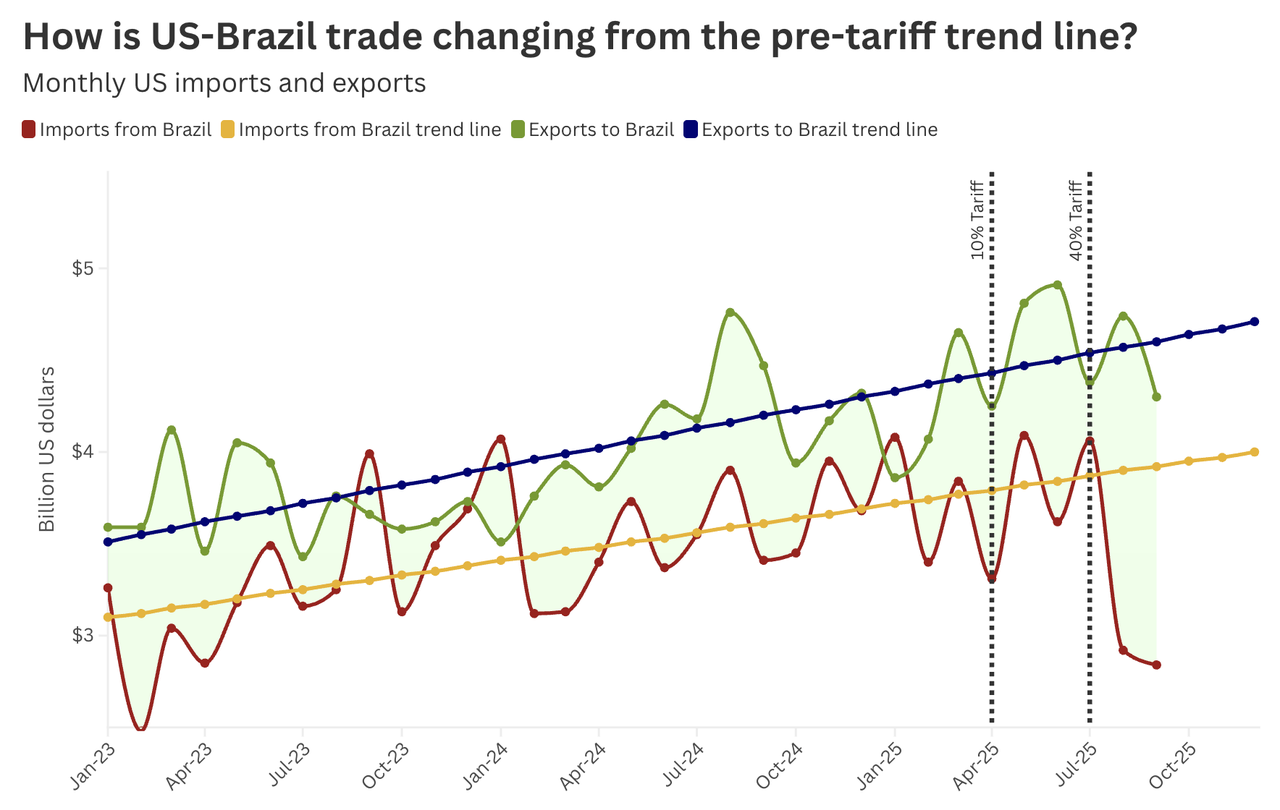
Calculated with data from the US Census Bureau's USA Trade Online platform
The strength of imports from the U.S. reflects Brazil’s reliance on products with limited short-term substitution. As investment activity recovered, import demand remained supported by capital formation levels of approximately 17–18% of GDP, a range historically associated with higher purchases of machinery and equipment.
Brazil’s imports from the United States in 2025 were mainly driven by:
By September–October 2025, Brazil’s imports from the U.S. rebounded toward US$4.6–4.7 billion per month, effectively returning to the projected growth path rather than signaling a contraction. At the end, the U.S. share of Brazil’s imports rose by 1.2 percentage points year over year, confirming that sourcing from U.S. suppliers remained competitive and structurally embedded in Brazil’s import profile.
Brazil’s imports from Argentina in Jan–Nov 2025 mainly were freight motor vehicles, followed by passenger vehicles, wheat, automotive parts, and dairy products, data provided by TradeInt. The trade flow highlights Argentina’s role as a key regional supplier of transport equipment and essential food inputs during the period.
| Rank | Products Category | Import Value (US$) | Share (%) | HS Code | Top 3 Importing Companies |
|---|---|---|---|---|---|
| 1 | Freight motor vehicles | $2,825,843,303 | 23.05% | 8704 | 1. TOYOTA DO BRASIL LTDA COMERCIO DE PECAS LTDA 2. BTG PACTUAL COMMODITIES SERTRADING S A 3. COMEXPORT TRADING COMERCIO EXTERIOR LTDA |
| 2 | Motor vehicles mainly used to carry people | $1,721,256,533 | 14.04% | 8703 | 1. STELLANTIS AUTOMOVEIS BRASIL LTDA 2. TOYOTA DO BRASIL LTDA 3. GENERAL MOTORS DO BRASIL LTDA |
| 3 | Wheat and mixed wheat | $1,011,294,494 | 8.25% | 1001 | 1. BUNGE ALIMENTOS S A 2. M DIAS BRANCO S A INDUSTRIA E COMERCIO DE ALIMENTOS 3. J MACEDO S A |
| 4 | Parts and accessories of motor vehicles | $442,665,438 | 3.61% | 8708 | 1. VOLKSWAGEN DO BRASIL INDUSTRIA DE VEICULOS AUTOMOTORES 2. SCANIA LATIN AMERICA LTDA 3. TOYOTA DO BRASIL LTDA |
| 5 | Concentrated, sweetened or other sweetened milk and cream | $304,771,896 | 2.49% | 0402 | 1. LEITESOL INDUSTRIA E COMERCIO S A 2. GLOBAL OPPORTUNITIES IMPORTACAO E EXPORTACAO LTDA 3. FIRST S A |
Data Source: TradeInt
Coffee is a major export driver for Brazil.
👉🏻 See TradeInt’s analysis on Brazil exporting coffee in FY2025 to discover where Brazilian coffee exports to the most and how the overall coffee market performs in the country.
Brazil imported US$13.41 billion from Argentina in 2025, ranking Argentina as Brazil’s 3rd-largest import partner after China and the United States. Import volumes were strongest in H1, as Argentina’s economic stabilization and eased trade restrictions aligned with Brazil’s demand and Mercosur supply-chain integration.
As a result, Brazil’s purchases expanded faster than reciprocal flows.
Argentina recorded a trade deficit of about US$3.5 billion with Brazil in the first seven months of 2025, since Brazilian import demand grew steadily while Argentina’s purchases from Brazil increased at a slower pace. Nevertheless, monthly import levels remained stable rather than volatile, indicating structurally anchored regional demand.
Meanwhile, energy trade emerged as a potential growth area but did not scale materially in 2025. Brazil signaled interest in importing up to 30 million cu m/d of Argentine gas by 2030, mainly from Vaca Muerta; however, flows remained limited to spot sales.
Transit fees via Bolivia of US$1.40–1.90/MMBtu, compared with ~US$0.50/MMBtu domestically, constrained volumes, even though Brazilian end-user gas prices of US$15–20/MMBtu kept the trade economically viable.
TradeInt’s trade insights on Brazil import data 2025 showed that Germany’s shipments to Brazil in Jan–Nov 2025 were led by medical and pharmaceutical products with over US$850 million in value, followed by automotive components, chemical compounds, and passenger vehicles. The trade data also highlights Germany’s role as a supplier of high-value healthcare, industrial, and precision manufacturing inputs.
| Rank | Products Category | Import Value (US$) | Share (%) | HS Code | Top 3 Importing Companies |
|---|---|---|---|---|---|
| 1 | Human blood; animal blood products for treatment | $854,319,702 | 7.05% | 3002 | 1. PRODUTOS ROCHE QUIMICOS E FARMACEUTICOS S A 2. MINISTERIO DA SAUDE 3. NOVARTIS BIOCIENCIAS SA |
| 2 | Medicines for the treatment or prevention of diseases | $754,971,001 | 6.23% | 3004 | 1. MINISTERIO DA SAUDE 2. MINISTERIO DA SAUDE 3. ELI LILLY DO BRASIL LTDA |
| 3 | Parts and accessories of motor vehicles | $622,007,914 | 5.13% | 8708 | 1. MERCEDES BENZ DO BRASIL LTDA 2. JOHN DEERE BRASIL LTDA 3. SCANIA LATIN AMERICA LTDA |
| 4 | Heterocyclic compounds | $580,793,247 | 4.79% | 2933 | 1. BASF SA 2. BAYER S A 3. SYNGENTA PROTECAO DE CULTIVOS LTDA |
| 5 | Motor vehicles mainly used to carry people | $489,497,502 | 4.04% | 8703 | 1. COMEXPORT TRADING COMERCIO EXTERIOR LTDA 2. BMW DO BRASIL LTDA 3. AUDI DO BRASIL INDUSTRIA E COMERCIO DE VEICULOS LTDA |
Data Source: TradeInt
💡 If you want to dive deeper into Brazil’s exports besides imports, check our analysis on Top 10 Brazil Exports by Country (2024–2025), where we evaluate each top export destination and the trade relationship of Brazil with global nations.
Brazil imported around US$14.79 billion from Germany in 2025, with demand centered on capital-intensive and technology-driven goods that support long-term production rather than short-term consumption. Import volumes stayed relatively stable across the year because these products are tied to manufacturing, healthcare, and infrastructure cycles.
Brazil’s imports from Germany in 2025 focused mainly on:
Discussions around the EU–Mercosur agreement continued during the year; however, Germany’s role in Brazil’s import structure in 2025 was already defined by technology intensity and capital-goods demand, rather than trade policy shifts.
According to Brazil import data collected by TradeInt, top imports from Russia in Jan–Nov 2025 were petroleum and refined oils, which were valued at US$3.84 billion, followed by potash-based fertilizers, other mineral fertilizers, nitrogen fertilizers, and small volumes of crude oil. Meanwhile, the total import value in 11 months was over US$7 billion.
| Rank | Products Category | Import Value (US$) | Share (%) | HS Code | Top 3 Importing Companies |
|---|---|---|---|---|---|
| 1 | Petroleum and oils | $3,837,025,664 | 51.04% | 2710 | 1. REFINARIA DE PETROLEOS DE MANGUINHOS S A 2. REFINARIA DE MANAUS S A 3. NIMOFAST BRASIL S A |
| 2 | Mineral potash fertilizer and chemical potash fertilizer | $1,486,216,365 | 19.77% | 3104 | 1. FERTILIZANTES TOCANTINS S A 2. FERTIPAR FERTILIZANTES DO PARANA LIMITADA 3. TECNOGAN AGRONUTRIENTES LTDA |
| 3 | Mineral fertilizers or chemical fertilizers | $1,053,887,404 | 14.02% | 3105 | 1. FERTILIZANTES HERINGER S A 2. ADUFERTIL FERTILIZANTES LTDA 3. FERTIPAR FERTILIZANTES DO PARANA LIMITADA |
| 4 | Mineral nitrogen fertilizer and chemical nitrogen fertilizer | $639,103,937 | 8.50% | 3102 | 1. ADUFERTIL FERTILIZANTES LTDA 2. FERTILIZANTES HERINGER S A 3. FERTILIZANTES TOCANTINS S A |
| 5 | Petroleum crude oil and crude oil | $89,558,356 | 1.19% | 2709 | 1. SSOL ENERGY S A 2. BLACK ARROWS BRASIL TRADING LTDA 3. AXA OIL PETROLEO S A |
Data Source: TradeInt
Despite potential geopolitical pressure, Russia remained a top supplier to Brazil in 2025, with large-volume supplies of essential inputs for agriculture and energy.
While there was a slight slowing in fuel imports due to the U.S. sanctions in late 2025, Brazil continues to import significant, cheap Russian diesel. Although some Western countries curtailed imports, Brazil continued to purchase Russian oil, benefiting from lower prices (up to $100 per barrel for premium vs. lower for others).
Key Brazilian imports from Russia include:
Brazil’s import profile in 2025 was shaped by scale, supplier concentration, and strategic inputs. Total imports exceeded US$280 billion, led by China (≈US$71 billion), the United States (≈US$42 billion), and Germany (≈US$14.8 billion). Key import categories were refined petroleum and crude oil, industrial machinery, pharmaceutical products, vehicles and parts, and specialty chemicals.
Entering 2026, energy security, industrial production, and healthcare supply chains are likely to keep import volumes elevated in 2026, with sourcing decisions increasingly driven by price competitiveness, logistics reliability, and regulatory access rather than short-term trade shifts.
According to Brazil import data from TradeInt, the country’s largest imports in 2025 were refined petroleum oils and crude oil, followed by industrial machinery, pharmaceutical products, vehicles and parts, and specialty chemicals. These categories highlight import demand driven by energy supply, manufacturing capacity, and healthcare rather than consumer-led spending.
Want to know which suppliers dominate each product category? Search top importers/exporters in Brazil.
From TradeInt’s verified shipment and customs records, Brazil’s main imports in 2025 included refined petroleum and crude oil, industrial machinery, pharmaceutical products, vehicles and automotive components, and specialty chemicals. Together, these products reflect long-term structural demand across energy, manufacturing, transport, and healthcare sectors.
Don’t know which products your competitors are importing/exporting? Find out using the free HS Code lookup tool on TradeInt.
From TradeInt’s verified shipment and customs records, Brazil’s main imports in 2025 included refined petroleum and crude oil, industrial machinery, pharmaceutical products, vehicles and automotive components, and specialty chemicals. Together, these products reflect long-term structural demand across energy, manufacturing, transport, and healthcare sectors.
Don’t know which products your competitors are importing/exporting? Find out using the free HS Code lookup tool on TradeInt.
According to regional trade analysis on TradeInt, Brazil sourced most of its imports in 2025 from Asia, North America, and Europe, with Asia accounting for nearly 39% of the total import value. Brazil imports the most from China, with total import value reaching US$67.6 billion, making China Brazil’s largest trading partner. The United States ranks second (US$39B), supplying advanced equipment, aerospace components, and chemicals. Other major suppliers are Argentina (US$12.3B), Germany (US$12.1B), and Russia (US$7.5B), primarily providing energy products, industrial machinery, and fertilizers.
According to Brazil import data from TradeInt, the country’s largest imports in 2025 were refined petroleum oils and crude oil, followed by industrial machinery, pharmaceutical products, vehicles and parts, and specialty chemicals. These categories highlight import demand driven by energy supply, manufacturing capacity, and healthcare rather than consumer-led spending.
Want to know which suppliers dominate each product category? Search top importers/exporters in Brazil.
From TradeInt’s verified shipment and customs records, Brazil’s main imports in 2025 included refined petroleum and crude oil, industrial machinery, pharmaceutical products, vehicles and automotive components, and specialty chemicals. Together, these products reflect long-term structural demand across energy, manufacturing, transport, and healthcare sectors.
Don’t know which products your competitors are importing/exporting? Find out using the free HS Code lookup tool on TradeInt.
From TradeInt’s verified shipment and customs records, Brazil’s main imports in 2025 included refined petroleum and crude oil, industrial machinery, pharmaceutical products, vehicles and automotive components, and specialty chemicals. Together, these products reflect long-term structural demand across energy, manufacturing, transport, and healthcare sectors.
Don’t know which products your competitors are importing/exporting? Find out using the free HS Code lookup tool on TradeInt.
According to regional trade analysis on TradeInt, Brazil sourced most of its imports in 2025 from Asia, North America, and Europe, with Asia accounting for nearly 39% of the total import value. Brazil imports the most from China, with total import value reaching US$67.6 billion, making China Brazil’s largest trading partner. The United States ranks second (US$39B), supplying advanced equipment, aerospace components, and chemicals. Other major suppliers are Argentina (US$12.3B), Germany (US$12.1B), and Russia (US$7.5B), primarily providing energy products, industrial machinery, and fertilizers.
According to Brazil import data from TradeInt, the country’s largest imports in 2025 were refined petroleum oils and crude oil, followed by industrial machinery, pharmaceutical products, vehicles and parts, and specialty chemicals. These categories highlight import demand driven by energy supply, manufacturing capacity, and healthcare rather than consumer-led spending. Want to know which suppliers dominate each product category?Search top importers/exporters in Brazil.
From TradeInt’s verified shipment and customs records, Brazil’s main imports in 2025 included refined petroleum and crude oil, industrial machinery, pharmaceutical products, vehicles and automotive components, and specialty chemicals. Together, these products reflect long-term structural demand across energy, manufacturing, transport, and healthcare sectors. Don't know which products your competitors are importing/exporting?Find out using the free HS Code lookup tool on TradeInt.
From TradeInt’s verified shipment and customs records, Brazil’s main imports in 2025 included refined petroleum and crude oil, industrial machinery, pharmaceutical products, vehicles and automotive components, and specialty chemicals. Together, these products reflect long-term structural demand across energy, manufacturing, transport, and healthcare sectors. Don't know which products your competitors are importing/exporting?Find out using the free HS Code lookup tool on TradeInt.
According to regional trade analysis on TradeInt, Brazil sourced most of its imports in 2025 from Asia, North America, and Europe, with Asia accounting for nearly 39% of the total import value. Brazil imports the most from China, with total import value reaching US$67.6 billion, making China Brazil’s largest trading partner. The United States ranks second (US$39B), supplying advanced equipment, aerospace components, and chemicals. Other major suppliers are Argentina (US$12.3B), Germany (US$12.1B), and Russia (US$7.5B), primarily providing energy products, industrial machinery, and fertilizers.
Brazil import data 2025: Top trade partner: China (26.29%, $70B). Top categories: machinery ($41.1B) and fuels ($30.1B). Key HS code: 2710 crude oil ($13.7B).
Discover what does Brazil export to the United States, from copper to soybeans, and how these exports shape lucrative business opportunities.
From soybeans to oil, see the top 10 Brazil exports by country markets and the forces driving them. Get market insights that could shape your next move
Brazil export data 2025: Top partner: China ($94.29B, 28.34%). Leading products: crude oil (HS 2709) & soybeans. Top exporting companies: Cargill & Petrobras.
Vietnam export data in 2025 top markets: U.S. US$153.18B, China US$70.45B, South Korea US$28.94B. Analyze Vietnam's key export destinations & trade trends.
Brazil export data 2025 shows China at US$89.7B, the United States at US$35.4B, and Argentina at US$16.5B as Brazil’s top export destinations.