6 Best Import Export Data Platforms For Vietnam Businesses
Top 6 import export data platforms for Vietnam businesses reviewed in 2026: TradeInt, Vietnam Customs Department, VNTR, WTO VCCI, NSO, and ITC Trade Map.

Data now functions as both a traded product and the operational backbone of global trade, powering supply chain visibility, AI-driven decision-making, compliance automation, and real-time market intelligence. For import export teams, it has replaced intuition and annual reports as the primary input behind every sourcing, sales, and risk decision.
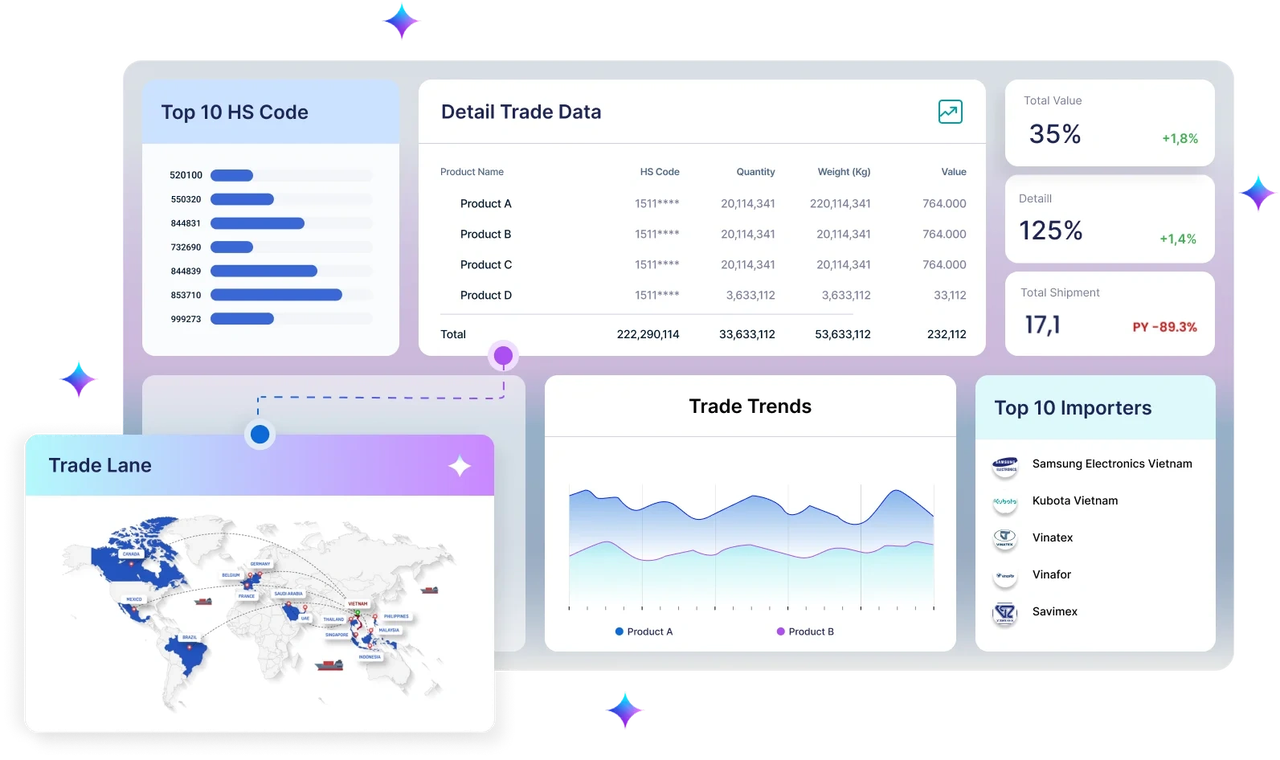
Data flows now drive international trade as much as physical goods do. Five roles define how it works in practice.
The fastest-growing import export teams treat trade data as a daily tool, not a quarterly report. They check shipment records before outreach, verify suppliers before contracts, and pull lane data before pricing calls.
TradeInt is a global trade data platform providing access to over 10 billion verified import and export records. Its coverage spans over 200 countries and more than 80 customs data sources.
This article provides an overview of trade data solutions for import and export teams. Use TradeInt to explore more detailed trade records and continue tracking this market as new data becomes available. Search global import and export records →
Discover how global trade data intelligence empowers importers, exporters, consulting firms, and supply chain teams to identify new buyers, evaluate suppliers, track demand shifts, and reduce market risk.
Next step: Explore how TradeInt turns trade data into actionable insights for smarter sourcing, expansion, and strategic decision-making
Export and import data drives successful global trade by turning fragmented customs and shipping records into unified market intelligence that import export teams can act on. It connects foreign governments, international corporate sellers, and corporations buying goods or setting up operations abroad, creating a transparent data layer that benefits every party in a cross-border transaction.
Modern import export teams rely on a specific set of data capabilities to stay competitive. Each one solves a distinct problem in the trade workflow.

✔ Lite ✔ Pro ✔ Premium ✔ Enterprise
TradeInt is a global trade data platform covering 200+ countries and 80+ customs sources.Learn about TradeInt →
Industry leaders are leveraging global trade databases such as TradeInt to analyse product trade trends using verified shipment records.
Try today: Search trade data by product, HS code, company, importer, exporter, or Bill of Lading on TradeInt.
Import export teams maximise trade data by treating it as a daily operational input rather than a one-off research exercise. The highest-impact strategies include lead qualification through shipment records, market trend analysis, HS code-based market research, competitive intelligence, supply chain optimisation, and proactive risk mitigation.
The teams that get the most value from trade data share a common habit: they build it into their workflow instead of consulting it occasionally. Here’s how high-performing import export teams turn data into measurable results.
The fastest way to build a qualified pipeline is to analyse who is already buying or selling your product category. Shipment records reveal active importers and exporters with documented trade history, letting sales teams target companies with confirmed demand rather than directory listings with unverified interest.
Import export teams that prospect from trade data consistently report higher conversion rates. Every lead comes pre-qualified by the simple fact that the company is already trading in your category.
Studying historical shipment volumes, prices, and frequencies reveals seasonal demand shifts, price volatility, and structural changes in trade flows. Import export teams use these trend analyses to time market entry, negotiate better contracts, and anticipate shifts before they hit the P&L.
The key is looking at trend lines, not snapshots. A product category that grew 40% over two years tells a very different story from one that spiked in a single quarter.
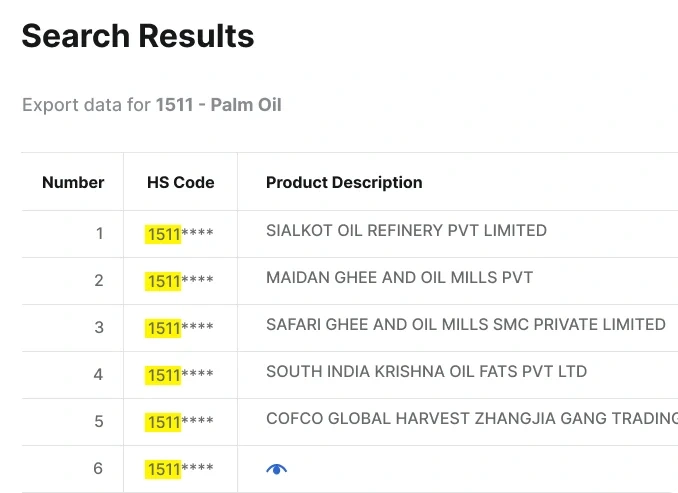
HS codes are the universal language of international trade. By filtering shipment data by HS code, import export teams can evaluate the growth potential of specific product categories across any target market, compare trade volumes between countries, and identify where demand is accelerating or contracting.
This is particularly powerful for market entry decisions. Instead of relying on generic country reports, teams can pull up the exact HS code matching their product and see which markets are actively importing it, from whom, and at what rate of growth.
✔ Lite ✔ Pro ✔ Premium ✔ Enterprise
TradeInt is a global trade data platform covering 200+ countries and 80+ customs sources.Learn about TradeInt →
Industry leaders use TradeInt to analyze global trade trends with verified shipment records across countries, products, and HS codes.
Best practice: Search global trade records by country, product, and HS code on TradeInt
Knowing who your competitors are selling to, at what volumes, and through which trade lanes is one of the most valuable applications of trade data. Competitive intelligence drawn from shipment records lets import export teams benchmark pricing strategies, identify at-risk accounts, and spot opportunities where a competitor is losing share.
Competitive intelligence from trade data isn’t speculation. It’s evidence. Every insight is backed by a customs record.
Trade data on ports of entry and exit, transport modes, and shipping routes helps import export teams reduce logistics costs and lead times. By analysing which routes competitors use and benchmarking against their own operations, teams can identify inefficiencies and negotiate better carrier rates.
For businesses managing complex, multi-country supply chains, this kind of lane-level intelligence compounds quickly.
Trade data allows import export teams to monitor regulatory changes, geopolitical risks, and trade disputes as they unfold. Early warning on shifting conditions gives teams time to diversify sourcing, adjust contracts, or pause commitments before exposure becomes a problem.
The strongest risk management posture is the one built on continuous data monitoring, not reactive research after a disruption has already happened.
TradeInt is the leading all-in-one trade data solution for import export teams because it consolidates every critical trade intelligence function into a single platform, from verified Bill of Lading records, buyer and supplier discovery, competitor tracking, market analytics, to supply chain risk monitoring, across 200+ countries.
Key data solutions by TradeInt:
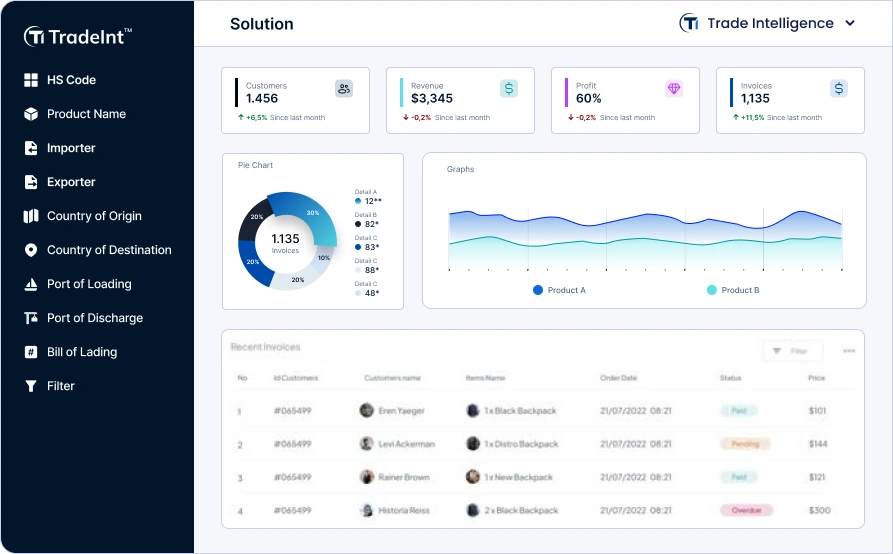
Import export teams use TradeInt to replace fragmented research, directory-based prospecting, and manual compliance checks with one unified workflow backed by real customs evidence.
Import export teams are left stitching together multiple tools, spreadsheets, and manual processes to get a complete picture. TradeInt takes a different approach. It delivers the full workflow under one platform, with every capability designed to move teams from raw data to decision in the shortest path possible.
Global trade has shifted from relationship-led to data-led, and the import export teams growing fastest are the ones treating customs intelligence as daily infrastructure rather than occasional research. From lead qualification to supply chain benchmarking and risk monitoring, the right data solutions turn every trade decision into an evidence-based one.
TradeInt brings every critical capability into a single platform built for modern trade teams. Book a personalized demo with TradeInt to see it in action.
Top 6 import export data platforms for Vietnam businesses reviewed in 2026: TradeInt, Vietnam Customs Department, VNTR, WTO VCCI, NSO, and ITC Trade Map.
Discover the best tools to find buyers for your export business in 2026 - B2B marketplaces, trade directories, and trade intelligence platforms compared.
Which trade data platforms are reliable? Compare TradeInt, Panjiva, ImportGenius, Trademo, UN Comtrade, and WITS, and 25 other platforms for business needs now.
Top 5 import export data platforms for Indonesia businesses reviewed: TradeInt, BPS Statistics Indonesia, ITC Trade Map, UN Comtrade, and Satu Data Perdagangan.
ImportGenius alternative review: TradeInt offers global trade intelligence with 10B+ shipment records, AI analytics, and verified worldwide supplier discovery.
Compare top 6 best trade data platforms like TradeInt, yTrade, WTO, ITC, UN Comtrade & WTIS by the latest data coverage and data intelligence features.