Key takeaways about the top 10 coffee exporting countries in 2025
- Brazil leads all coffee-exporting countries with a record 50.44 million 60-kg bags exported in 2024, up 28.5% year-over-year, with total export value exceeding US$12.5 billion, according to the Coffee Exporters Council (Cecafé).
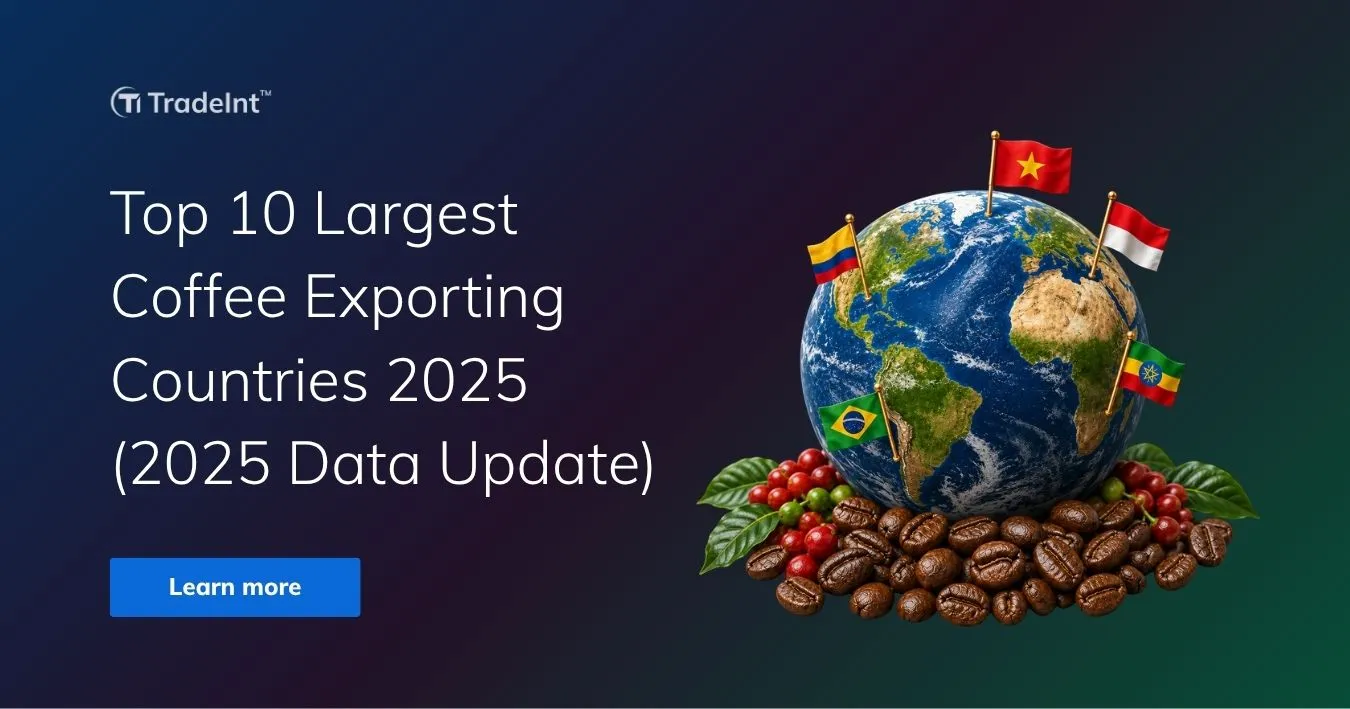
- Vietnam holds second place with approximately 30 million bags in 2025, the largest Robusta supplier globally, followed by Colombia (12.9 million bags), Indonesia (10.9 million bags), and Ethiopia (8.36 million bags), which together complete the top 5 coffee exporting countries.
- Global coffee production reached approximately 10.5 million metric tons in 2024, up 4% year-over-year, with inventories at their lowest level since 2018 and prices more than doubling due to climate shocks, reshaping trade flows into 2025.
Top 10 coffee exporting countries: Which country exports the most coffee in the world?
Brazil is the world's largest coffee exporter by a wide margin. According to TradeInt trade data, Brazil's coffee exports (HS 0901) reached US$14.92 billion in 2025, a 31.17% increase year-over-year. This is further corroborated by Comunicaffe and the Coffee Exporters Council (Cecafé), which recorded a shipment volume of 50.44 million 60-kg bags in 2024, the highest ever logged by any country. According to the USDA, Brazil and Vietnam together account for 55% of global coffee output, with Brazil alone representing 38%.
Top 10 largest coffee exporting countries by volume in 2024-2025:
- Brazil - 50.44 million bags (2024 record, +28.5% YoY)
- Vietnam - ~30 million bags (2025 estimate)
- Colombia - 12.9 million bags
- Indonesia - 10.9 million bags
- Ethiopia - 8.36 million bags
- Uganda - 6.4 million bags
- India - 6.2 million bags
- Honduras - 5.3 million bags
- Peru - 4.35 million bags
- Mexico - 3.9 million bags
How much is Brazil's coffee export worth, and who are its top buyers?
According to TradeInt trade data, Brazil's coffee exports (HS 0901) totalled US$14.92 billion in 2025, up 31.17% year-over-year. Germany is the single largest buyer, accounting for US$2.30 billion (15.41% of total), followed by the United States at US$1.92 billion (12.85%) and Italy at US$1.33 billion (8.93%). This is consistent with figures from Comunicaffe and the Coffee Exporters Council (Cecafé), which recorded a shipment volume of 50.44 million 60-kg bags in 2024, making Brazil the dominant price-setter for the global Arabica market.
Which country is the world's largest Robusta coffee exporter?
Vietnam is the world's leading supplier of Robusta coffee. According to the USDA Foreign Agricultural Service (FAS) Coffee Annual Report, Vietnam exported approximately 30 million bags in 2025, holding the number-two position globally. TradeInt trade data further reflects the global demand for Robusta, showing that Germany (15.41% share), the United States (12.85%), and Italy (8.93%) are among the top buyers of coffee from major exporting origins in 2025, markets where Vietnamese Robusta underpins a significant share of espresso and commercial blends.
Top 1 Coffee Exporting Country: Brazil at 50.44 million bags
Brazil solidified its position as the world's leading coffee bean exporter in 2024, shipping a record 50.44 million 60-kg bags, a 28.5% increase year-over-year and the highest volume ever recorded by any country, confirmed by the Coffee Exporters Council (Cecafé). Total export value exceeded US$12.5 billion. Germany and the United States are Brazil's two largest destination markets, with Germany importing over US$1.72 billion in Brazilian coffee in 2024.
Which top 5 country buyers imports coffee beans from Brazil? Based on Brazil coffee export data 2025 on the TradeInt trade data platform, here are the top 5 importing countries:
- Germany - US$1.88 billion (14.70%): Central European processing gateway importing immense green volumes for domestic consumption and continental re-export.
- United States - US$1.74 billion (13.65%): Foundational high-volume blending resource satisfying massive commercial retail supply chains and consumer brands.
- Italy - US$1.29 billion (10.14%): Premium unroasted bean acquisition vital for traditional industrial espresso roasting and blending lines.
- Japan - US$855.73 million (6.71%): Premium grade procurement satisfying rigorous domestic quality benchmarks and canned beverage formulation processes.
- Belgium - US$815.96 million (6.40%): Strategic maritime trade access routing large commercial bean volumes to Western European hubs.

TradeInt is a global trade data platform providing access to over 10 billion verified import and export records. Its coverage spans over 200 countries and more than 80 customs data sources.
This article provides an overview of global coffee exports. Use TradeInt to explore more detailed trade records and continue tracking this market as new data becomes available. Search global coffee export records →
🟤 Explore Brazil Coffee Export Trade Records on TradeInt Trade Data Platform
TradeInt provides verified coffee export data by origin country, HS code, buyer, and shipment value. Access Brazil's full coffee export history, top buyers, and Bill of Lading trade record details.
Preview here: Brazil coffee export trade data and historical shipment records
Top 2 Coffee Exporting Country: Vietnam at ~30 million bags
Vietnam holds second place among coffee exporting countries with approximately 30 million bags in 2025, according to the USDA Foreign Agricultural Service (FAS) data. As the world's largest Robusta supplier, Vietnamese beans are widely used in instant blends, espresso bases, and commercial soluble coffee. Major investments from Nestle, Trung Nguyen, and Highlands Coffee are expanding domestic processing capacity, while yields are improving, and specialty coffee farming is gaining ground in regions like Lam Dong.
Which top 5 countries import coffee beans from Vietnam? Based on the Vietnam coffee export data 2025 on the TradeInt platform?
- Switzerland - US$2.22 billion (30.14%): Major institutional procurement of cost-efficient Robusta inputs for dominant worldwide instant coffee brands.
- Germany - US$729.15 million (9.89%): Massive processing economies acquiring competitive Robusta beans for large-scale soluble coffee processing lines.
- Netherlands - US$693.91 million (9.42%): Primary trade hub securing cost-competitive blending assets for Western European commercial roasting brands.
- Singapore - US$541.87 million (7.35%): Logistics proximity allowing regional re-routing and blending of high-volume soluble coffee materials.
- Japan - US$448.51 million (6.09%): Cost-efficient sourcing of high-solubility Robusta inputs for widespread domestic canned beverage distribution.
Vietnam's coffee export profile (2025):
- Primary type: Robusta, approximately 85% of total exports, widely used in instant coffee and espresso blends globally.
- Growing Arabica production: Lam Dong province is expanding Arabica cultivation to diversify the export portfolio and target premium market segments.
- EU deforestation regulations: Approximately 41% of Vietnam's exports are affected by EUDR compliance requirements, creating traceability challenges for smaller farms.
- Top buyers: EU member states, Japan, South Korea, and the United States are key destination markets for Vietnamese Robusta.
Top 3 Coffee Exporting Country: Colombia at 12.9 million bags
Colombia ranks third globally with 12.9 million bags exported in 2024. Known for high-quality Arabica beans with bright acidity and fruity aromatic profiles, Colombian coffee is produced across premium origin regions including Antioquia, Huila, Narino, and Cauca. The iconic "Juan Valdez" brand remains one of the most recognizable national coffee identities globally, associated with certified single-origin Arabica across North American and European markets.
Which top 5 countries import coffee beans from Colombia? Based on Colombia coffee export data 2025 on the TradeInt platform?
- United States - US$2.35 billion (39.37%): High-volume proximity sourcing of high-grade washed Arabica for specialty boutique retail sectors.
- Belgium - US$471.15 million (7.89%): Leading logistical gateway receiving premium single-origin Arabica for high-value European distribution networks.
- Canada - US$460.33 million (7.71%): Secure stable supply chain sourcing premium specialty mild Arabica for affluent consumer markets.
- Germany - US$453.63 million (7.60%): Premium grade milder bean procurement to elevate quality profiles of standard retail blends.
- Japan - US$296.74 million (4.97%): Elite single-origin sourcing satisfying specialized niche demand for premium gourmet coffee profiles.
Colombia's export characteristics (2024):
- Volume: 12.9 million 60-kg bags, 100% Arabica, single-origin certified.
- Key regions: Antioquia, Huila, Narino, and Cauca, each with distinct altitude and flavor profiles.
- Certifications: Fair trade, organic, and Rainforest Alliance certifications are common among Colombian premium exporters.
- Top markets: USA, Germany, Japan, Belgium, and Canada lead destination volumes.
Top 4 Coffee Exporting Country: Indonesia at 10.9 million bags
Indonesia contributes approximately 10.9 million bags annually, split between Robusta, primarily from Sumatra and Arabica from Aceh and Toraja. Indonesian coffee is known for its earthy, smoky, and bold flavor profiles, which are popular in Japan and Europe. Kopi luwak (civet coffee), while a niche product, draws global specialty interest. Indonesia remains among the most distinctive coffee exporters globally due to its flavor diversity and regional origin differentiation.
Which top 5 country buyers import coffee beans from Indonesia? Based on Indonesia coffee export data 2025 on the TradeInt platform?
- Czech - US$548.92 million (17.69%): Competitive pricing advantages securing regional inputs for expanding Central European retail markets.
- Switzerland - US$433.18 million (13.96%): Corporate sourcing of premium unique earthy flavor profiles for high-end specialty consumer goods.
- Singapore - US$392.63 million (12.65%): Geographically strategic trade node routing diverse specialty and robust intermediate coffee beans regionally.
- United States - US$255.70 million (8.24%): Supply chain diversification introducing unique single-origin flavor assets to specialty gourmet roasters.
- Netherlands - US$204.41 million (6.59%): Longstanding distribution links channeling premium unique Indonesian coffee beans across Western European hubs.
Indonesia's export characteristics (2024):
- Volume: approximately 10.9 million 60-kg bags.
- Bean mix: Robusta (primarily Sumatra, accounting for the majority of volume) and Arabica (Aceh, Toraja, Flores).
- Key markets: Japan, the USA, Germany, and Malaysia are the primary export destinations.
- Notable niche: Kopi luwak (civet coffee) draws specialty trade interest globally.
Top 5 Coffee Exporting Country: Ethiopia at 8.36 million bags
Ethiopia, the birthplace of Arabica coffee, exported 8.36 million bags in 2024. Coffee from Ethiopia is floral, fruity, and complex, with Yirgacheffe, Sidamo, and Harrar recognized as the most valued origin regions internationally. The country is expanding traceable and organic exports to meet rising global standards, with a growing presence in the specialty segment as European and US specialty roasters seek certified single-origin lots.
Top 6 to 10 Coffee Exporting Countries
Top 6: Uganda (6.4 million bags): A key Robusta producer, with Arabica gaining ground in the eastern highlands. Government investment in post-harvest processing and export infrastructure is strengthening Uganda's position among major coffee exporting countries.
Top 7: India (6.2 million bags): A nearly even split between Arabica and Robusta. Monsooned Malabar gives Indian coffee a distinctive woody, herbal profile popular in niche markets. Domestic consumption is rising but export volumes remain significant in the global rankings.
Top 8: Honduras (5.3 million bags): High-altitude Arabica known for balance and acidity. Strong organic and fair-trade backing continues to expand Honduras's reach in North American specialty and commercial markets.
Top 9: Peru (4.35 million bags): Arabica grown in the Andes with mild flavors and cocoa notes. Cooperative-based farming and traceability efforts position Peru well in the organic and certified specialty segment.
Top 10: Mexico (3.9 million bags): Arabica from Chiapas and Oaxaca is sweet and lightly acidic, favored for cold brew and blends in the US market. Over 60% of Mexican coffee exports go to the United States, making it a key nearshore supplier for US roasters.
How can businesses use trade data to act on coffee export shifts?
Trade intelligence platforms provide actionable data layers for importers, roasters, and distributors navigating a volatile coffee supply environment. Four practical applications:
- Competitive analysis: Coffee-producing nations can monitor export volumes, pricing trends, and destination markets to adjust their own sourcing and commercial strategies. Brazil's record 2024 volume directly affects competitor pricing from Colombia, Vietnam, and Indonesia.
- Supplier sourcing: International roasters, specialty brands, and wholesalers can use export data to identify verified top suppliers by country and HS code, assess reliability, and negotiate better terms ahead of seasonal price spikes.
- Market opportunity identification: Importers and retailers can track shifts in demand across regions, including the recent surge in Asian demand for premium Arabica origins, to target new markets or diversify sourcing ahead of competitors.
- Risk management: Understanding a country's export patterns, logistics exposure, and climate vulnerability helps buyers anticipate supply fluctuations and build contingency sourcing before disruptions hit.
Trade intelligence platforms like TradeInt support all four strategies. Interested in learning more about how the platform can help? Book a discovery call to schedule a platform demo
Conclusion
The top 10 largest coffee exporting countries in 2025 collectively shape how the world accesses its most traded agricultural commodity. Brazil's record 50.44 million bags, Vietnam's Robusta dominance, and Ethiopia's specialty expansion illustrate the depth and diversity of global coffee supply chains.
As climate volatility increases and policy requirements tighten under EUDR and sustainability standards, the ability to track real trade flows by origin, HS code, and buyer-seller pair becomes a strategic advantage. Access to verified shipment-level data allows importers, roasters, and food manufacturers to move from reactive sourcing to proactive supply chain management.
Book a demo with TradeInt to access verified coffee export records, global supplier databases, and shipment-level trade data by origin country.