Crude Palm Oil Indonesia Export Overview 2018-2025
This article explores the trends of crude palm oil Indonesia export from 2018 to early 2025 and provides insights into what awaits from 2025 onwards.

In early 2025, palm oil exporters in Indonesia continue to dominate the global market. As the world’s largest producer and exporter of palm oil, Indonesia plays a critical role in fulfilling the global demand for this versatile commodity.
But with growing domestic pressures, regulatory challenges, and rising competition from neighboring countries, exporters must navigate a shifting landscape. In this article, we examine the key export trends, major players, opportunities, and challenges facing the industry.
According to TradeInt‘s latest trade data 2025, Indonesia is the world’s largest palm oil exporter and continues to lead the global palm oil market by a wide margin. In the first five months of 2025, the country exported around 8.3 million tons of palm oil products, representing a 3.6% year-over-year increase. This export volume confirms the country’s position as a leading supplier to both developed and emerging economies.
Key notes: Major exports to India, China, and Pakistan. Government pushing B40 biodiesel, price stabilization. Land, sustainability, and labor policy shifts.
Key notes: Major buyers: India, China, Kenya, Philippines. Facing labor shortages and responding to EU green policies. Exports rebounded in Q3.
Key notes: High domestic biodiesel demand has curbed export growth. Main buyers: EU, Mexico. Strategic investment in productivity and traceability.
Key notes: Top LATAM exporter after Colombia. Main buyers: Mexico, Chile, Ecuador. New sustainability frameworks, but face land/environment pressure.
Key notes: Growth trend, but vulnerable to climate. Major buyers: Malaysia, Vietnam, China. Focus on domestic demand, value-added products, and delivery reliability.
| Rank | Country | Export value (USD$ billion) | Key Highlights |
|---|---|---|---|
| 1 | Indonesia | 3.359 | Major exports to India, China, and Pakistan. Government pushing B40 biodiesel, price stabilization. Land, sustainability, and labor policy shifts. |
| 2 | Malaysia | 1.774 | Major buyers: India, China, Kenya, Philippines. Facing labor shortages and responding to EU green policies. Exports rebounded in Q3. |
| 3 | Colombia | 0.43 | High domestic biodiesel demand has curbed export growth. Main buyers: EU, Mexico. Strategic investment in productivity and traceability. |
| 4 | Peru | 0.09 | Top LATAM exporter after Colombia. Main buyers: Mexico, Chile, Ecuador. New sustainability frameworks, but face land/environment pressure. |
| 5 | Philippines | 0.04 | Growth trend but vulnerable to climate. Major buyers: Malaysia, Vietnam, China. Focus on domestic demand, value-added products, and delivery reliability. |
| 6 | Ghana | Exports are climbing, under 0.1Mn tons. Regional leader in West Africa. Exports to the EU, ECOWAS. Government program for processing, smallholder support. | |
| 7 | Vietnam | Smaller exporter but rising: main markets Cambodia, Laos. Palm oil trade supported by Malaysia, with demand rebounding post-pandemic. | |
| 8 | Liberia | Ships mainly to the Ivory Coast, Cameroon, the Netherlands, Ghana, and Spain. Infrastructure and processing investments strengthening sector. | |
| 9 | Costa Rica | Export volume fluctuates; top buyers are Mexico, Netherlands, and Nicaragua. Industry focuses on value addition and sustainability. | |
| 10 | Brazil | Mainly to Uruguay, Germany, Angola, US. Exports are growing but market is overshadowed by imports. Market is driven by domestic consumption and regional demand. |
In early 2025, the biggest buyers of Indonesian palm oil came from diverse regions, reflecting a highly diversified global trade network with presence across Asia, the Americas, and Africa.
Egypt – $219.86 million (6.56%)
In both traditional and emerging markets, Indonesia’s palm oil products have many unique advantages, including supply stability and price competitiveness.
Businesses looking to thrive in this dynamic landscape need the expertise of reliable and savvy partners. Schedule a free demo to uncover reliable import partners in your target market.
TradeInt is a global trade data platform providing access to over 10 billion verified import and export records. Its coverage spans over 200 countries and more than 80 customs data sources.
This article provides an overview of Indonesia’s palm oil exporters. Use TradeInt to explore more detailed trade records and research exporters and revisit their trade activity as new data becomes available. Search Indonesia palm oil export records →
Based on TradeInt’s latest trade records, the biggest palm oil exporter in Indonesia, based on value, was Ivo Mas Tunggal. At $337.49 million, its figure accounted for more than 10% of the country’s total.
1. IVO MAS TUNGGAL, export value: 337.49 USD millionKey notes: Subsidiary of Sinar Mas, a major producer/exporter serving domestic and global clients. Focused on plantation management, refining, and sustainability.
2. INTIBENUA PERKASATAMA, export value: 289.25 USD millionKey notes: Leading palm oil refiner/manufacturer under Apical Group. Key player in exports, especially to Asia. Strong sustainability and RSPO compliance record.
3. SARI DUMAI SEJATI, export value: 276.72 USD millioNKey notes: Refiner and exporter under Apical Group, known for a traceable supply chain and advanced refineries. Key export markets: Europe, Asia. 100% mill traceability.
4. PT SUMBER INDAHPERKASA, export value: 241.06 USD million
Key notes: Sinar Mas subsidiary, large palm oil plantation and production operations across Sumatra, Lampung, and Papua. Established in 1989. Focused on sustainable plantation and RSPO standards.
5. PACIFIC INDOPALM INDUSTRIES, export value: 182.67 USD million
Key notes: Major refinery and exporter based in Dumai (Sumatra). State-of-the-art refining/fractionation. Rapid asset and revenue growth (2023).
| Rank | Company name | Market share (%) | Export value (USD Million) | General Info & Highlights | Recent News / Press |
|---|---|---|---|---|---|
| 1 | IVO MAS TUNGGAL | 10.07 | 337.49 | Subsidiary of Sinar Mas, a major producer/exporter serving domestic and global clients. Focused on plantation management, refining, and sustainability. | Credit rating affirmed at A+ (Fitch, 2025). Recent RSPO submissions for HCV compensation and peat mitigation. Part of Sinar Mas's broader sustainable palm oil strategy. |
| 2 | INTIBENUA PERKASATAMA | 8.63 | 289.25 | Leading palm oil refiner/manufacturer under Apical Group. Key player in exports, especially to Asia. Strong sustainability and RSPO compliance record. | RSPO certification maintained; no major public news in 2025. |
| 3 | SARI DUMAI SEJATI | 8.26 | 276.72 | Refiner and exporter under Apical Group, known for a traceable supply chain and advanced refineries. Key export markets: Europe, Asia. 100% mill traceability. | Ongoing sustainability audits; traceability systems externally verified. High export market share in Indonesia's sector. |
| 4 | PT SUMBER INDAHPERKASA | 7.19 | 241.06 | Sinar Mas subsidiary, large palm oil plantation and production operations across Sumatra, Lampung, and Papua. Established in 1989. Focused on sustainable plantation and RSPO standards. | RSPO certificate issued for Lampung mill (2024). No major negative press, significant export volumes to Asia/Europe. |
| 5 | PACIFIC INDOPALM INDUSTRIES | 5.45 | 182.67 | Major refinery and exporter based in Dumai (Sumatra). State-of-the-art refining/fractionation. Rapid asset and revenue growth (2023). | Financial report: 3.3% sales revenue growth and capacity expansion (2023–2024). Upgrades in automation and logistics. |
| 6 | INCASI RAYA | 🔒 Request a demo to unlock full trade insights | 🔒 Request a demo to unlock full trade insights | Leading palm oil plantation and processing company specializing in sustainability and export of crude and refined palm oil. Operates across Sumatra and West Kalimantan. Engaged in biofuel initiatives and RSPO compliance. | Recent focus: expansion of environmentally-friendly plantations and increased traceability in exports (2024–2025). |
| 7 | MULTIMAS NABATI ASAHAN | 🔒 Request a demo to unlock full trade insights | 🔒 Request a demo to unlock full trade insights | Major palm oil processor under Wilmar, operating large refineries in North Sumatra and Riau. Focuses on crude palm oil, processed oils, industrial fats, and exports to Asia, EU, Africa. Part of Wilmar’s global network. | Recent upgrades in refinery efficiency, expansion projects in Asahan (2025), investment in green energy. |
| 8 | MUSIM MAS | 🔒 Request a demo to unlock full trade insights | 🔒 Request a demo to unlock full trade insights | One of Indonesia’s largest palm oil companies with a vertically integrated supply chain from plantation to finished goods. Leading exporter of RSPO-certified sustainable palm oil and derivatives. Operates globally. | 2025: Musim Mas strengthened traceability, launched new sustainability initiatives, and expanded global export footprint. Noted for the broad portfolio in food, cosmetics, and industrial oils. |
| 9 | KUTAI REFINERY NUSANTARA | 🔒 Request a demo to unlock full trade insights | 🔒 Request a demo to unlock full trade insights | A significant palm oil processing/refining company located in East Kalimantan, affiliated with Wilmar’s integrated network. Focused on bulk palm oil exports, oleochemicals, and specialty fats for food manufacturers. | Recent highlights: optimized logistics for export growth, awarded new certifications for quality standards (2025). |
Opportunities
Despite some uncertainties, strong global demand continues to offer major growth opportunities for palm oil exporters in Indonesia.
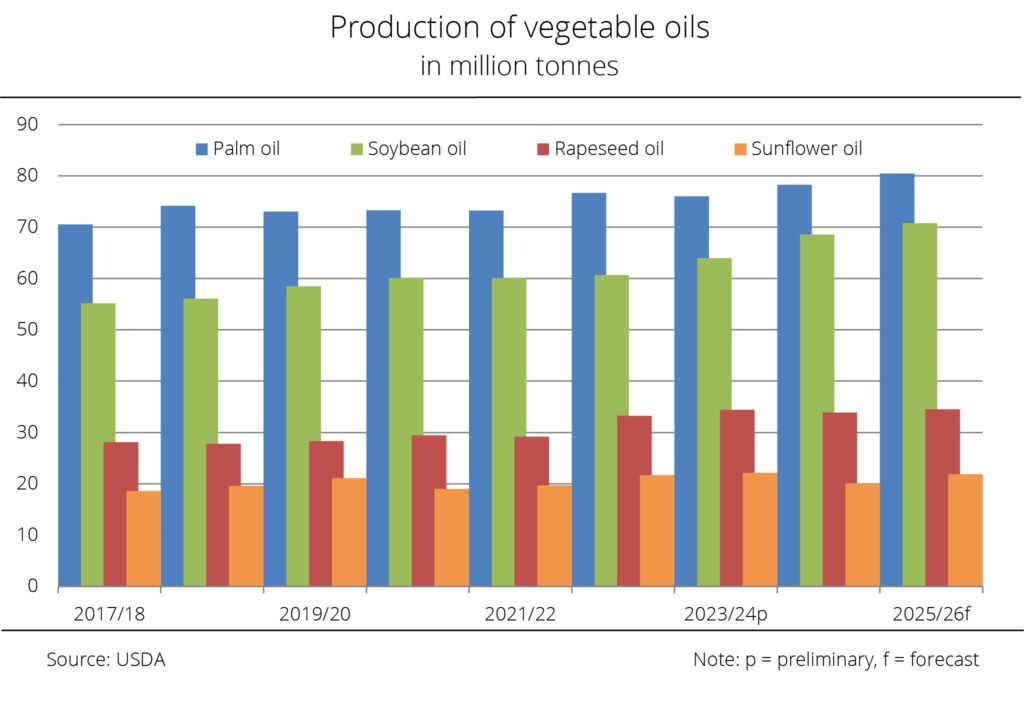
Bar chart of global vegetable oil production (million tonnes) for 2017/18, 2019/20, 2021/22, 2023/24 prelim., and 2025/26 forecast: palm oil remains largest (70→~80 Mt), soybean oil rises (55→~70 Mt), rapeseed edges up (28→mid-30s Mt), sunflower stays around the low-20s. Source: USDA.
While opportunities are strong, exporters must also prepare for several structural challenges.
Domestic use is projected to reach 22.6 million tons in 2025/26, including:
To support domestic programs, the government increased the Indonesia palm oil export tax by 10% in 2025. This policy limits competitiveness abroad, especially in emerging markets that are sensitive to price.
As a result, the 2025-26 export forecast is 24 million tons, only slightly up from 23 million in 2024-25, showing signs of stagnation.
The US is expected to impose a higher tariff of 19% on Indonesian palm oil, causing significant disruptions to one of Indonesia’s major export markets. In addition, the European Union continues to implement strict sustainability regulations (EUDR), which place pressure on supply chain traceability. These barriers significantly impact palm oil exporters in Indonesia, particularly smaller firms with limited compliance capacity.
In early 2025, Indonesia outperformed Malaysia in both value and volume of palm oil exports. However, the latter is investing heavily in its palm oil industry to close the gap with Indonesia in terms of sustainability requirements and value-added products.
To succeed in a rapidly evolving trade environment, palm oil exporters in Indonesia need more than just operational efficiency. They need strategic intelligence, which TradeInt supplies.
TradeInt provides:
With the help of TradeInt, exporters can develop smarter sourcing strategies, set competitive pricing, and forecast demand fluctuations. In other words, TradeInt enables palm oil exporters in Indonesia to future-proof their businesses with confidence.
This article explores the trends of crude palm oil Indonesia export from 2018 to early 2025 and provides insights into what awaits from 2025 onwards.
Bangladesh export data 2026: Cotton T-shirts (HS 610910) lead at US$3.03B, US is top market at US$2.35B, tracked RMG exports fell 19.87% YoY.
Which country is the largest fish exporting countries in 2026? Data show Indonesia at US$599.94M (31.68%) under HS 03, Vietnam at US$433.66M, and the US at US$197.47M.
How to import betta fish from Thailand step by step: find a breeder, arrange a transshipper, handle permits and health certificates, and receive live delivery.
Which country is the largest producer of pepper in the world? Vietnam leads exports at US$761.98 million in 2026, ahead of Indonesia and Peru under HS 0904.
Top importers of spices in UAE 2025: PURE FOOD LIMITED, JAYANTI HERBS SPICE DMCC, J H S DMCC lead the UAE spice trade. Explore top HS codes and market analysis.