Turkey’s export engine is shifting gears. From automobiles rolling into Europe to refined machinery and booming jewelry trade, the Turkey Export Product list in 2024 reveals a market-breaking record while reshaping its global footprint.
This article will reveal the trends, winners and challenges in Turkey’s main exports, offering exporters a window into where the real opportunities are emerging.
All insights in this article are powered by TradeInt’s Universal Trade Data Search, built on more than 8 billion shipment records, 450 million verified contacts, and 60 million companies worldwide.
🔍 Use TradeInt’s Global Trade Search tool to browse billions of transactions, filter instantly for relevance, and connect with the right buyers and suppliers across global markets.
Turkey Export Product List: What are Turkey's main exports in H2 2024?
TradeInt’s latest Turkey export data insights, collected in near-real time, reported that Turkey’s outbound trade from July to December 2024 was driven by strong performance in automotive and vehicle parts, heavy machinery, electronic and audio equipment, mineral fuels, and jewelry raw materials such as gold.
The country’s industrial backbone, particularly its automotive and manufacturing sectors, continued to dominate most of its high-value shipments, while sectors like apparel and plastics also made notable contributions to the main exports of Turkey.
Key Turkey export products list:
Vehicles and Parts ($19.01 B, HS 87)
Importance: Leading sector; vital for EU and global automotive supply chains.
Challenges: High competition, EV transition costs, trade policy risks.
Boilers, Machinery, Mechanical Appliances ($14.99 B, HS 84)
Importance: Core of industrial exports; boosts Turkey’s role in manufacturing hubs.
Challenges: Rising input costs, reliance on tech upgrades.
Electronics and Audio Equipment ($9.93 B, HS 85)
Importance: Expanding sector, supports domestic innovation, and exports to Europe/Asia.
Challenges: Rapid tech cycles, dependency on imported components.
Mineral Fuels, Oils & Related Products ($8.75 B, HS 27)
Importance: Supports energy exports and regional trade.
Challenges: Oil price volatility, green energy transition pressures.
Jewelry, Precious Metals & Stones ($8.13 B, HS 71)
Importance: Strong cultural and export market, supports value-added trade.
Challenges: Gold price swings, global demand fluctuations.
Plastics and Plastic Articles ($6.44 B, HS 39)
Importance: Critical for packaging and industrial demand.
Challenges: Environmental policies, sustainability pressures.
Knitted Garments ($5.36 B, HS 61)
Importance: Long-standing textile strength; key to Turkey’s EU apparel exports.
Challenges: Labor costs, rising competition from Asia.
Steel Products ($5.03 B, HS 72)
Importance: Backbone of industrial exports and construction supply chains.
Challenges: Global overcapacity, carbon footprint concerns.
Other notable exports
- Woven apparel
- Edible fruits and nuts
- Aluminium
According to TradeInt, Germany, the U.S., and the U.K. led the list of Turkey’s top trade destinations in the second half of 2024, highlighting the country’s deep ties with both the EU and MENA regions. This diversified export strategy supports Turkey’s resilience against global trade disruptions and strengthens its core sectors, from vehicles to textiles.
Want to see more trade record detail? Sign up for a demo with TradeInt to reveal the complete HS code breakdowns, volumes, and trade partners based on real-time insights from exporters.
#Top 1 Export: Vehicles and Vehicles Parts
In 2024, automotive products firmly led the Turkey export products list, generating US$37.2 billion in foreign sales, a 6.3% increase from 2023. This made up 17.3% of the country’s total exports, maintaining its position as Turkey’s top export category for the 18th time in 19 years.
Which top countries imported the most automotive and vehicle parts from Turkey in 2024
In 2024, the top destinations for Turkey’s automotive products and vehicle parts were the United States, Turkey, Belarus, Indonesia, Ukraine, and Gabon. These markets highlight Turkey’s diversified export reach across North America, Europe, Asia, and Africa. While crucial for economic growth and industry expansion, exporters face challenges such as geopolitical risks, trade policy shifts, competition, and supply chain disruptions that may affect long-term market stability.
Key Importers/Countries of Destinations for automotive and vehicle parts from Turkey in 2024:
- United States ($805.48 M)
- Importance: Key market, diversifies Turkey’s exports, large consumer base.
- Challenges: Tariff risks, competition from established automakers, and supply chain costs.
- Turkey ($261.23 M)
- Importance: Domestic auto sector growth; rise of EV brand Togg boosts self-reliance.
- Challenges: High R&D costs, need for global competitiveness, and tech adoption speed.
- Belarus ($97.02 M)
- Importance: Strategic corridor into Eastern Europe, stable demand for autos.
- Challenges: Political instability, sanctions, logistics disruptions.
- Indonesia ($65.68 M)
- Importance: Expanding presence in Southeast Asia, rising middle-class demand.
- Challenges: Strong regional competition, import tariffs, and infrastructure gaps.
- Ukraine ($62.75 M)
- Importance: The New Free Trade Agreement gives Turkey a post-conflict market advantage.
- Challenges: War-related instability, rebuilding infrastructure, and investment risk.
- Gabon ($55.54 M)
- Importance: Shifting from oil to strategic resources; demand for EV-related goods.
- Challenges: Small market size, limited logistics capacity, and political risk.
The European Union remained Turkey’s largest regional buyer, accounting for $25.3 billion (68.2% share) of automotive exports, led by Germany and other non-EU countries in 2024:
Shipments to the NAFTA region grew 17%, while exports to Oceania surged by 55%. Despite a challenging trade environment, these figures highlight the ongoing dominance of vehicles and vehicle parts in Turkey’s products for export, both within Europe and across global markets.
#Top 2 Export: Boilers, Machinery, Mechanical Appliances
Boilers, machinery, and mechanical appliances ranked among the top sectors on the Turkey export products list in 2024, continuing to cement their role as one of the main exports of Turkey.
With a total export value of US$14.99 billion in the second half of 2024, given by TradeInt’s data, and a total of US$28.3 billion full year for the machinery sector, according to data from the Makine ve İhracatçıları Birliği (MAIB) (Turkish Machinery and Exporters Association).

Top machinery export groups of Turkey in 2024. Source: TurkStat
Moreover, Turkey delivered products to over 200 destinations globally, including major markets such as Germany, the UK, France, and Italy.
One of the standout performers in this category was the Turkish milling machinery industry, which recorded a 5% growth in 2024, reaching US$3.7 billion in exports. This growth came despite ongoing global challenges such as high inflation, logistical hurdles, and geopolitical risks.
Notably, US$2.5 billion worth of boilers, mechanical devices, and nuclear-related components were shipped to neighboring countries, alongside US$2.1 billion in electrical machinery and devices, making them key contributors to regional exports.
The sector also benefited from Turkey’s strategic position as Europe’s manufacturing base for air handling units (AHUs) and a thriving HVAC segment. Altogether, these figures reflect the growing role of Turkey’s exports in advanced machinery and industrial technology.
Adding to this momentum, DESMÜD (Turkish Milling and Sector Machinery Manufacturers Association) announced a landmark project: the Grain and Grain Products Innovation Centre. Backed by a $5 million investment, the center in Ankara will include R&D labs, production facilities, and training infrastructure to boost both innovation and export performance.
#Top 3 Export: Mineral Fuels, Oils & Related Products
Mineral fuels, oils, and related products ranked as the 4th largest item in Turkey’s export list in 2024, with total export value reaching US$16.53 billion, a slight 1.8% year-over-year decline compared to 2023.
While Turkey does not possess significant domestic oil reserves, it plays a crucial role as a refining and transit hub for oil flows from neighboring producers such as Azerbaijan and, until recently, Northern Iraq. Much of Turkey’s crude oil exports are derived from Azeri BTC crude via the Baku–Tbilisi–Ceyhan pipeline, with all volumes shipped from the Ceyhan terminal.
While Turkey does not possess significant domestic oil reserves, it plays a crucial role as a refining and transit hub for oil flows from neighboring producers such as Azerbaijan and, until recently, Northern Iraq. Much of Turkey’s crude oil exports are derived from Azeri BTC crude via the Baku–Tbilisi–Ceyhan pipeline, with all volumes shipped from the Ceyhan terminal.
While Azerbaijan plays a key regional role as a transit hub, global crude oil exports are still dominated by Saudi Arabia, the U.S., and Russia, together accounting for over 30% of the world’s total.
💡For a closer look at the major players shaping the global crude oil trade, see our breakdown of the Top 10 Crude Oil Exporting Countries in the World.
The country’s major refineries, particularly the Azeri-owned STAR refinery, which is 98% reliant on Russian crude, have ramped up their processing and re-export of refined oil products, especially gasoline.
In terms of broader energy trade, Turkey’s foreign trade deficit from energy and mineral resources remains substantial, estimated at US$100 billion, with US$60 billion coming from imports of minerals, metals, and gold.
Yet, sector leaders continue to stress the untapped potential of Turkey’s underground wealth and refining infrastructure, viewing the $100 billion export goal as a long-term vision contingent on increasing value-added production.
The country’s major refineries, particularly the Azeri-owned STAR refinery, which is 98% reliant on Russian crude, have ramped up their processing and re-export of refined oil products, especially gasoline.
#Top 4 Export: Electronics and Audio Equipment
Electronics and audio equipment are one of the main exports of Turkey in 2024, reaching an impressive US$16.45 billion in total export value according to COMTRADE data.
The Turkey electronics industry is built on more than 2,000 manufacturing firms, with expertise ranging from consumer electronics and white goods to telecom equipment and defense systems. These firms are not only supplying the domestic market with the latest tech, on par with Europe, but also actively exporting to major destinations like Germany, the UK, Italy, and France.
Despite a dip in production output in July 2024, caused by declining new orders in the electronics sector, Turkish manufacturers performed relatively better than peers in securing new international orders, due in part to a skilled workforce, expanding R&D infrastructure, and Turkey’s ability to act as an alternative supplier amid global trade disruptions.
More specifically, as global trade becomes more tense, especially with the U.S. placing tariffs on Chinese electronics and trying to rely less on foreign-made computer chips, Türkiye is stepping in as a potential “bridge” partner. This means Türkiye could help connect Western companies (like those in the EU and U.S.) with alternative manufacturing options.
To make this work, officials suggest Türkiye should offer benefits like tax-free trade zones, rewards for using eco-friendly production, and government contracts that prioritize local companies. These steps would help Türkiye stay competitive on the global stage.
According to TESID, improving SME access to finance, streamlining investment procedures, and expanding sustainable production practices will be key to maintaining momentum. There is also growing pressure to modernize the legal framework and ease bureaucratic friction to attract more foreign investors.
#Top 5 Export: Jewelry, Precious Metals & Stones
In 2024, jewelry, precious metals, and stones ranked 5th among the main exports of Turkey, reflecting the country’s rich mineral wealth and centuries-old craftsmanship in ornamentals.
The sector generated strong momentum, with jewelry exports jumping 72.1% in Q1 2025, reaching US$2.5 billion, according to data from the . This growth positioned the jewelry sector as a core contributor to Turkey’s overall trade, making up 3.9% of the country’s total Q1 exports, which reached US$65.3 billion.
Out of US$2.5 billion in jewelry exports, each sector shares:

Pie chart of Turkey’s jewelry export composition in 2024: Jeweler’s gold products 81.7%, unprocessed/semi-processed gold 13.5%, silver jewelry 3.5%, unprocessed/semi-processed silver 1.3%
While exports flourished, sector representatives stressed the strategic importance of Turkey’s mineral and mining capacity. The country holds US$3.5 trillion in mineral assets and is home to 70 of the 90 globally traded minerals, including gold, silver, boron, feldspar, chrome, and marble.
Yet, US$60 billion of Turkey’s US$100 billion foreign trade deficit still stems from imports of gold, metals, and minerals, highlighting the opportunity for domestic value-added processing.
#Top 6 Export: Plastics and Plastic Articles
Plastics and plastic articles firmly held the 6th spot in Turkey’s export product rankings in 2024, emerging as the top-performing subgroup within the broader chemicals category. According to data from the Turkish Exporters Assembly (TİM), out of US$262 billion worth of Turkey’s total exports, plastics contributed US$9.5 billion, marking a 7% year-over-year increase, well above the national export growth rate of 2.5%.
This performance solidified plastics as the leading export category within chemicals and chemical products, a sector that ranked second overall after automotive ($37.2B) with US$30.8 billion in total exports.
Federation of Plastic Manufacturers Chairman Ömer Karadeniz emphasized that the plastics sector provided the strongest support to this figure, not only by value but also through its indirect role in over 35 other industries. From construction to consumer goods, the demand for Turkish plastic products continues to rise globally.
Turkey’s packaging industry, closely tied to plastics, performed well in 2024. It exported US$6.95 billion worth of packaging products, 1% more than the year before, and cut imports by 7%, increasing the trade surplus by 19% to $2.68 billion. This is led by plastic packaging, which makes up 64% of exports.
Despite global headwinds, including regional conflicts, macroeconomic imbalances, and rising production costs, Turkey’s plastics industry demonstrated resilience and competitive strength.
#Top 7 Export: Knitted Garments & Woven Apparel
Knitted garments remained a cornerstone of Turkey’s export strength in 2024, generating $6.1 billion alone in the H2 2024, according to TradeInt’s data, and ranking 7th among the country’s top export products by HS code (HS 61). Making up 52.1% of total apparel exports between January and September in 2024, the sector significantly outpaced both woven garments (36.8%) and other ready-to-wear items (11%).
On the product side, cotton-based T-shirts, undershirts, and similar garments dominated with $2.1 billion in exports (+0.9%), while hosiery saw a 2.5% decline to $864.4 million.
Despite these gains, Turkey’s knitted garment industry faces mounting challenges.
Suppressed exchange rates, rising energy and labor costs, and global supply chain tensions have significantly reduced competitiveness. The TÜSİAD Manufacturing Competitiveness Index fell to 86.1 in Q1 2025, the lowest level since 2015. This was accompanied by a wave of closures: 1,270 textile firms shut down in early 2024 alone, costing over 20,000 jobs. Industry leaders report US$2 billion in lost production, half from declining exports, half from rising imports, as Turkey loses market share to lower-cost rivals like China, Bangladesh, and Pakistan.
Turkey’s knitted garment exports rely heavily on Germany, Spain, and the UK, but rising competition from Asia means exporters can’t stand still.
💡AI-Powered Global Trade Data Intelligence Platform helps exporters pinpoint which high-potential buyers beyond Europe and the U.S. are increasing orders, track shifts in demand across markets like the Middle East and Africa, and secure opportunities before competitors do.
The woven apparel category, ranked 10th overall, also faced headwinds.
Exporting US$4.1 billion worth of products in H2 2024, it saw a 12.5% decline from the previous year. Women’s woven suits, jackets, trousers, and dresses led this category, but even these traditional strengths could not offset the downturn.
Among key markets, the Netherlands showed promise with a 48.8% rise in imports, reaching US$908.3 million, yet overall, the decline reflected waning demand across most of Europe and the US. Even denim garments, a quarter of Turkey’s woven exports, fell by 4.4% to US$1.1 billion.
From a geographic perspective, 62% of apparel exports were directed to EU countries, though that share slipped by 5.7% compared to 2023. Istanbul remained the main export hub, responsible for 68.6% of total ready-to-wear shipments, followed by Bursa.
While Turkey’s textile exports to Africa and Asia surged, the decline in key markets were partially offset by sharp increases in emerging destinations: Africa saw a 21.6% rise to $899 million, and Asia–Oceania exports surged 30.3% to $483.7 million, with volume up 44.4%. Notably, Egypt and Morocco posted respective gains of 38.5% and 24.6%.
The sector’s overall competitiveness is now at its lowest level since 2015, with the manufacturing index falling to 86.1 in Q1 2025.
Industry leaders are urging urgent policy reforms, calling for tax relief, social security discounts, and revised trade agreements, to restore Turkey’s export performance. Without these, the risk of deeper contraction looms, especially as more companies shutter operations and buyers shift to lower-cost alternatives.
#Top 8 Export: Steel & Steel Products
According to the International Trade Administration, in 2024, Turkey reinforced its status as the world’s fourth-largest steel exporter, excluding the EU, by exporting nearly 15.5 million metric tons of steel, a 24.2% increase from the 12.5 million metric tons shipped in 2023, valued at US$10.19 billion in 2024.
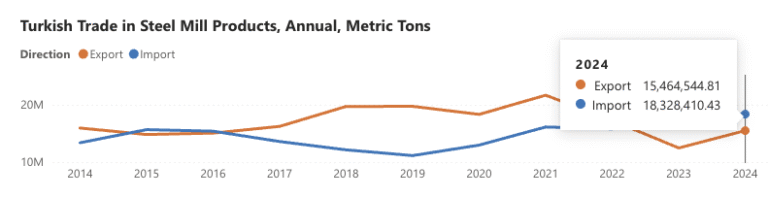
Turkey’s steel mill products trade from 2014 to 2024, showing exports at 15.46 million metric tons and imports at 18.33 million metric tons in 2024
This surge was driven primarily by a significant uptick in demand from the European Union, where Turkish exporters shipped 5.9 million metric tons, representing a remarkable 64.6% year-on-year rise, ISSB reported.
Turkey’s main destinations for steel export in 2024 include Romania, Italy, and Yemen, while the UK and Ukraine also emerged as strong markets.
Still, foreign trade was squeezed by aggressive pricing strategies from China, Indonesia, Vietnam, and Malaysia, countries benefiting from trade pacts and less production overhead. As part of efforts to stabilize the trade balance, Turkish steelmakers began exploring new markets.
In a notable shift, the industry identified Syria as an emerging export destination in light of reconstruction needs. Although only 200,000 tons had been exported as of early 2024, industry leaders projected this could rise to 750,000 tons in the second half, with a potential reaching 2 million tons annually.
Moving forward, Turkey’s steel sector will need to continue navigating volatile global pricing and increased import penetration to preserve competitiveness and capture new regional demand.
While Turkey is active in steel products manufactured with a continuously large production volume, surprisingly, it is not the market dominant for steel export.
Use TradeInt’s Global Trade Search tool to browse billions of transactions, filter instantly for relevance, and connect with the right buyers and suppliers across global markets.

TradeInt is a global trade data platform providing access to over 10 billion verified import and export records. Its coverage spans over 200 countries and more than 80 customs data sources.
This article provides a snapshot of Turkey’s leading export products. Use TradeInt to explore more detailed trade records and continue tracking this market as new data becomes available. Search Turkey export records →
Conclusion
In short, among the Turkey export products list, automobiles and machinery kept the country at the forefront of industrial supply chains, jewelry surged with growing demand in the Middle East, while knitted garments continued to anchor its apparel strength despite mounting competition from Asia.
At the same time, electronics and refined fuels gained traction as rising stars. Together, these trends show that Turkey’s export economu is diversifying, but also remind us that success depends on reading shifting markets quickly and adapting strategies before rivals do.
For exporting business oweners, knowing these insights is only the first step; the real challenge is turning those into decisions: Where is the next growth market for knitted apparel, as Germany and Spain become saturated? Which buyers in Latin America are increasing orders for machinery? How are competitors reshaping supply chains to stay cost-effective? These are not questions as a simple report can answer, but you need live, data-driven visibility.
This is where TradeInt makes the difference.
As an AI-powered global trade data intelligence platform, TradeInt lets exporters dig deeper than headlines. Imagine you are a Turkish garment exporter: by using TradeInt, you can track shipments leaving Bangladesh and Vietnam, compare them against Turkey’s exports, and spot which buyers in Africa or the Gulf shifting suppliers.
Consult with TradeInt’s experts today and see how you can turn data into your competitive edge.