Malaysia Import Duty Exemption List 2025 Explained
Explore Malaysia import duty exemption list, why certain products are prioritized, and how eligible businesses can apply for duty-free imports.

Malaysia is rising as a key import-export hub in 2025, with RM1.23 trillion in trade from Jan–May 2025, up 6.2% YoY. Its strategic location, strong trade sectors, and expanding free trade deals with several key target nations make it the ideal spot to start an import-export business.
A quick summary of the 7 steps to launch an import-export business in Malaysia:
A successful journey of import and export in Malaysia, similar to any other language, begins with thorough market understanding, including demand patterns, year-on-year fluctuations, and popular or potential products.
Companies must establish which products experience strong demand both within Malaysia and in their target export markets. This can be done via analyzing industry reports that entail market trends and consumption data, both nationwide and regionally, given that consumer preferences can vary considerably across different regions. This can help in predicting market shifts and understanding which products will be most needed in the future.
Before starting an import-export business in Malaysia, understanding the country’s market demands is crucial for making informed, low-risk decisions.
👉🏻 Explore Malaysia’s trade profile and statistics to see what products are driving imports and exports, and where the biggest opportunities lie..
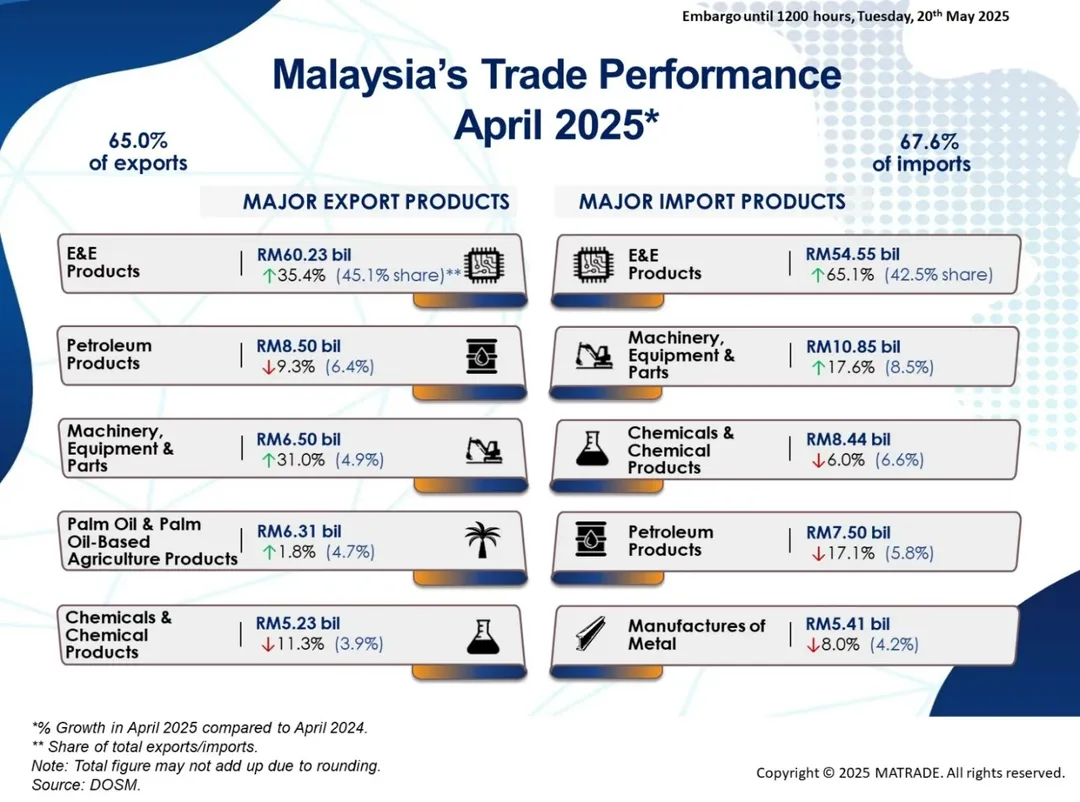
Image Caption: Infographic showing Malaysia’s trade performance for April 2025, highlighting major export and import products by value, growth rate, and share. Top exports include E&E, petroleum, and machinery.
To increase their chances of success, many businesses invest in high-growth sectors in Malaysia, such as electrical and electronics (E&E), machinery & equipment, chemicals, and palm oil-based products (as depicted in the image above). Government support for an industry is also a strong indicator of its potential.
Another important factor is competition. By identifying and studying competitors (including factors such as product, pricing strategies, and market share), businesses can pinpoint potential gaps and opportunities.
🔍 Find out what other businesses are doing in Malaysia’s import-export landscape, and how these insights can shape your next move.
Legal requirements and regulations are another vital consideration for import and export businesses in Malaysia. By understanding these frameworks and following them strictly, they can avoid hefty fines and costly disruptions to their trade activities.
For example, not all goods require licenses, but for regulated products (e.g., agricultural products, foodstuff, iron and steel, vehicles, heavy equipment), companies must apply for an import/export license from the Ministry of International Trade and Industry (MITI). To simplify the process, the country has introduced the Dagang Net online portal, Malaysia’s single digital window for import-export licensing and customs procedures, where businesses can learn what documents they need and apply.
After companies have identified the market space and product segment they want to engage in, the next step is registering with the Companies Commission of Malaysia (SSM) to obtain a legal business entity. This is mandatory before applying for any import or export licenses.
Following customs regulations helps traders streamline customs clearance, which subsequently reduces transit time and ensures timely deliveries.
Businesses should thoroughly research their intended products against the Royal Malaysian Customs Department website, on which there is a comprehensive list of prohibited or restricted products. Afterwards, it is time for the proper preparation of the required documentation, which includes:
For E&E products, businesses must obtain the SIRIM certification to prove that they comply with local technical standards and safety regulations.
Malaysia has established a procedure that ensures smooth trade operations. Importers must declare goods through the Customs Information System (CIS) – Malaysia’s centralized platform for processing trade transactions. On this platform, they will submit the necessary documents for customs clearance.
Meanwhile, exporters face similar procedural requirements but with more focus on customs declarations that demonstrate compliance with export controls and international trade regulations. These declarations verify that exported goods meet all applicable standards and restrictions, ensuring Malaysia maintains its reputation as a reliable trading partner in the international market.
In this step, there are also important financial obligations that businesses must account for, since they may affect operational costs and pricing strategies. Tariffs and duties vary by product category and country of origin, with rates determined by Malaysia’s trade agreements and domestic policies.
Network development forms a solid foundation for successful import-export operations. Therefore, import and export businesses in Malaysia must develop relationships with trusted suppliers, buyers, customs brokers, and logistics partners. These professionals have specialized expertise in dealing with Malaysia’s diverse port systems and customs requirements, as well as providing warehousing, distribution, and transportation services that enable efficient product movement.
One recommended way to find partners in these aspects, along with understanding market demands, is by attending trade fairs and networking events that involve the Malaysian market
💡 Looking for a reliable trade network in Malaysia?
Use TradeInt to connect with verified suppliers and buyers, backed by real trade data. Book a demo to explore your import-export insight
The next step is partnering with experienced freight forwarders and shipping companies who are familiar with Malaysia’s customs regulations, procedures, and local requirements. It helps companies easily navigate regulatory complexities and avoid pitfalls that increase costs and affect their competitiveness.

Image Caption: Illustration of a global supply chain network with icons for raw materials, planning, warehouse, manufacturing, store front, and customers
These partners also contribute to effective logistics management, thus ensuring timely delivery and efficient handling of goods. They have experienced staff and a solid tracking system to provide real-time visibility into shipment status, enabling businesses to monitor progress and identify potential issues before they become costly problems. These systems also facilitate communication with customers and partners, maintaining transparency throughout the shipping process. They also help importers and exporters plan for contingencies in case of unforeseen shipping disruptions, ensuring a backup plan is in place to avoid delays.
The dynamic nature of international trade requires businesses to keep pace with changing regulations, policies, and market conditions that can affect their operations. Therefore, it is essential to monitor changes in trade regulations, tariff rates, and international trade agreements affecting Malaysia. Furthermore, Malaysia’s strategic location and active participation in regional trade agreements create ongoing opportunities for business expansion and market development. Therefore, businesses must closely follow new opportunities for trade expansion, such as those stemming from Malaysia’s strategic location and participation in agreements like RCEP and CPTPP.
TradeInt is a global trade data platform providing access to over 10 billion verified import and export records. Its coverage spans over 200 countries and more than 80 customs data sources.
This article explains starting an import and export business in Malaysia. Use TradeInt to explore more detailed trade records and apply this guidance to your own product and market research. Search Malaysia trade records →
Malaysia’s trade performance in 2024 showed strong momentum, setting a promising tone for 2025. According to the Department of Statistics Malaysia, total trade surged to RM2.879 trillion (~$670 billion), a 9.2% year-on-year increase, and the fourth straight year exceeding the RM2 trillion mark.
The trade surplus reached RM136.88 billion (~$32 billion), extending an impressive 27-year streak since 1998; a sign of Malaysia’s consistent export strength.
Exports climbed 5.7% year-on-year to RM1.508 trillion (~$325 billion) led by:
This sectoral diversity reduces market concentration risk and opens multiple opportunities for businesses exploring trade with or from Malaysia.
On the import side, Malaysia recorded RM1.371 trillion (~$295 billion) in value, a 13.2% YoY increase. Key imports included:
Malaysia’s top trading partners span across Asia, the US, and Europe, reflecting the country’s globally integrated supply chain. Platforms like TradeInt allow businesses and analysts to track these trends in real time, offering a clearer view of who’s trading what, where, and when, across global markets.
Additionally, The Ministry of Investment, Trade and Industry (MITI), together with the Malaysia External Trade Development Corporation (MATRADE) has unveiled that Malaysia is actively pursuing expanded ties with Brazil, Russia, India, China, South Africa (BRICS) nations, and emerging markets with trade expansion efforts focused targeting Africa, the Middle East, and Latin America.
Singapore stands as one of Malaysia’s most significant trading partners, with bilateral trade reaching approximately MYR 23 billion (USD 5.3 billion) in April 2025, representing a substantial 26.1% increase from the previous year.
This robust trade relationship is strengthened by both countries’ ASEAN membership and various free trade agreements. In addition, Singapore’s strategic role as a major re-export hub amplifies the reach of Malaysian goods to the global market. The proximity of the Malaysia-Singapore border facilitates seamless trade flows and investment opportunities, particularly in Malaysia’s manufacturing and services sectors.
As Malaysia’s exports surge to major economies like Singapore, China, and the U.S., understanding where the demand is coming from is important for making trade decisions.
Read Malaysia’s Top 10 Exports by Country to see who’s buying and what’s behind their growing demand.
According to the Malaysia External Trade Development Corporation (Matrade) Trade Performance report for 2024, China has remained Malaysia’s largest trading partner since 2009. Nonetheless, 2024 saw a slight 2.2% decline in export values due to reduced demand for E&E products, metalliferous ores, and metal scrap. This shift urges importers and exporters to prioritize diversifying into other growing markets.

Image Caption: Docked cargo vessel loaded with multicolored shipping containers, representing Malaysia’s seaborne exports and trade links with China.
US-Malaysia bilateral commerce is centered on electronics, machinery, and chemicals. This partnership is institutionally supported through the US-Malaysia Trade and Investment Framework Agreement (TIFA) and various cooperation mechanisms that facilitate smoother trade relations.
American firms have established substantial investments in Malaysia, particularly concentrated in the manufacturing and technology sectors, contributing to the country’s industrial development. Malaysia’s export portfolio to the US features electrical and electronic products, machinery, and palm oil derivatives, while the country imports essential machinery, aircraft, and agricultural products from America. This balanced trade relationship reflects the complementary nature of both economies and their mutual benefit from technological and industrial cooperation.
The EU-Malaysia annual trade volumes exceed $58 billion and, consequently, play a crucial role in the latter’s international commerce.
The EU imports a diverse range of Malaysian products, including palm oil, electronics, machinery, and various manufactured goods, while Malaysia benefits from comprehensive trade agreements that include provisions for tariff reductions, intellectual property protection, environmental safeguards, and labor rights standards.
Beyond trade, the EU represents a significant source of foreign direct investment (FDI) in Malaysia, contributing to the country’s economic development and industrial modernization. This partnership reflects the EU’s importance as both a market destination and an investment source for Malaysia’s continued economic growth.
In the first five months of 2025, bilateral trade surged 36.8% to RM 92.77 billion, with exports from Malaysia to Taiwan reaching RM 32.30 billion and imports from Taiwan hitting RM 60.47 billion, according to Global Taiwan Institute. The trade is anchored by electrical & electronic (E&E) products, optical and scientific equipment, and petroleum-related goods, showcasing a highly complementary industrial link. Malaysia dominates back-end semiconductor processing—packaging and testing—while Taiwan leads in upstream activities like integrated circuits (IC) design and fabrication.
Looking ahead, the entire Southeast Asia, not only Malaysia, will be pivotal to the AI revolution, where focus is shifting from back-end testing toward IC design and potential wafer fabrication, supported by Malaysia’s partnership with Arm Holdings for chip design development.
Global ESG and supply chain resilience drivers—such as geopolitical diversification amid U.S.–China tensions and rising demand for green technology—are accelerating collaborative semiconductor growth between ASEAN and Taiwan.
Malaysia demonstrates strong momentum in achieving its trade growth objectives, with the country well-positioned to meet or exceed the ambitious targets established by the Ministry of Finance and the Ministry of International Trade and Industry (MITI) for 2025. By 2024, Malaysia had already achieved an impressive 87.2% of its 2025 export target, as reported by The Edge Malaysia.
The country’s extensive network of Free Trade Agreements (FTAs) will continue to catalyze growth, providing Malaysian exporters with preferential access to major markets and reducing trade barriers. Looking beyond 2025, Malaysia’s diversified export base and strategic trade partnerships position the nation to capitalize on emerging opportunities in technology, sustainable agriculture, and advanced manufacturing, ensuring continued economic resilience and growth in an increasingly competitive global marketplace.
To succeed in Malaysia’s import-export landscape, it takes more than understanding and complying with local regulations. Companies must also have a profound knowledge of market dynamics, demand fluctuations, and competition analysis.
TradeInt, a leading platform for accurate and in-depth trade intelligence, becomes the go-to solution for businesses to address these gaps. With TradeInt, they can view the latest trade patterns in Malaysia, monitor shifts in demand across different product segments, and identify how to improve business strategies and operations. As a result, TradeInt is a trusted assistant that helps businesses navigate the trade landscape of Malaysia and achieve long-term success.
We are honored to have received prestigious accolades, including the Quality Choice and Happiest Users awards from Crozdesk, as well as recognition as a Top Performer on SourceForge and Slashdot. Explore our reviews on reputable review sites:
– G2: https://www.g2.com/products/tradeint/reviews
– SourceForge: https://sourceforge.net/software/product/TradeInt/
– Slashdot: https://slashdot.org/software/p/TradeInt/
– Crozdesk: https://crozdesk.com/software/tradeint
– Product Hunt: https://www.producthunt.com/products/tradeint
Trade Intelligence Global Pte. Ltd. is a distinguished leader in global trade solutions, delivering exceptional results for businesses worldwide. With a focus on excellence, innovation, and client success, Trade Intelligence Global empowers businesses to thrive in today’s interconnected global economy. To find out more, visit https://tradeint.com.
Explore Malaysia import duty exemption list, why certain products are prioritized, and how eligible businesses can apply for duty-free imports.
How to use customs data to find global buyers: search shipment records by HS code, filter active importers, and verify contacts before outreach. Full guide.
Discover how trade data drives market entry strategies, from research to partner discovery, with TradeInt's AI for global expansion success.
Explore Malaysia top 10 imported product list and see which top 10 categories are the most important. Explore the latest Malaysia trade data with TradeInt.
Learn more about Malaysia top 10 export by country and gain insights into the sector's future growth, key products, opportunities, and projections in 2025.
How to import betta fish from Thailand step by step: find a breeder, arrange a transshipper, handle permits and health certificates, and receive live delivery.